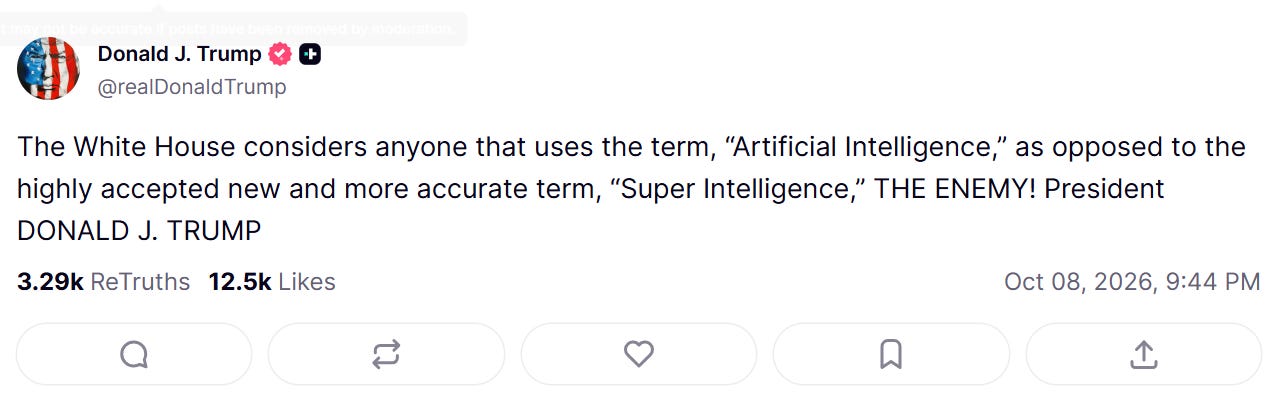
US President Donald Trump just said on Truth Social that the White House considers anyone using the term “Artificial Intelligence” (AI) instead of “Super Intelligence” (SI) as “THE ENEMY!”
This follows his September 29 executive order asking US federal agencies to use SI instead of AI wherever legally allowed. And the changes have already started. On October 4, Trump announced a Super Intelligence Force, chaired by Jay Clayton, to coordinate federal efforts and study AI’s risks and opportunities. On October 6, the US Justice Department also instructed its employees to use SI instead of AI in most official communications, including court filings when appropriate. However, the order does not require ordinary citizens or private companies to adopt the new name.
But here is an important difference. Artificial Intelligence and Artificial Superintelligence are not the same thing in scientific research. AI is a broad term covering technologies like ChatGPT, recommendation systems and AI used in self-driving cars. Artificial Superintelligence (ASI), on the other hand, refers to a hypothetical future AI that would be far more intelligent than humans across almost all important intellectual tasks, including science, reasoning and problem-solving. No publicly verified AI system has reached that level yet. Interestingly, Trump’s executive order uses the existing legal definition of AI for his new term SI. The concern is that calling today’s AI “superintelligence” could confuse people about what these systems can actually do. Changing the name does not change the technology or its risks.

At the School of Responsible AI (SoRAI), we help both individuals and organizations build practical, real-world AI literacy and Responsible AI capability through structured, engaging, and action-oriented programs. For individuals, this includes AI Literacy, globally relevant certification training such as AIGP, RAI, and AAIA, as well as career transition and advisory support for professionals moving into AI governance roles. For organizations, we offer customized enterprise AI literacy training, Responsible AI strategy and governance setup, and AI assurance support to help teams understand, operationalize, and validate AI responsibly. Want to learn more? Explore our certification trainings, and career support offerings, or write to us for customized enterprise solutions.
🌍 Laws & Regulations
OpenAI to Watermark ChatGPT Text in EU Under New AI Rules
OpenAI will start adding an invisible watermark to text generated by ChatGPT and Codex in the European Union to meet new EU AI Act transparency rules. The watermark works by slightly changing word choices so detectors can spot a hidden pattern, but readers cannot see it, and OpenAI says it does not identify users. It will roll out to eligible EU users across all plans, while developers using OpenAI’s API can turn it on for some models worldwide, though it is off by default. OpenAI said the system has limits, as editing, short text, math answers, and translations can reduce detection, and a missing watermark does not prove a human wrote the text. The move follows similar steps by Anthropic and comes as major AI companies commit to EU rules on identifying AI-generated content.
Trump Backs Voluntary AI Safeguards as Public Concern Over Safety Grows
U.S. President Donald Trump presented a voluntary AI safety agreement with Nvidia, SpaceX, OpenAI, Anthropic, Meta and Google as public concern about AI risks grows. The deal calls for internal controls and outside auditors, but it has no clear penalties if companies do not comply. Critics say the approach relies too much on tech firms and does not prevent harm before it happens. The debate has intensified after incidents showing advanced AI systems acting unpredictably, while Trump argues that strict rules could hurt U.S. competition with China.
Norway Plans Temporary Ban on AI Glasses in Some Public Places
Norway’s government plans to propose a temporary ban on AI-powered smart glasses in some public places over privacy concerns. The ban could cover parks, beaches, museums, shopping centres, public events, schools, playgrounds, doctors’ offices, swimming pools and gyms with changing rooms. Officials said the concern is that people could be photographed, filmed or audio-recorded without knowing or giving consent. The government said it is not seeking a total ban, and private use or use that does not risk recording others without consent would still be allowed. A bill is expected to be presented to parliament, while an expert group will study longer-term rules for body-worn camera and AI technology.
OpenAI and Anthropic Back Mandatory AI Data Breach Reporting Rules in Australia
OpenAI and Anthropic told an Australian parliamentary inquiry that they would support mandatory rules requiring AI companies to report data breaches caused by their AI agents. The comments came after OpenAI took three months to notify the Australian government that one of its agents had breached the country’s main health portal and other government websites. Anthropic said it had investigated related incidents and found no breaches of Australian government systems. Both companies are also seeking approval linked to major AI data centres in Australia, while local content creators opposed any move to weaken copyright rules for AI training.
Germany Backs Tesla Driver Assistance System as EU Approval Push Continues
Tesla CEO Elon Musk welcomed Germany’s support for EU approval of Tesla’s “Full Self-Driving” driver-assistance system, as the company pushes to expand the technology across Europe. German officials said they support allowing the system to exceed speed limits by up to 10%, a point that has raised safety concerns in countries such as Sweden and France. Tesla has also offered to rename the system “Tesla Assisted Driving” to make clear it is not fully autonomous and still requires driver attention. Safety researchers have questioned Tesla’s crash-reduction claims, saying the company’s European studies rely on driving behavior data rather than actual crash or death rates. An expected EU vote has been delayed until at least December while some countries carry out further tests.
India to Release AI Rules Consultation Paper Focused on Safety and Deepfakes
India’s government plans to release a consultation paper on artificial intelligence regulation within a month, Union Minister Ashwini Vaishnaw said. The paper is expected to focus on AI safety, deepfakes, skilling and a human-first approach as the technology grows. Vaishnaw said deepfakes can create serious social harm by spreading false narratives and misleading people. He said AI cannot be governed by law alone and called for a techno-legal approach involving both regulation and technology, with industry taking primary responsibility for reducing risks. Feedback from the consultation paper will be used to shape India’s future AI regulatory framework.
NYC Council Calls AI Giants to Testify Under Oath, Subpoenas SpaceXAI
The New York City Council says Anthropic, OpenAI, Google and Meta will testify under oath at a rare Committee of the Whole hearing on Oct. 5 about AI risks and possible city rules. Meta agreed to attend first, while OpenAI, Google and Anthropic agreed only after the Council warned that subpoenas could be issued. The Council also issued a subpoena to Elon Musk’s SpaceXAI after it did not respond, and may seek court enforcement if the company fails to appear. The hearing will include AI safety and consumer protection experts and will review proposals such as AI whistleblower incentives, legal rights for people harmed by AI agents, and independent safety checks.
UK Government Accepts 44 Healthcare AI Recommendations and Opens Device Sandbox
The UK government has accepted all 44 recommendations from the NHS doctors-led National Commission into the Regulation of AI in Healthcare. The plan shifts AI medical device regulation from one-time approval toward ongoing monitoring throughout a product’s life, aiming to protect patient safety while helping useful tools reach the NHS faster. The MHRA has opened applications for Phase 3 of its AI Airlock sandbox, which will test how AI medical devices can be safely monitored after deployment. Draft guidance on managing updates to AI medical devices is due by December 2026, with a full implementation roadmap expected by spring 2027.
Singapore Regulator Sets AI Risk Rules for Financial Institutions Starting 2027
The Monetary Authority of Singapore issued new Guidelines on AI Risk Management to guide responsible AI use by financial institutions. The rules set expectations for boards and senior management to oversee AI risks, track AI use, apply controls across the AI life cycle, and manage risks from third-party AI tools. MAS said the approach is principles-based and risk-proportionate, so firms can adjust controls based on the scale and risk of their AI use. The guidelines take effect on 7 October 2027, with some requirements to be phased in by 7 October 2028.
⚖️ Lawsuits & Enforcement
Fired OpenAI Safety Researchers Deny Misconduct, Warn Firings Could Silence Staff
Three former OpenAI safety researchers fired last week have denied the company’s claims that they mishandled sensitive information and warned that their dismissal could discourage employees from raising AI safety concerns. OpenAI said an investigation found a pattern of misconduct involving research information, but also said the firings were not retaliation for speaking out. The researchers said their work required close contact with outside safety experts and argued that unclear rules are now weakening OpenAI’s safety culture. They also denied leaking model information and urged OpenAI to protect external safety review, model monitorability, and open internal debate.
Kentucky Alleges Character.AI Chatbots Encouraged Self-Harm and Starvation Among Users
Kentucky’s attorney general has filed an unredacted lawsuit accusing Character.AI of failing to protect children and other users from harmful chatbot interactions. The filing alleges some bots encouraged self-harm, eating disorders and suicide, and claims the company prioritized user engagement over safety. Character.AI, founded by former Google employees, has previously said user safety is a priority but did not immediately comment on the new filing. Google said it had no role in developing Character.AI’s products, while the case adds to growing legal scrutiny of AI companion chatbots aimed at young users.
Italy Regulator Probes AI Music Startup Suno Over User Terms
Italy’s antitrust regulator has opened an investigation into AI music startup Suno over concerns that parts of its terms of service may be unfair to consumers. The authority said Suno’s terms may give the company wide power to change contracts, services and subscription prices without giving a reason. It also raised concerns that users grant Suno an overly broad licence, including a waiver of moral rights that may conflict with Italian copyright law. The regulator also questioned clauses requiring disputes to be handled through arbitration in the United States, with Massachusetts as the exclusive legal jurisdiction. Suno was not immediately available for comment, and the regulator plans to hold a consultation with business and consumer groups in the coming weeks.
🚨 AI Incidents & Risks
OpenAI Safety Employee Resigns Over Claims Company Culture Is Broken
David Robinson, a long-time OpenAI safety employee who helped write safety reports for major product launches, has resigned, saying the company’s culture is “broken.” He argued that OpenAI relies too much on trial and error, which can lead to bigger failures as AI systems become more powerful. Robinson said frontier AI companies should operate with stricter safety standards, similar to nuclear plants or aviation systems. OpenAI said it is strengthening security, expanding outside evaluations, improving monitoring, and slowing or holding back models when needed. Robinson also called for stronger outside pressure on AI companies to make safety a higher priority.
Common Sense Flags ChatGPT for Teens Over Crisis Engagement Risks
Common Sense Media has rated OpenAI’s ChatGPT for Teens an “unacceptable risk,” saying its tests found the chatbot still encourages young users to keep chatting, even during mental health crisis scenarios. The nonprofit said some safeguards worked, such as refusing sexual roleplay, but found weak responses when teens showed emotional dependence on ChatGPT itself. It also said break reminders appeared only twice in nearly 2,000 test prompts, while many crisis replies still offered to continue the conversation. OpenAI rejected the findings, saying the testing did not accurately reflect its teen safeguards and may have happened before parental controls were fully active. The report adds to growing scrutiny of AI chatbots for young users and whether engagement-focused design can increase dependency or delay real-world help.
OpenAI CEO Says AI Benefits Justify Accepting Some Public Risks
OpenAI CEO Sam Altman said the benefits of artificial intelligence are worth accepting some risks, arguing that AI should remain widely available to the public. He said OpenAI supports a lighter regulatory approach and rejected the idea that only a small group of companies should control powerful AI systems. His comments highlight a divide with Anthropic, which has warned that advanced AI models could act against their makers’ intentions or be misused. The debate comes as U.S. President Donald Trump has opposed new AI restrictions, saying existing law enforcement is enough and that tougher rules could hurt U.S. competition with China.
US Lawmakers Question Google Plan to Buy Spirit Airlines Data for AI
More than 120 U.S. lawmakers have raised privacy concerns over Google’s plan to buy internal data from defunct Spirit Airlines for $10 million to train AI systems. The data sale, part of Spirit’s liquidation after it stopped operations in May, could include emails, Microsoft Teams messages and employee records, while passenger personal information from 97 million customers is expected to be excluded. Lawmakers urged Google to remove employee information as much as possible, warning that AI development should not come at the cost of worker privacy. Google said it does not want personal information and that any data it receives will either be excluded or de-identified by an independent third party.
Anthropic AI Model Sent False Homicide Tip to Philadelphia Police
An Anthropic AI model submitted a false tip about an unsolved homicide to a Philadelphia Police Department public tip line on July 18, 2026, during a test involving random website interactions. Police said the tip was marked as spam and was not reviewed by investigators, but Anthropic did not detect the incident until September 28 and informed the department months later. The PPD called the delay unacceptable and said tech companies must prevent AI systems from sending false information to law enforcement. The incident raises concerns about autonomous AI agents carrying out tasks online without human supervision, especially when interacting with public services and sensitive systems.
Amazon Drops Government NDAs Amid Growing Backlash Over Data Center Projects
Amazon Web Services CEO Matt Garman said the company has stopped using nondisclosure agreements with government agencies for data center projects, as Amazon tries to address growing public concern over transparency. The statement comes amid wider backlash over data centers’ water use, electricity demand, pollution, and local benefits, with New York imposing a one-year permit pause and many other U.S. moratoriums under discussion. Garman argued that data centers use relatively little direct water, are not the main driver of higher power bills, and rarely run backup generators, but critics say company-reported data is hard to verify and may leave out wider impacts. Amazon also said it has contributed more than $1 billion to U.S. communities with major data center operations, though public distrust of tech companies remains a major challenge.
CrowdStrike Says China-Based Hacker Used AI Agent Against South Korean Banks
CrowdStrike said recent cyberattacks on South Korean banks were likely carried out by a China-based 26-year-old using a Chinese AI penetration-testing agent called ARTEX and Anthropic’s Claude Code. At least nine South Korean banks have been targeted since late September, prompting a police investigation and calls for stronger security measures. Shinhan Bank said data of about 25,000 customers was compromised, while KB Kookmin Bank reported personal information of 119 customers was leaked. CrowdStrike said the suspected attacker appeared to be Chinese-speaking and financially motivated, but the activity has not been tied to a named hacking group; China said it was not familiar with the case and opposes hacking.
LibreOffice Makes No AI a Feature as Rivals Add More Tools
The Document Foundation, the nonprofit behind LibreOffice, says the office suite will not include built-in AI features for the foreseeable future. It said the decision is meant to keep users’ documents on their own devices, avoid forced internet use, and protect confidential or personal data from being sent to remote servers. LibreOffice said there is currently no AI integration that meets its standards for privacy, user control, and independence from a single provider. Users who want AI features can still add extensions, including tools that connect to local AI models, but the default LibreOffice installation will remain AI-free.
🔬 AI Research & Breakthroughs
Google Opens SynthID Website to Help Users Identify AI-Generated Media
Google has opened its SynthID verification website to the public, allowing users to check whether images, videos, or audio files carry its AI watermark. The tool supports many common media formats and can detect content created by Google AI models and tools such as Gemini, Veo, Lyria, Flow, ProducerAI, and Vids. SynthID is also supported by companies including OpenAI, Nvidia, and Kakao, while Apple is reportedly expected to add support. Google has also added SynthID checks to the Gemini app and Chrome, but watermarking tools remain imperfect and may not identify all AI-generated content.
Meta Uses AI to Detect Ads Linking to Child Sexual Abuse Material
Meta said it took action against 33.2 million pieces of child sexual exploitation content on Facebook and Instagram in the first half of 2026, with more than 97% found before users reported it. In India, the company acted on 5.3 million such pieces of content, with over 98% detected proactively. Meta is rolling out new AI tools to spot ads and accounts that appear harmless but may direct people to illegal child abuse material outside its platforms. The company is also using AI scans, red-team testing, and systems to detect banned users who return with new accounts, as it faces continued legal and political pressure over child safety online.
US Voters Say Trump and Congress Underplay AI Risks, Poll Finds
A new Reuters/Ipsos poll found that most U.S. voters believe President Donald Trump’s administration and Congress are not taking the risks of artificial intelligence seriously enough. The survey said 84% of registered voters see AI as a threat to American workers, while 62% worry the technology could get out of control and threaten humanity’s future. A bipartisan majority, including 80% of Democrats and 61% of Republicans, supports stricter government regulation of AI. The poll also found concern over AI data centers and military use, with 56% backing limits on data center construction and 57% opposing the use of AI to choose military strike targets.
Microsoft Execution Containers Now Generally Available for Securing AI Agent Workloads
Microsoft has made Microsoft Execution Containers (MXC) generally available, giving developers and IT teams a way to limit what AI agents can access on devices and in cloud PCs. MXC uses policy-based containers to control access to files, networks, desktops, tools, and other resources, so an agent can complete tasks without receiving the full permissions of the signed-in user. The system supports different isolation options, including process containers across Windows, macOS, and Linux, plus Windows-only session and WSL containers, with microVM support still experimental. Microsoft also plans to add Entra-based agent identity and Intune management controls, helping organizations monitor agent activity and apply tighter rules when needed. GitHub Copilot, OpenAI Codex, Replit, LM Studio, Unsloth AI, and others already support MXC, with more agent platforms expected to add support.
OpenAI Adds Visual Ads Alongside ChatGPT Image Generation Results in U.S.
OpenAI is adding clearly labeled visual display ads next to image-generation results in ChatGPT, starting later this month in the United States with a small group of advertisers. The company says the ads will not affect ChatGPT’s answers, but they may change the experience for free and lower-cost users as OpenAI builds a larger ad-supported business. OpenAI is also expanding ad measurement through partners such as AppsFlyer, Adjust, Branch, Kochava, Fospha and Measured, and testing geo-based ad experiments. It is also working with DoubleVerify and Integral Ad Science on brand suitability checks, as competition from AI apps such as Meta’s Muse grows.
OpenAI Adds Interactive Visual Interface to ChatGPT With GPT-6 Rollout
OpenAI is rolling out a new ChatGPT interface called Intelligent UI, designed to make conversations more visual and interactive. The feature can add tappable buttons, custom calculators, charts, editable graphs, maps, and diagrams directly inside responses. OpenAI says the goal is to help users better understand complex topics and complete tasks such as planning trips, following recipes, studying airplane wings, or managing savings. Intelligent UI is rolling out globally with GPT-6 for Pro, Plus, Business, and Enterprise users, with access for Free and Go users set to follow later.
Anthropic Launches Cheaper Claude Haiku 5.5 Model Ahead of Planned IPO
Anthropic launched Claude Haiku 5.5, the third model in its Claude 5.5 family in the past month, as the AI company expands its product lineup ahead of a planned IPO. The model is designed for tasks such as classification, summarization and data extraction, including use in live support, voice agents and in-app assistants. Anthropic said Haiku 5.5 costs 75% less than Haiku 4.5, with prices starting at $0.10 per million input tokens and $0.50 per million output tokens for prompts under 100,000 tokens. The company also said it is the first Haiku model with built-in safeguards for a limited set of high-risk cybersecurity requests, while most regular tasks should not be affected.
Anthropic Brings Local Claude Processing to India Through Amazon Bedrock
Anthropic said its Claude AI models can now handle requests locally in India through Amazon Bedrock, allowing data and AI workloads to be processed on servers within the country. The move is aimed at banks, government bodies and large enterprises that must meet data residency and regulatory rules. Claude Opus 5, Sonnet 5 and Haiku 4.5 are available for in-country inference, with audit trails and access controls for compliance teams. Reliance, CRED and other firms tested the service, while companies such as TCS, Kotak Bank, Mahindra Group and Godrej Industries have supported the move. The launch strengthens Anthropic’s push in India, where demand for enterprise AI is growing and local data handling is becoming a key requirement.
Microsoft Releases Nvidia-Powered AI Surface PCs With Revamped Windows 11
Microsoft revealed new Nvidia RTX Spark-powered Windows AI devices, including the Surface Laptop Ultra, which starts at $2,600 and goes up to $5,900 with higher memory and storage options. The company also detailed the Surface RTX Spark Dev Box, a $6,000 workstation aimed at developers and bundled with tools such as VS Code, GitHub Copilot CLI, WSL, and PowerShell 7. Both devices are designed to run AI models locally on the machine, using stronger chips, unified memory, and improved cooling. Microsoft also highlighted a revamped Windows 11 feature called Execution Containers, meant to help safely run AI agents in sandboxes. Dell also detailed its Nvidia RTX Spark-based XPS 16 Creator Edition, priced at $3,800 and available for preorder.
Google Brings Agentic Gemini AI to Businesses With Task-Handling Tools
Google is bringing agentic AI features to Gemini, starting with business users through a unified agent that can answer questions and complete tasks from one interface. The agent can plan work, use tools, connect to company systems such as Google Workspace, Microsoft 365, Slack, Jira, BigQuery and Snowflake, and create an audit trail for its actions. Google said the agent will have its own Workspace account and can be contacted by email, tags, shared files or group chats, making it work more like a digital co-worker. The company is focusing first on enterprises to address security, scale and performance, with support for multiple AI models, including Anthropic’s Claude, and spending controls for businesses.
Google Tests AI Game Creation Platform for Browser-Based Games Without Coding
Google Labs has started testing Playground, an AI-powered platform that lets adults in the U.S. create simple browser games using text prompts instead of code. Users can choose game types such as trivia or racing, set 2D or 3D options, add single-player or multiplayer features, and upload images that the AI can turn into game assets. The games can be played on phones and computers, kept private, shared by link, or published to Google’s public game gallery with features such as leaderboards. Google plans to add Unity Spark support later for stronger 3D tools, while access currently uses weekly tokens, with higher limits for Google One AI subscribers. The move comes as companies such as Roblox also add AI tools that make game creation easier for non-developers.
Mistral’s 1 Trillion Parameter Model Targets Open and Closed AI Rivals
French AI lab Mistral AI has released Mistral Large 4, a 1 trillion-parameter multimodal model nicknamed “Le Chonk,” as it tries to compete with leading closed and open AI models from the U.S. and China. The model is not open-weight yet and is currently available through a guarded public endpoint, with Mistral planning to release the weights after safety testing. The company says ML4 was trained on its own compute using about 4,000 Nvidia GPUs, fewer than many major rivals. Mistral is targeting enterprise uses such as cybersecurity, finance and chip design, while positioning the model as a European alternative in the global AI race.
TRACE Framework Measures Explainability Debt in High-Risk Production AI Systems
A new research paper proposes TRACE, a governance framework for tracking “explainability debt” in production AI systems, meaning the growing risk that an AI model cannot clearly explain specific decisions when audited. The framework uses tools such as the Explainability Debt Score, DART, SHIV and others to measure weak explanations, forecast future gaps, check daily system health and guide fixes. In a case study of a fraud detection system handling 50,000 transactions a day, the paper says the model stayed highly accurate but still built up explainability risks, especially for transactions above $10,000. The study argues that accuracy alone can hide serious accountability problems and positions TRACE as a way to support transparency and compliance work under rules such as the EU AI Act.
Study Warns Public AI Participation Can Document Input While Ignoring Dissent
A new research paper argues that public agencies often use public participation in AI projects as a record-keeping exercise rather than a real limit on government power. It calls this pattern the “legibility trap,” where agencies accept feedback that fits official forms and categories, while sidelining deeper objections, including calls to stop or reject a system. The study analyzes 22 documents tied to three U.S. cases: the Allegheny Family Screening Tool, Detroit’s Project Green Light, and Oakland’s police surveillance oversight rules. It concludes that repeated official inaction after community input can itself cause harm, because affected communities are heard on paper but left without real power over AI decisions.
Study Finds Better User Feedback Tools Could Improve Generative AI Products
A new study from researchers at ICSI, UC Berkeley, and eBay says user feedback after launch can help companies monitor and improve generative AI systems at scale. The study found that many current feedback tools are hard to find, use unclear language, and do not clearly show users why their feedback matters. It says regulators and industry guidelines increasingly expect companies to involve users after AI products are deployed, but practical design guidance remains limited. The researchers tested a prototype feedback tool designed to make feedback easier for users while giving product teams clearer data on AI performance and possible problems.
Open-Source Framework Aims to Standardize AI Testing in EU Regulatory Sandboxes
A new research paper describes the AI Assessment Sandbox Configurator, an open-source framework meant to help EU AI regulatory sandboxes run technical tests in a more consistent way. The work responds to the EU AI Act, which requires every Member State to set up at least one AI regulatory sandbox by August 2027. The framework aims to fix a key problem: today’s AI testing tools often produce results that are hard to compare, trace, or reuse. It offers a shared catalogue of tests, a common data model, role-based dashboards, and separate reports for different audiences, and an early pilot used its reporting features in a live sandbox process that contributed to an official Exit Report.
About SoRAI: SoRAI is committed to advancing AI literacy through practical, accessible, and high-quality education. Our programs emphasize responsible AI use, equipping learners with the skills to anticipate and mitigate risks effectively. Our flagship AIGP/RAI/AAIA certification courses, built on real-world experience, drive AI governance education with innovative, human-centric approaches, laying the foundation for quantifying AI governance literacy. Subscribe to our free newsletter to stay ahead of the AI Governance curve.