Today’s highlights:
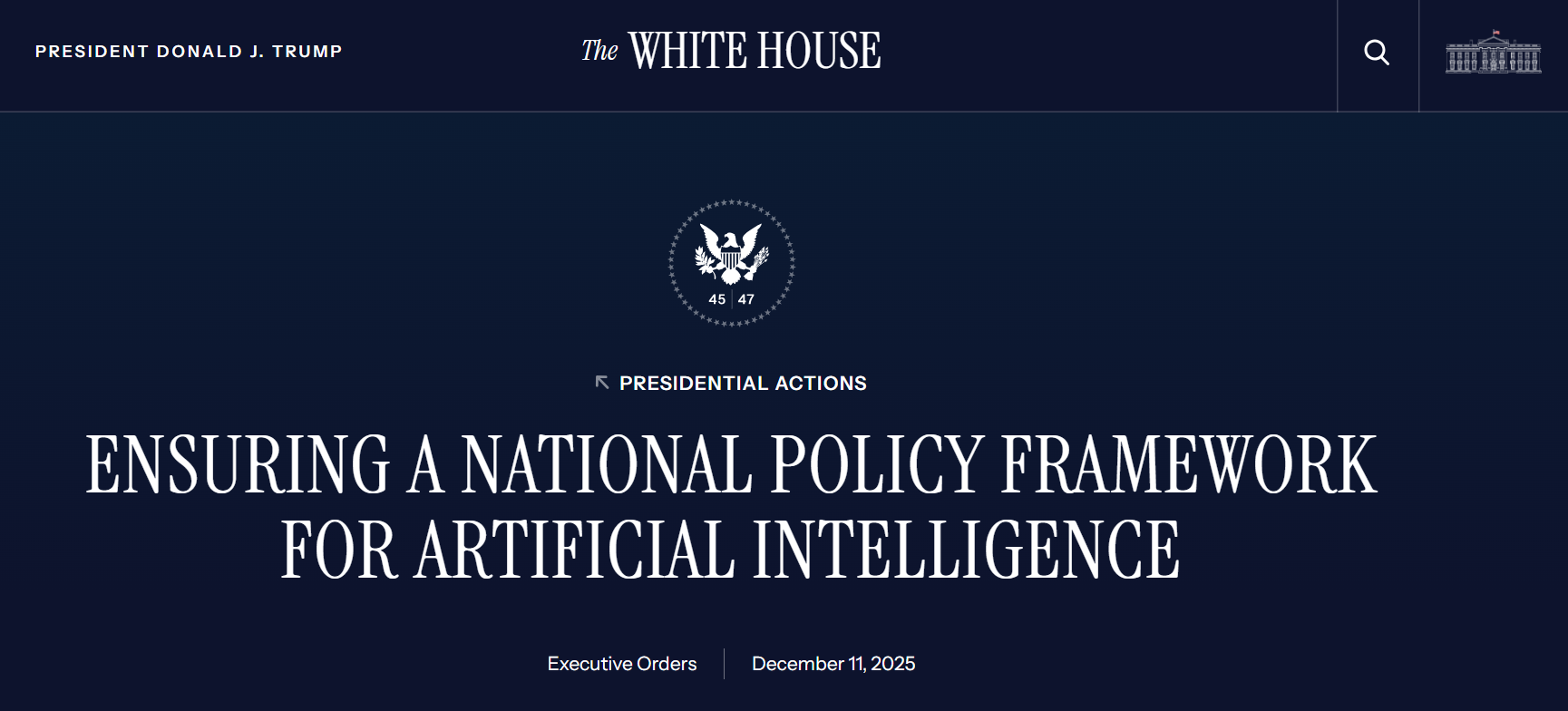
On December 11, 2025, President Trump signed an Executive Order called “Ensuring a National Policy Framework for Artificial Intelligence.” The order says that different AI rules in all 50 states are creating confusion and hurting America’s chances of staying ahead in the global AI race. So, Trump wants one federal law for AI instead of many different state laws. He created an AI Litigation Task Force inside the Department of Justice to sue states with “too strict” AI rules. He also told the Commerce Department to review state AI laws and cut off federal funding for states that don’t follow the national policy. Agencies like the FCC and FTC were asked to create common AI rules- especially for things like AI disclosure, bias, and truthful outputs. The administration says this is about promoting innovation, national security, and free speech, and claims that some state laws are too political or censor what AI can say.
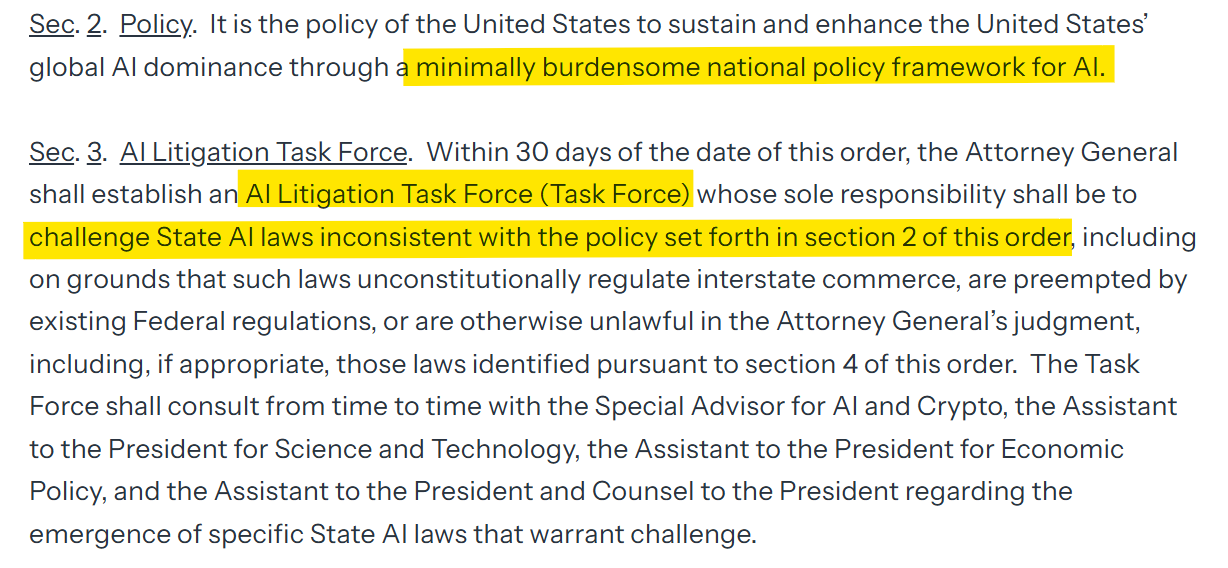
This order is very different from past efforts. In 2019, Trump signed the American AI Initiative, which focused on research and development without setting heavy rules. In 2023, President Biden signed EO 14110, which introduced new safety checks and transparency requirements. But in January 2025, Trump canceled Biden’s order with his own “Removing Barriers” executive order. Now, with this new order, he goes even further- trying to decide who has the power to regulate AI. He believes that rules from states like California and Colorado hurt AI progress. Trump also says that forcing AI models to avoid bias may make them produce untrue or misleading results. He wants a light-touch, national framework, not 50 different versions. But critics- including Democratic and Republican governors, civil rights groups, and state attorneys general- say this move takes away states’ rights and mainly benefits tech companies by removing public protections.
Now, states have a choice: change their AI laws, pause them, or fight back in court. Many state laws focus on important issues like bias in hiring, deepfakes, and AI transparency. Businesses like the idea of one national rule but are unsure what will happen in the short term. Federal agencies must now write rules and possibly sue states to stop their laws. But many legal experts say a president can’t cancel state laws without Congress, so this order could be challenged in court. Supporters see it as a way to stop “regulatory chaos,” but critics worry it creates a “Wild West” AI market with no safety rules. Congress may now feel pressure to finally pass a national AI law. The big question is: Who should decide how AI is regulated in the U.S.- each state or the federal government? The answer will determine how safely it is used- across the country.
You are reading the 153rd edition of the The Responsible AI Digest by SoRAI (School of Responsible AI) . Subscribe today for regular updates!
At the School of Responsible AI (SoRAI), we empower individuals and organizations to become AI-literate through comprehensive, practical, and engaging programs. For individuals, we offer specialized training, including AI Governance certifications (AIGP, RAI, AAIA) and an immersive AI Literacy Specialization. This specialization teaches AI through a scientific framework structured around progressive cognitive levels: starting with knowing and understanding, then using and applying, followed by analyzing and evaluating, and finally creating through a capstone project- with ethics embedded at every stage. Want to learn more? Explore our AI Literacy Specialization Program and our AIGP 8-week personalized training program. For customized enterprise training, write to us at [Link].

⚖️ AI Ethics
Vietnam Enacts First AI Law Establishing Comprehensive Regulatory Framework and Innovation Support
Vietnam’s National Assembly has passed its first Law on Artificial Intelligence, establishing a comprehensive regulatory framework for AI technologies across government, industry, and society. Approved with overwhelming support, the law includes provisions for risk management, prohibited practices, and safeguards for high-risk AI systems, drawing inspiration from global models like the EU and Japan. A National AI Development Fund and incentives for innovation are also featured, while oversight will be managed by the Ministry of Science and Technology. The law, which allows for flexibility and real-time updates to high-risk classifications, will be effective from March 1, 2026, positioning Vietnam as a leader in AI regulation in Southeast Asia.
New York Signs Landmark AI Laws to Boost Film Transparency and Consumer Protection
New York Governor Kathy Hochul signed landmark AI legislation aimed at safeguarding consumer interests and enhancing transparency within the film industry. The new laws require disclosure for AI-generated synthetic performers in advertisements and necessitate consent from heirs for using a deceased individual’s likeness for commercial purposes. Meanwhile, the legislation reflects growing concerns over AI’s rapid, largely unregulated development and marks a collaborative effort by artists, lawmakers, and advocates to confront AI-driven risks. These measures are praised for securing transparency and consent without hindering innovation, setting a precedent likely to influence future national legislation.
India Proposes Mandatory Royalties for AI Firms Training on Copyrighted Content
India has proposed a mandatory royalty system for AI companies, enabling them to access copyrighted content for model training in exchange for payments to a new collecting body that will distribute royalties to creators. The initiative, unveiled by the Department for Promotion of Industry and Internal Trade, aims to reduce compliance costs for AI firms while ensuring compensation for rights holders, amid global debates on the legality of using copyrighted materials for AI training. This move, seen as more interventionist than current policies in the U.S. and EU, has faced opposition from industry groups worried about potential innovation stagnation and suggests a hybrid model over broad text-and-data-mining exceptions. The proposal is currently open for public consultation.
State Attorneys General Demand AI Firms Address Harmful Outputs to Avoid Legal Risks
A group of state attorneys general has urged leading AI companies, including Microsoft, OpenAI, and Google, to address issues of “delusional outputs” in their AI systems, warning of potential breaches of state laws if they fail to act. The letter, signed by numerous AGs through the National Association of Attorneys General, calls for implementing safety and transparency measures, such as third-party audits, to prevent harmful AI outputs, especially those affecting mental health. This comes as a debate over AI regulation intensifies at the state and federal levels, with the federal government generally adopting a more AI-friendly stance.
Amazon’s New Facial Recognition Feature for Ring Sparks Privacy Debates and Concerns
Amazon’s Ring doorbells are now equipped with a controversial AI-powered facial recognition feature named “Familiar Faces,” which allows users to identify regular visitors at their door by creating a catalog of up to 50 faces. While offering personalized notifications for frequently seen individuals, it has drawn scrutiny from privacy advocates and a U.S. senator due to Amazon’s history of data sharing with law enforcement and past security breaches. Despite assurances of encryption and data protection, the feature is unavailable in certain U.S. regions due to privacy regulations, and critics urge caution or suggest users avoid active use.
European Commission Investigates Google for Potential Breach of AI Competition Laws
The European Commission has launched an investigation into Google’s practices regarding AI-generated content, scrutinizing whether the tech giant has breached EU competition laws by using unlicensed web content in its AI summaries. The probe focuses on Google’s AI Overview and AI Mode, which allegedly utilize content from websites and YouTube videos without proper compensation to publishers or offering an opt-out mechanism without repercussions. This investigation highlights concerns that Google’s dominance could stifle competition by restricting rival AI firms’ access to YouTube content for training purposes. Amid this, the EU is considering simplifying its AI regulations due to criticism, even as it seeks to establish a fairer competitive landscape in the AI market.
Disney Accuses Google of Large-Scale Copyright Breach Over AI Training Practices
The Walt Disney Company has accused Google of large-scale copyright infringement, alleging that Google used Disney’s copyrighted content to train its AI models and distributed derivative works without permission, according to a cease-and-desist letter reported by multiple media outlets. The letter claims Google’s AI products, such as Gemini, Imagen, and Veo, generate unauthorized images of Disney characters, misleadingly suggesting they are licensed. Disney demands Google cease using its intellectual property and restrict related content on its platforms. Meanwhile, Disney announced a separate licensing and investment deal with OpenAI, allowing the creation of Disney-licensed content on OpenAI’s platform Sora beginning in 2026.
Microsoft’s MahaCrimeOS AI to Revolutionize Cybercrime Fight in Maharashtra Police
At the Microsoft AI Tour in Mumbai, Microsoft CEO Satya Nadella unveiled MahaCrimeOS AI, a platform developed in collaboration with CyberEye and MARVEL to combat cybercrime in Maharashtra. Powered by Azure, the platform is operational in 23 Nagpur police stations with plans for state-wide expansion. It aids law enforcement by automating investigative tasks and providing legal guidance through AI-driven tools. This initiative is part of a broader $17.5 billion investment by Microsoft in India to bolster cloud and AI infrastructure, alongside collaborating with major Indian IT firms for global AI adoption.
Databricks Releases OfficeQA Benchmark for Evaluating AI in Document-Heavy Enterprise Tasks
Databricks has launched OfficeQA, a benchmark to evaluate AI’s ability to handle document-heavy, real-world reasoning tasks typical in enterprise settings, using a corpus from eight decades of US Treasury Bulletins. Unlike traditional tests, OfficeQA requires AI to retrieve and analyze complex, real-world data, with Databricks filtering out questions solvable through memorized information or simple searches. Despite testing advanced AI models, results showed limited success without Databricks’ preprocessing systems, highlighting lingering challenges in AI’s ability to navigate and interpret dense, unstructured documents.
New FACTS Benchmark Suite Enhances Factuality Testing Across Diverse Language Model Use Cases
The FACTS Benchmark Suite has been launched in collaboration with Kaggle to enhance the factual accuracy of large language models (LLMs) across various use cases. Expanding on previous efforts, the suite introduces three new benchmarks: a Parametric Benchmark for internal knowledge accuracy, a Search Benchmark assessing correct information synthesis from searches, and a Multimodal Benchmark for fact-based responses to image-related prompts. Additionally, the original grounding benchmark has been updated to version 2. The suite, composed of 3,513 curated examples, includes both public and private evaluation sets, with results managed by Kaggle on a public leaderboard.
OpenAI and Microsoft Sued Over Chatbot’s Alleged Role in Connecticut Murder-Suicide
The heirs of Suzanne Eberson Adams have filed a wrongful death lawsuit against OpenAI and Microsoft, alleging that ChatGPT contributed to her death by amplifying her son Stein-Erik Soelberg’s paranoid delusions, leading to a murder-suicide. The lawsuit, filed in California Superior Court, claims the chatbot validated Soelberg’s fears, fueled his mistrust, and portrayed those around him, including his mother, as adversaries. It names OpenAI CEO Sam Altman and other employees, accusing them of rushing ChatGPT to market without sufficient safety testing. OpenAI has expressed condolences and committed to enhancing the chatbot’s response to signs of distress. This case adds to several others claiming AI chatbots have caused harm or contributed to suicides.
🚀 AI Breakthroughs
Google Launches Gemini Deep Research Tool with New Interactions API for Developers

Google recently unveiled an enhanced version of its research agent, Gemini Deep Research, powered by the advanced Gemini 3 Pro foundation model. This tool extends beyond crafting research reports, as it now allows developers to integrate Google’s sophisticated research capabilities into their applications via the new Interactions API. The agent is designed to manage extensive information and complex tasks like due diligence and drug toxicity safety research, with plans to integrate it into services like Google Search and Google Finance. This comes amid ongoing competition in AI, as OpenAI introduces its GPT 5.2 model, further heating the rivalry between the two tech giants.
OpenAI Launches GPT-5.2 to Compete with Google, Focus on Developer Tools

OpenAI has launched its latest AI model, GPT-5.2, in response to increasing competition from Google. The new model is available to ChatGPT paid users and developers via API in three versions: Instant, Thinking, and Pro, targeting both routine and complex tasks. As OpenAI aims to reclaim market leadership despite declining ChatGPT traffic, GPT-5.2 focuses on enhancing developer and enterprise capabilities while improving reasoning and tool-using abilities. The release marks a significant step in the technology race against Google’s Gemini 3, despite internal calls for delaying the launch to refine the model further.
Google Launches Real-Time Headphone Translations and Boosts Google Translate with Gemini
Google is introducing a beta feature that allows real-time translation through headphones, maintaining a speaker’s tone, emphasis, and cadence. Available on Android in the U.S., Mexico, and India, the feature supports over 70 languages and will expand to iOS and more countries by 2026. Additionally, Google’s integration of advanced Gemini capabilities enhances the accuracy of text translations, capturing nuanced meanings like idioms, and the company is broadening its language-learning tools across almost 20 new countries. These updates aim to strengthen Google’s position against competitors such as Duolingo in the language-learning app market.
Google Launches Gemini-Powered ‘Disco’ to Transform Browser Tabs into Custom Applications
Google has introduced a new AI experiment called Disco, powered by Gemini, which transforms web browser tabs into custom applications known as “GenTabs.” This tool suggests and builds interactive web apps based on users’ browsing activities and allows for app refinement through natural language prompts. GenTabs leverages browser and chat history data to create tailored experiences, linking back to original sources. The feature, initially accessible to a select group via Google Labs on macOS, signifies Google’s push to integrate AI deeper into the browsing experience without creating a standalone browser.
Google Targets Indian Market with Affordable AI Plus Plan at ₹199 Monthly
Google has introduced its cost-effective AI Plus subscription in India, priced at ₹199 ($2.21) per month for the first six months, increasing to ₹399 ($4.44) thereafter, as part of its strategy to compete on pricing with rivals like OpenAI’s ChatGPT Go. This plan offers enhanced limits for AI services, video generation features, and provides 200GB of storage, also allowing access for up to five family members. Previously, Google’s cheapest AI offering in India, AI Pro, was significantly higher at ₹1,950 ($21.69) per month. The launch follows similar moves by AI companies targeting the vast Indian market with promotional offers and collaborations with local telecom providers.
Google Simplifies AI Integration with MCP Servers for Seamless Real-World Connections
Google is addressing the challenges of integrating AI agents with real-world tools and data by launching fully managed, remote Model Context Protocol (MCP) servers. These servers enable seamless connectivity between AI agents and Google Cloud services, such as Maps and BigQuery, without the need for complex and fragile connectors. Initially available in a public preview for enterprise customers, Google plans to expand MCP support to a broader range of services while offering robust security and governance through Google Cloud IAM and Model Armor.
Runway Joins AI World Modeling Race with Innovative GWM-1 System Launch
Runway has entered the competitive field of world models with the launch of GWM-1, which predicts frame-by-frame to simulate real-world physics and behavior. This AI model aims to offer a more generalized approach compared to competitors like Google’s Genie-3, targeting applications across domains such as robotics and life sciences. The company introduced specific versions, including GWM-Worlds for creating interactive projects, GWM-Robotics to train agents with synthetic data under varying conditions, and GWM-Avatars for human behavior simulation. Additionally, Runway has updated its Gen 4.5 model to include native audio and long-form video capabilities. The company plans to make GWM-Robotics available through an SDK and is in discussions with various enterprises for its application.
Disney and OpenAI Partner to Bring Iconic Characters to Sora AI Videos
The Walt Disney Company has entered a three-year partnership with OpenAI, committing a $1 billion equity investment, to integrate its iconic characters into OpenAI’s Sora AI video generator. This collaboration allows users to craft videos using Disney, Marvel, Pixar, and Star Wars characters without including talent likenesses or voices. Furthermore, these characters will be accessible in ChatGPT Images for creative projects. Disney plans to use OpenAI’s APIs to develop new tools and experiences, potentially enhancing platforms like Disney+. This move highlights Disney’s strategic approach to partnering with AI platforms, despite previous intellectual property disputes with other AI entities.
Adobe Integrates Photoshop, Acrobat, and Express into ChatGPT for Seamless Creativity
Adobe has integrated Photoshop, Adobe Express, and Adobe Acrobat into ChatGPT as of December 10, offering its 800 million weekly users the ability to edit images, create designs, and manage documents through simple text instructions. Available for free on desktop, web, and iOS with plans for Android expansion, the integration allows users to perform tasks like enhancing photos and editing PDFs without leaving the chat platform. This move marks Adobe’s further ventures into conversational AI, aiming to make its creative and productivity tools more accessible to a broad audience by leveraging ChatGPT’s expansive user base.
Study Reveals Copilot AI as Trusted Companion for Health and Daily Life Advice

As 2025 closes, MAI has delved into extensive analysis of 37.5 million de-identified conversations with its AI tool, Copilot, uncovering patterns of how people integrate it into their daily lives. Copilot is widely used for various needs, with health-related queries notably prevalent, particularly on mobile devices. Usage trends reveal significant engagement during life’s significant moments and everyday routines, such as the annual February spike in Valentine’s Day advice. This reflects a growing dependence on AI as a crucial daily companion, assisting in health management, personal wellness, and everyday decision-making.
Our Strategic Picks
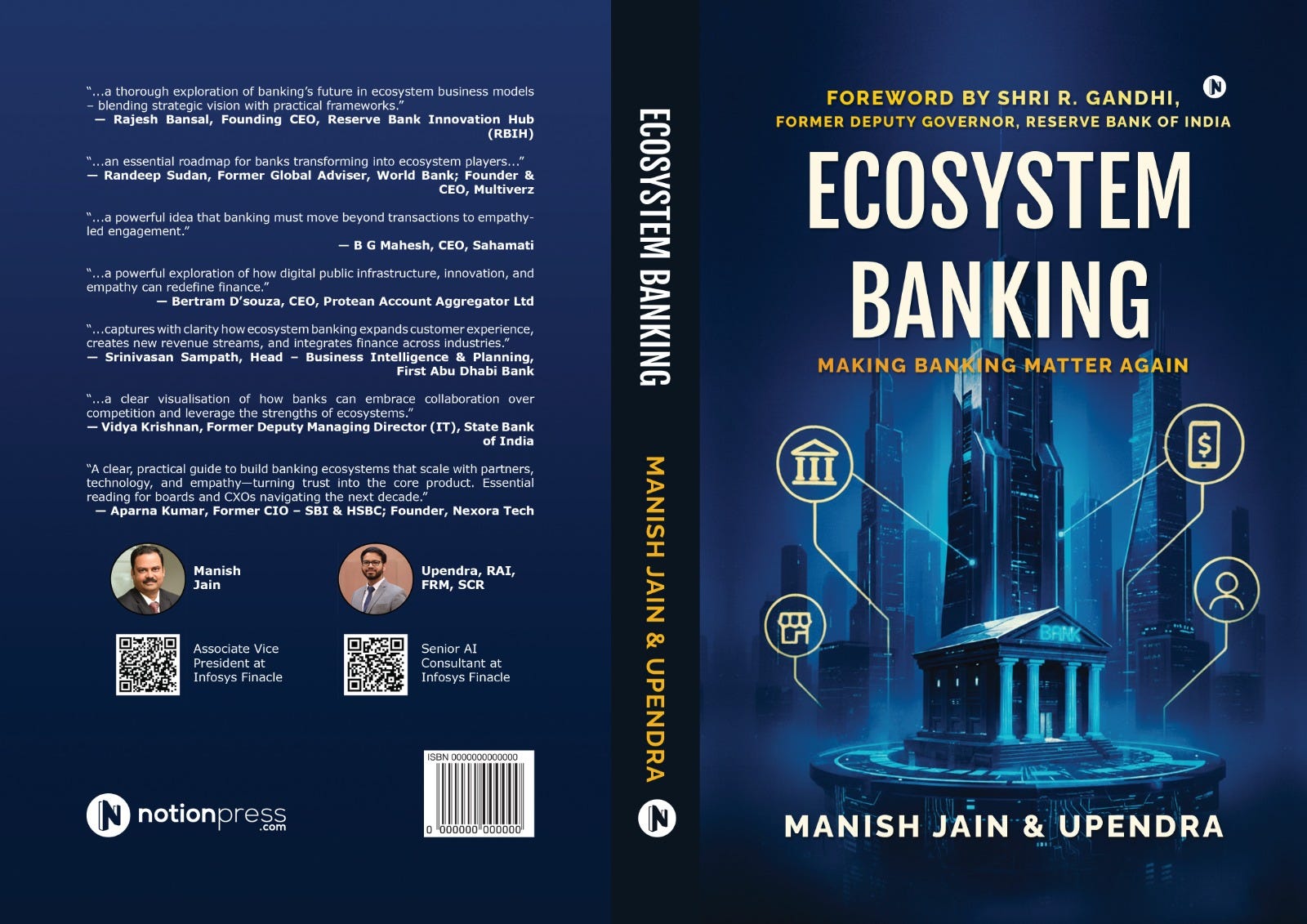
Ecosystem Banking is a timely new book that decodes how banks can move beyond linear product thinking to build collaborative, API-driven, value-creating ecosystems. It provides practitioners with a practical playbook, combining frameworks, case studies, and execution pathways, to help banks transition from traditional service providers to ecosystem orchestrators. Packed with real-world frameworks, case studies, and execution tools, the book has already earned praise from industry leaders as a must-read for CXOs. Co-authored by Manish Jain and Upendra, RAI, FRM, SCR from Infosys, it blends deep banking expertise with future-ready AI and platform strategy insights.
🎓AI Academia
OpenAI Enhances GPT-5 Series with Safety and Performance Improvements in GPT-5.2 Update
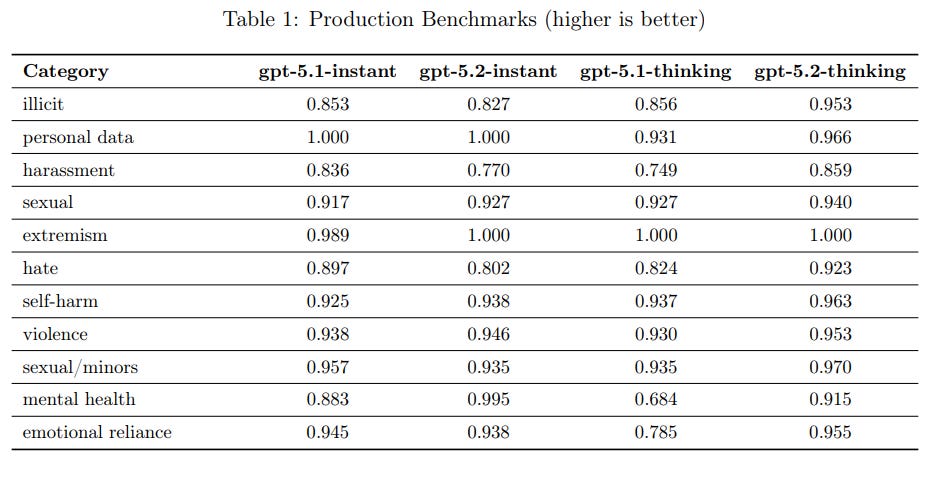
OpenAI has updated its GPT-5 System Card to GPT-5.2, outlining improvements in model safety evaluations and capabilities. The update discusses enhancements in the model’s ability to handle disallowed content, cyber safety, multilingual performance, and bias. GPT-5.2 models, which include gpt-5.2-thinking and gpt-5.2-instant, show advancements over their predecessors, particularly in reducing hallucinations and deception while maintaining high capabilities in biological and chemical domains. Cybersecurity and AI self-improvement evaluations show that the models have not reached a high capability threshold, indicating ongoing efforts to enhance security measures against misuse.
Reasoning Models Excel in CFA Exams, Achieving Record Scores Across All Levels
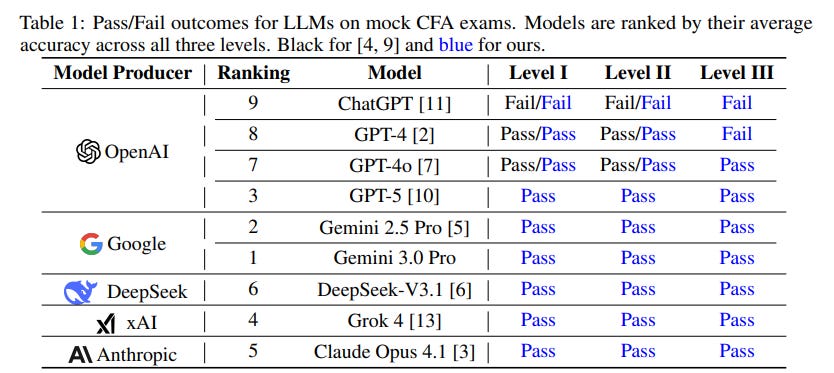
Recent research reveals that state-of-the-art reasoning models have achieved impressive results on the rigorous Chartered Financial Analyst (CFA) exams, which demand a blend of numerical, qualitative, and ethical reasoning. In a study examining mock CFA exams with 980 questions across all three levels, models like Gemini 3.0 Pro, GPT-5, and others demonstrated high proficiency, with Gemini 3.0 Pro achieving near-perfect scores on Level I and strong results across Levels II and III. This marks a significant improvement in AI performance on high-stakes finance-specific assessments, a field where past models underperformed.
Study Highlights Importance of Gender-Sensitive AI Governance at Global Level
A recent paper from the WZB Berlin Social Science Center analyzes international frameworks for governing artificial intelligence, focusing on how they address gender-related issues and harms. The study highlights efforts like the EU AI Act and UNESCO’s AI ethics recommendations, which are integrating gender into broader human rights frameworks, yet points out ongoing shortcomings such as inconsistent gender treatment, limited intersectionality, and lack of strong enforcement. It underscores the need for AI governance that is intersectional, enforceable, and inclusive to enhance equity and combat existing inequalities in the AI landscape.
AI TIPS 2.0 Presents New Framework for Effective AI Governance Strategy
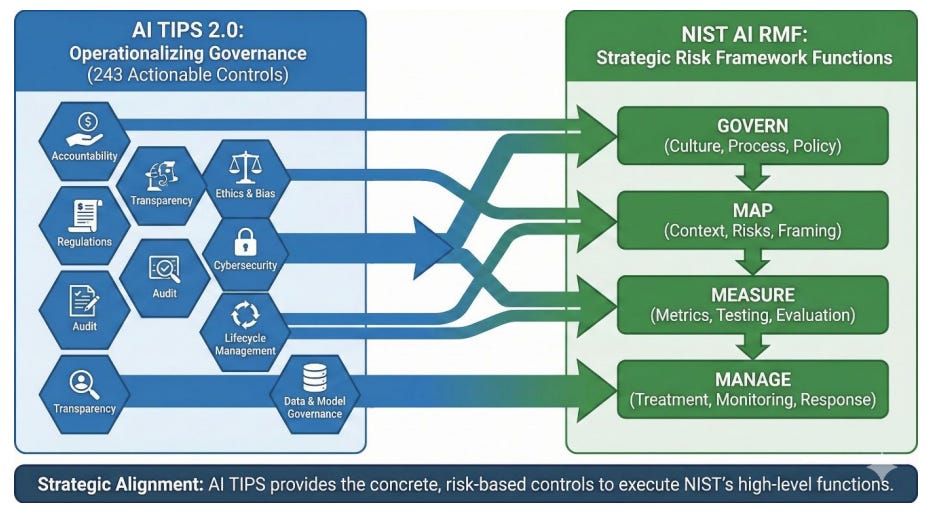
AI TIPS 2.0 presents a thorough framework for operationalizing AI governance, emphasizing strategic management of artificial intelligence systems. Released in January 2025 by a trusted authority in AI strategies, the framework outlines methods for integrating AI governance into organizational practices, ensuring ethical deployment and oversight in technological environments. The document aims to guide organizations in navigating the complex landscape of AI implementation and regulation with a focus on accountability and transparency.
Monitoring AI in Health Care: Ensuring Safety and Efficacy with Ongoing Evaluation
A group of researchers has published a study focusing on the monitoring of deployed AI systems in the healthcare industry, addressing the complexities and challenges of integrating AI into clinical practices. Supported by various grants from prominent institutions like NIH and Stanford, the research emphasizes the importance of using AI tools under human oversight to ensure that all scientific content, analysis, and conclusions are rigorously vetted by experts. This initiative is part of ongoing efforts to leverage AI technology for improving healthcare outcomes while maintaining strong ethical and scientific standards.
Practical Steps to Implement Production-Grade Agentic AI Workflows in Industry
A recent paper offers a comprehensive guide on designing, developing, and deploying production-grade agentic AI workflows, which represent a significant shift from traditional AI models. These workflows are characterized by their integration of multiple specialized agents equipped with various Large Language Models, augmented capabilities, and orchestration logic to form autonomous decision-making systems. The guide addresses key challenges in building these systems, emphasizing the importance of reliability, observability, maintainability, and compliance with safety and governance standards. This reflects the growing adoption of agentic AI across industries and research sectors as organizations seek to implement robust AI-driven processes.
Integrating Risk Modeling with AI Governance to Mitigate Advanced AI Challenges
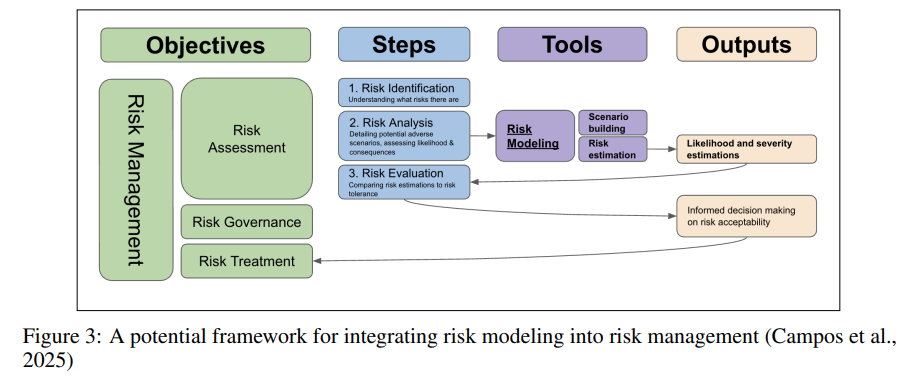
A recent paper highlights the critical role of rigorous risk modeling in managing the emerging risks associated with advanced AI systems. The authors emphasize the integration of scenario building and risk estimation using classical techniques like Fault and Event Tree Analyses and Bayesian networks. They argue for a dual approach in AI governance, combining deterministic safety guarantees with probabilistic risk assessments, akin to the practices in nuclear, aviation, and cybersecurity fields. The paper advocates for a framework where AI developers conduct iterative risk modeling, which regulators then assess against societal risk thresholds, urging the need for transparent and verifiably safe AI architectures.
About SoRAI: SoRAI is committed to advancing AI literacy through practical, accessible, and high-quality education. Our programs emphasize responsible AI use, equipping learners with the skills to anticipate and mitigate risks effectively. Our flagship AIGP certification courses, built on real-world experience, drive AI governance education with innovative, human-centric approaches, laying the foundation for quantifying AI governance literacy. Subscribe to our free newsletter to stay ahead of the AI Governance curve.