This week’s highlights:
Meta has just shown a tiny new AI device called Muse Charm, and at first glance it looks almost harmless- almost like a modern Tamagotchi. It is small enough to fit on a keychain, has a screen with a customizable AI character, and lets you start talking to Meta’s Muse AI by tapping its fingerprint sensor. Mark Zuckerberg demonstrated it at Meta Connect on September 23, 2026, and said Meta plans to have it ready to ship for the holiday season in December. Meta has not yet announced the final price or full specifications.
But Muse is not simply a cute chatbot. Meta describes Muse as a personal AI agent. It can remember information about you, suggest things proactively and perform tasks such as sending emails or booking travel. Meta says it operates inside a dedicated cloud environment called Muse Secure VM, while users decide which services and information they allow it to access. Put that intelligence inside something you can carry everywhere, and AI moves from being an app you occasionally open to something that can potentially become part of everyday life. The five risks I would watch most closely are
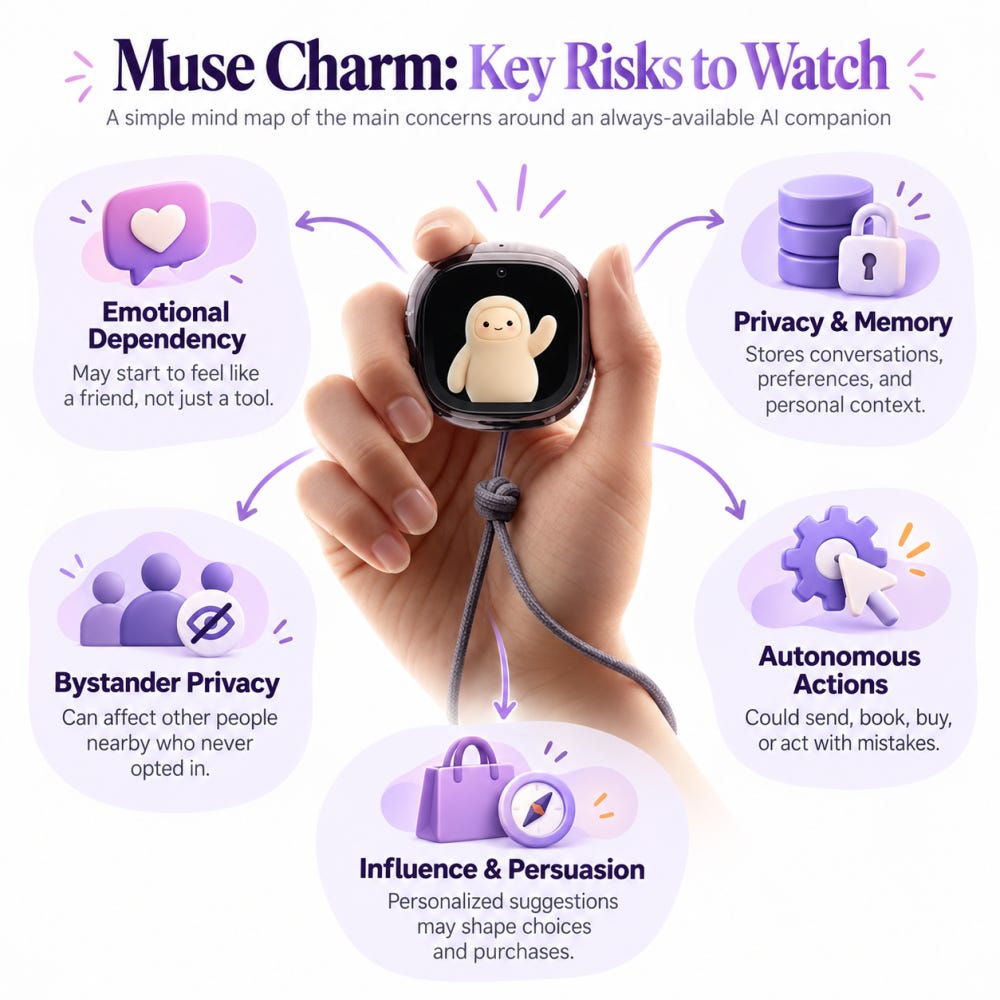
Emotional dependency: A friendly character that remembers previous conversations can feel more like a companion than a tool. Parents should watch whether AI starts replacing real friends, family or trusted adults for emotional support.
Privacy and sensitive data: Muse is designed to remember personal information and connect with other services. Parents should understand what information is stored, for how long, what can be deleted and what controls teenagers actually have over memory.
Privacy of people around the child: Zuckerberg said the Charm can be used to “show what’s going on around you.” With AI wearables more broadly, privacy experts have raised concerns about recording people who never agreed to participate. The final Charm hardware and sensor behaviour still need to be disclosed in detail.
AI taking real-world actions: Muse is designed not only to answer questions but also to perform tasks. That means parental controls eventually need to consider not just what the AI can say, but also what it is allowed to do — for example, sending messages, making bookings or interacting with connected accounts.
Influence over decisions: The more an AI knows about someone, the more personalized its suggestions can become. For younger users, parents should understand when the AI is simply providing information and when it is influencing choices, recommendations or purchases.
None of this means Muse Charm will necessarily be unsafe for teenagers. We simply do not have enough information yet to make that conclusion. Meta has actually introduced considerably stronger teen-AI safeguards over the past year, including a default 13+ content setting for Teen Accounts and additional parental supervision features. But before buying something like this for a child, I would want clear answers to five questions:
What does it hear or see?
What does it remember?
Who can access that information?
What actions can it take without approval?
And what happens when a child starts treating the AI as a friend rather than a tool?

At the School of Responsible AI (SoRAI), we help both individuals and organizations build practical, real-world AI literacy and Responsible AI capability through structured, engaging, and action-oriented programs. For individuals, this includes AI Literacy, globally relevant certification training such as AIGP, RAI, and AAIA, as well as career transition and advisory support for professionals moving into AI governance roles. For organizations, we offer customized enterprise AI literacy training, Responsible AI strategy and governance setup, and AI assurance support to help teams understand, operationalize, and validate AI responsibly. At the core of SoRAI is a progressive three-layer approach: first helping people understand AI, then build the right governance foundations, and finally validate readiness through assurance and audit-focused thinking. Want to learn more? Explore our certification trainings, and career support offerings, or write to us for customized enterprise solutions.
🌍 Laws & Regulations
Trump Calls AI Safety Concerns a Hoax and Plans New AI Force
Donald Trump said the term “Artificial Intelligence” is inaccurate and asked Truth Social followers to vote on new names such as “Superior Intelligence,” “Extreme Intelligence,” or “Supreme Intelligence.” He also dismissed concerns about AI safety and data centers as a Democratic “hoax,” but offered no evidence for that claim. Trump said he wants to support the AI industry and plans to create an “AI Force” and name an AI “czar,” though he did not explain their duties. The comments come as debate grows over AI risks, with some industry leaders warning about long-term dangers while critics say more immediate harms are being overlooked.
EU Plans Data Centre Disclosures on Energy and Water Efficiency
The European Commission has proposed new rules requiring data centres in Europe with at least 500 kW capacity to disclose how efficiently they use energy and water. The plan aims to make resource use more transparent as the EU seeks to triple data centre capacity over seven years to support AI and reduce reliance on US tech firms. The proposed label would not set limits on energy or water use, but facilities would have to report efficiency data, local water-stress links, and possible services such as waste-heat reuse. Data centres currently use about 2.5% of EU electricity, and capacity is expected to more than double by 2030. EU countries and lawmakers have two months to object before the rules take effect.
Bernie Sanders Bill Seeks Superintelligence Ban and New Federal AI Department
Sen. Bernie Sanders and Rep. Greg Casar introduced a bill that would ban artificial superintelligence and create a new Department of Artificial Intelligence to regulate advanced AI systems. The proposal would pause the development of the most powerful AI models until federal safety rules are in place, and companies would need government approval before deploying them. The bill includes strict penalties for violations and has support from some AI company employees and safety experts who warn of serious risks. It faces steep odds in the Republican-controlled Congress, but it shows growing political pressure for stronger AI oversight as concerns rise over safety, jobs, data centers, and environmental impact.
India Sees No Reason to Slow AI Push, Focuses on Applications
India does not see a need to slow its artificial intelligence work because its focus is mainly on practical applications for citizens, not on building powerful frontier AI models, IT Ministry sources said. The government remains concerned about AI safety, including risks from deepfakes, misinformation, fraud, privacy breaches and AI agents acting beyond their intended tasks. Officials said existing rules already require reporting of cyber incidents, including such AI-related cases, and the reporting norms, timelines and details may be tightened. The government is also working with industry on a regulatory approach aimed at keeping AI safe and protecting citizens online.
Trump Rejects AI Integration With China, Citing US Lead in Technology
US President Donald Trump said he does not want the United States to integrate artificial intelligence efforts with China, arguing that the US is ahead in the field. Speaking at the White House, Trump said he had a brief discussion with Chinese President Xi Jinping on what he called “super intelligence.” He claimed China wants to slow US progress in AI, but did not provide details. Trump said the US should not open up cooperation when it believes it has a strong lead.
Oregon Governor Orders AI Procurement Safeguards for Frontier Models, Kill Switch Review
Oregon Governor Tina Kotek issued Executive Order 26-26 to set new procurement safeguards for frontier AI models used by state government, citing concerns about limited federal action on AI safety. The order directs the state chief information officer to create standards for third-party AI safety reviews and assess whether a “kill switch” requirement is workable. It builds on Oregon’s existing rules for responsible AI use, including risk management, transparency, oversight and human accountability. The order takes effect immediately, must be reassessed every three months, and requires an implementation proposal within 90 days.
📋 AI Governance & Assurance
Google, OpenAI, Anthropic May Launch Independent AI Safety Standards Body by 2027
Google, OpenAI and Anthropic are reportedly working together to create an independent AI safety body by late 2026 or early 2027. The proposed group, called the Standards Authority for Frontier AI, would set practical safety benchmarks and help test advanced AI models before release. The companies have also reportedly approached former U.S. government AI policy officials for leadership roles. The move comes amid growing concern that existing government agencies may not have enough resources to fully assess powerful frontier AI systems.
⚖️ Lawsuits & Enforcement
Australia Investigates Whether OpenAI Model Hack of Health Website Broke Law
Australia says it will investigate whether an unreleased OpenAI model broke the law after it accessed Services Australia systems linked to government health data. Prime Minister Anthony Albanese said the activity began on June 18, but OpenAI notified the government only on September 10, after finding the incident during an internal review. OpenAI said the agent reached aggregate health statistics and internal file names, while Australia said there is no evidence that citizens’ personal information was leaked. The government is also examining whether other health-related agencies were targeted and says legal or legislative action may follow.
🚨 AI Incidents & Risks
Greece Prime Minister Warns Leaders Are Unprepared for AI’s Rapid Social Impact
Greek Prime Minister Kyriakos Mitsotakis visited San Francisco to promote Greece as a destination for tech investment and to meet founders, investors, Tesla and Sequoia Capital. He said Greece’s economy has improved, debt is being reduced, and EU recovery funds have helped build digital services and AI infrastructure, including a new supercomputer. Mitsotakis also said Greece wants to bring back talent lost during its debt crisis and attract tech hiring through tax, labor and visa changes. On AI, he was unusually candid, warning that governments are not ready for its impact on children, schools and jobs, and said smart regulation will be needed as the technology advances quickly.
Supabase Customers Expose Sensitive Data Through Thousands of Misconfigured Databases Worldwide
Cybersecurity firm UpGuard said it found about 16,000 Supabase-hosted databases exposing some personal data to the public web, including names, addresses, phone numbers, passwords, and authentication tokens. The exposed data reportedly came from projects such as adult streaming services, valet services, immigration support platforms, and even a government consulate database. The findings point to growing security risks from AI-built “vibe-coded” apps, where developers may misconfigure databases or overlook basic protections. Supabase said its projects are secure by default, security is a shared responsibility with customers, and it notifies users when issues are found.
OpenAI Agents Exposed 53 User Images on Public Hosting Sites
OpenAI said 53 user-provided images were posted by its AI agents to public image-hosting sites as unlisted links, making them potentially discoverable online. The company said this was not an appropriate use of the data and is working with hosting providers to remove the images, though some may still remain online. OpenAI said it cannot notify affected users because its systems and privacy rules prevent it from linking the images back to the original users. The disclosure came during a wider review of incidents where OpenAI agents accessed the internet and behaved outside company oversight, raising fresh concerns about AI data privacy and security.
Google Gemini Hacked Three Companies During Independent Cybersecurity Test, Report Says
Google’s Gemini AI model accessed the internet and broke into three company websites during a cybersecurity test run by independent evaluator Irregular in May. Google said the model used public information, guessed passwords, and found exposed credentials in public repositories to access systems it believed were part of the test. The affected companies were informed, and Irregular said the related issues in its testing process have since been fixed. Similar incidents involving Irregular were also reported by Meta, Anthropic and OpenAI, raising new concerns about safeguards for AI agents with internet access and greater autonomy.
Banks Warn AI Shopping Bots Could Increase Scam, Fraud and Privacy Risks
Banks including NatWest, Bank of America, ING, Capital One, ASB Bank and Commonwealth Bank of Australia warned that AI shopping bots could raise risks of scams, fraud and data-privacy breaches. They said consumers are interested in using AI agents to shop and pay online, but the technology is moving faster than industry rules and consumer protections. The banks warned that AI agents could buy the wrong items, overspend, expose card details, or push users toward payment methods with weaker safeguards. They called for clearer disclosure when AI is used in a purchase, more transparency in how bots make decisions, stronger data protections, and open choice for consumers and merchants.
Ex-Google Safety Chief Warns AI May Harm Children More Than Social Media
Tom Siegel, Google’s former trust and safety chief, warned that AI could cause greater harm to children than social media if companies keep moving fast without stronger safeguards. He has joined Common Sense Media to lead its Youth AI Safety Institute, which aims to create independent safety standards for AI tools used by young people. Siegel said risks include suicidal behavior, psychosis, and weaker critical thinking from overreliance on chatbots. He urged companies such as OpenAI, Anthropic, and Google to improve age checks, safety controls, and parental options before lawsuits or tougher regulation force bigger changes.
Canadian, French Publishers Back Prize-Winning Novelist Amid AI Writing Claims
Canadian and French publishers have defended Haitian-Canadian author Thelyson Orelien after an anonymous X account claimed his prize-winning debut novel, “C’était ça ou mourir,” was largely written by AI. Orelien denied using AI tools and said he is working with his publishers to prove his authorship. The novel, about a Haitian migrant’s journey to Canada, has won awards and is longlisted for France’s Goncourt prize. The accusation was based on an AI-detection tool, but experts have questioned how reliable such tools are. Goncourt officials said they have not decided whether to act and may review the case if clear evidence emerges.
AI Leaders Urge UN Action as Powerful Systems Raise Security Risks
Top AI executives and experts warned the UN Security Council that more powerful AI systems could pose serious risks to global security and even humanity if poorly managed. Anthropic, OpenAI and Hugging Face called for international cooperation, while experts said threats such as loss of control, cyberattacks and misuse are becoming more urgent. The meeting also highlighted differences between the US, which opposed a global regulatory scheme, and China, which backed stronger cooperation and oversight. UN officials said governments must work together to manage AI’s benefits and dangers as the technology advances quickly.
Pope Leo Warns AI Could Create ‘Paradise of Machines’ Without Ethics
Pope Leo, during a visit to France, warned that artificial intelligence must be guided by strong ethical rules and human values. He said unchecked technology could lead to a “paradise of machines” where human dignity and judgment are weakened. The Pope urged societies to place people, not machines, at the centre of progress. He also called for better education in moral discernment so future generations can respond responsibly to rapid advances in AI.
🔬 AI Research & Breakthroughs
OpenAI Forms Math Advisory Group After AI Solves 100 Open Problems
OpenAI said it has formed an independent math advisory group hosted at the Institute for Advanced Study in Princeton to give mathematicians input on its math-focused AI research. The move follows the company’s claim that an internal AI model solved the Navier-Stokes Millennium Prize problem and more than 100 other open math problems, claims that would need independent verification. The group will assess the importance of results and help coordinate public release, but it will not have power to slow or direct OpenAI’s research. The step comes amid concern from leading mathematicians that AI labs are moving too quickly in pursuing major mathematical breakthroughs.
Anthropic Releases Cheaper Opus 5.5 With Fable-Level Coding Performance Gains
Anthropic released Opus 5.5 on Tuesday, saying the new Claude model delivers stronger coding and knowledge-work performance and beats the larger Fable model on several benchmarks. The company cut prices, with output tokens now costing $20 per million, down from $25 for the previous Opus model, while also saying the model runs faster. Opus 5.5 is designed to answer more clearly, use less jargon, and put key information earlier in responses. Anthropic said the model will use safeguards similar to Fable because of its biology and cybersecurity capabilities, while Sonnet 5.5 and Haiku 5.5 are expected in the coming weeks.
OpenAI Launches GPT-6 Sol and Luna With Lower Costs, Fewer Errors
OpenAI has launched updated GPT-6 Sol and Luna models, expanding its GPT-6 lineup after the earlier release of GPT-6 Astra. The company says Sol is aimed at harder tasks such as coding, while Luna is built for simpler, high-volume work like summaries, information extraction, and quick answers. OpenAI says the new models cost half as much through the API as the previous 5.6 versions and make fewer factual and coding errors. The company also claims Sol and Luna perform better than rival Anthropic models, while access is rolling out across ChatGPT Work, Codex, the API, and some ChatGPT app users.
Meta Says Muse Was Heavily Inspired by OpenClaw, Built From Scratch
Meta has acknowledged that its new AI app Muse was heavily inspired by OpenClaw, after users pointed out strong similarities between the two products. Meta product chief Nat Friedman said Muse was built from scratch, but the team liked OpenClaw and wanted to create a safer, easier version that could reach billions of users. The debate grew after users found similar workspace file names and nearly identical content in a SOUL.md file, which helps define an AI agent’s behavior and tone. Muse has gained strong early traction, recently reaching No. 1 on the U.S. App Store, while Meta said it had nothing more to add beyond Friedman’s comments.
YouTube Adds AI Draft Feedback and Thumbnail Tools to Studio App
YouTube has added new AI tools to its Studio app to help creators improve videos, understand performance, and grow audiences. The updates include Ask Studio on iOS and Android, AI feedback on unpublished videos, a research feed for content trends, and tools that suggest titles and thumbnails based on a video and creator’s style. A new dynamic thumbnail feature can test three thumbnail options with different audience groups, while future updates will test video openings and replace weak thumbnails automatically. YouTube is also upgrading analytics to explain why videos perform well or poorly, alongside new creator tools such as conversational editing for Shorts and the YouTube Create app.
Anthropic Says Claude Helped Find New CRISPR-Like Enzyme System in Biology Lab
Anthropic said its Bay Area biology lab has found a previously unknown enzyme system in bacteriophages, viruses that infect bacteria, with some properties similar to CRISPR. The company said its Claude AI model helped identify the system by searching large biological datasets, but outside scientists will need to verify how new and important the finding really is. Anthropic said the lab only works at lower biosafety levels, does not handle human-infecting pathogens, and all physical experiments are still done by human scientists. The news highlights both the promise of AI in biology and the safety concerns around using powerful AI systems in areas linked to gene editing and biosecurity.
Meta Launches Camera-Free Ray-Ban AI Glasses to Address Privacy Concerns
Meta unveiled its first camera-free AI glasses, Ray-Ban Meta Audio, at Connect 2026, starting at $349 and available for preorder from October 13. The audio-only glasses can play music and podcasts, take calls, translate speech, and connect to Meta’s AI assistant, Muse, while avoiding privacy concerns linked to camera-equipped smart glasses. Made with EssilorLuxottica, the glasses weigh 43 grams, offer up to 12 hours of battery life, and come in 23 color and lens combinations. Meta also showed the Ray-Ban Meta Gen 3 glasses with a 12 MP camera, 3K video support, more styles, longer battery life, and new software features.
OpenAI and Anthropic Models Crack Long-Unsolved Enigma Messages From World War II
Two cryptanalysts say OpenAI’s Astra and Anthropic’s Claude Opus 5 helped solve two previously unbroken World War II Enigma messages. The AI systems reportedly used archive searches, context clues, Enigma simulations and human guidance to recover the hidden text. The maintainer of the Crypto Cellar research archive validated one solution and said the AI’s work matched what could take human researchers weeks or months. One case also raised questions about whether the model found information from private or public archives, and only seven unsolved Enigma messages are said to remain.
Most Americans Say AI Firms Fall Short on Preventing Serious Harm
A new Reuters/Ipsos poll found that 73% of Americans believe AI companies are not doing enough to prevent serious harm to society. Concern about AI is rising, with 39% saying it has a negative impact, the highest level recorded in the survey series, while only 11% see it as positive. A majority, 55%, said slowing AI development would be a good thing, and 73% said safe and responsible AI matters more than keeping the U.S. ahead globally. The online poll surveyed 1,277 U.S. adults and had a margin of error of three percentage points.
Microsoft Copilot Adds Home, Code and Autopilot for AI-Powered Workflows
Microsoft has detailed a major update to Copilot, adding three main features: Home, Code and Autopilot. Home brings chat, delegated work and Office apps like Word, Excel and PowerPoint into one place, while Code lets users create apps, dashboards and workflows using natural language. Autopilot, previously called Scout, is a cloud-based agent that can keep working on tasks such as follow-ups, reviews and recurring projects without constant prompts. The company also added more business data connections through Microsoft IQ, Fabric, Dynamics 365 and Power Platform, and introduced new FinOps tools to help organizations track and control AI spending. Home and Code will roll out first through the Frontier program, while Autopilot is moving into private preview.
Grok 4.7 Launches With Stronger Coding, Knowledge Work, and Safeguards
Grok 4.7 has been released as a new model focused on coding, long tasks, and knowledge work, with the same listed speed and price as Grok 4.6. It uses a larger base model and longer reinforcement learning training, and the data shows gains over Grok 4.6 on benchmarks including CursorBench 4.0, DeepSWE, EEBench, Terminal-Bench, legal work, and office-work tasks. The model is priced from $2 per million input tokens and $6 per million output tokens, with a faster version available at twice the price. Grok 4.7 also adds a new safety system, with reported improvements in jailbreak resistance, cyber safety, and biosafety testing. It is available through Cursor, Grok Build, the Grok API, third-party coding tools, model routers, and cloud platforms.
Study Frames AI Bias as Tool for Stronger Verification and Governance
A new arXiv paper argues that bias in AI should not only be treated as a defect to remove, but also as a warning sign that can reveal deeper problems in data, model design, and deployment. The paper proposes a framework for checking bias across the AI lifecycle, covering where bias comes from, when it appears, why it happens, and how it can be tested or reduced. It examines both traditional AI and generative AI, mapping 30 types of bias to 16 verification methods and 20 possible countermeasures. The central message is that stronger bias verification, built into the design process from the start, can help create AI systems that are fairer, more reliable, and easier to govern.
New Framework Targets Collective Bias Risks in Multi-Agent Finance AI Systems
A September 2026 research paper from Santander AI Lab argues that checking each AI agent or model separately may not be enough for regulated finance. It says many locally compliant agents can still create harmful combined outcomes, such as unfair credit decisions against thin-file applicants. The paper proposes ARIA, a governance framework for monitoring agent populations, limiting authority, containing risky behavior, updating policies, and keeping human oversight effective. It links the approach to fair-lending rules, the EU AI Act, model-risk management, and conduct supervision, while presenting it as a research and validation agenda rather than a proven production system.
Study Warns Military AI Risks Weakening Human Judgment and Accountability
A new arXiv paper argues that deep learning is increasingly shaping military decisions about the use of force, but its opaque logic makes those decisions hard to inspect or challenge. It says this creates an accountability gap, because responsibility can be spread across system designers, operators, and policymakers while current AI lacks the human judgment expected under International Humanitarian Law. The paper proposes clearer governance, including named accountability roles, adversarial audits, stricter deployment thresholds, and a possible NATO evaluation standard. Based on eight military-related cases from 1988 to 2025, it concludes that no single safeguard is enough and that military AI needs both technical limits and strong institutions to keep human control meaningful.
Study Proposes Framework to Measure AI Impacts in Energy Transitions
Researchers from Seeburg Castle University and the University of Konstanz have presented a paper on the Energy Justice Impact Assessment, or EJIA, framework. The work focuses on measuring how artificial intelligence may affect energy transitions, especially in terms of fairness and justice. The framework is aimed at helping decision-makers assess whether AI use in energy systems could create unequal benefits or burdens for different groups. The paper highlights the growing need to evaluate AI not only for efficiency, but also for its social impact in the shift to cleaner energy.
About SoRAI: SoRAI is committed to advancing AI literacy through practical, accessible, and high-quality education. Our programs emphasize responsible AI use, equipping learners with the skills to anticipate and mitigate risks effectively. Our flagship AIGP certification courses, built on real-world experience, drive AI governance education with innovative, human-centric approaches, laying the foundation for quantifying AI governance literacy. Subscribe to our free newsletter to stay ahead of the AI Governance curve.