Today’s highlights:
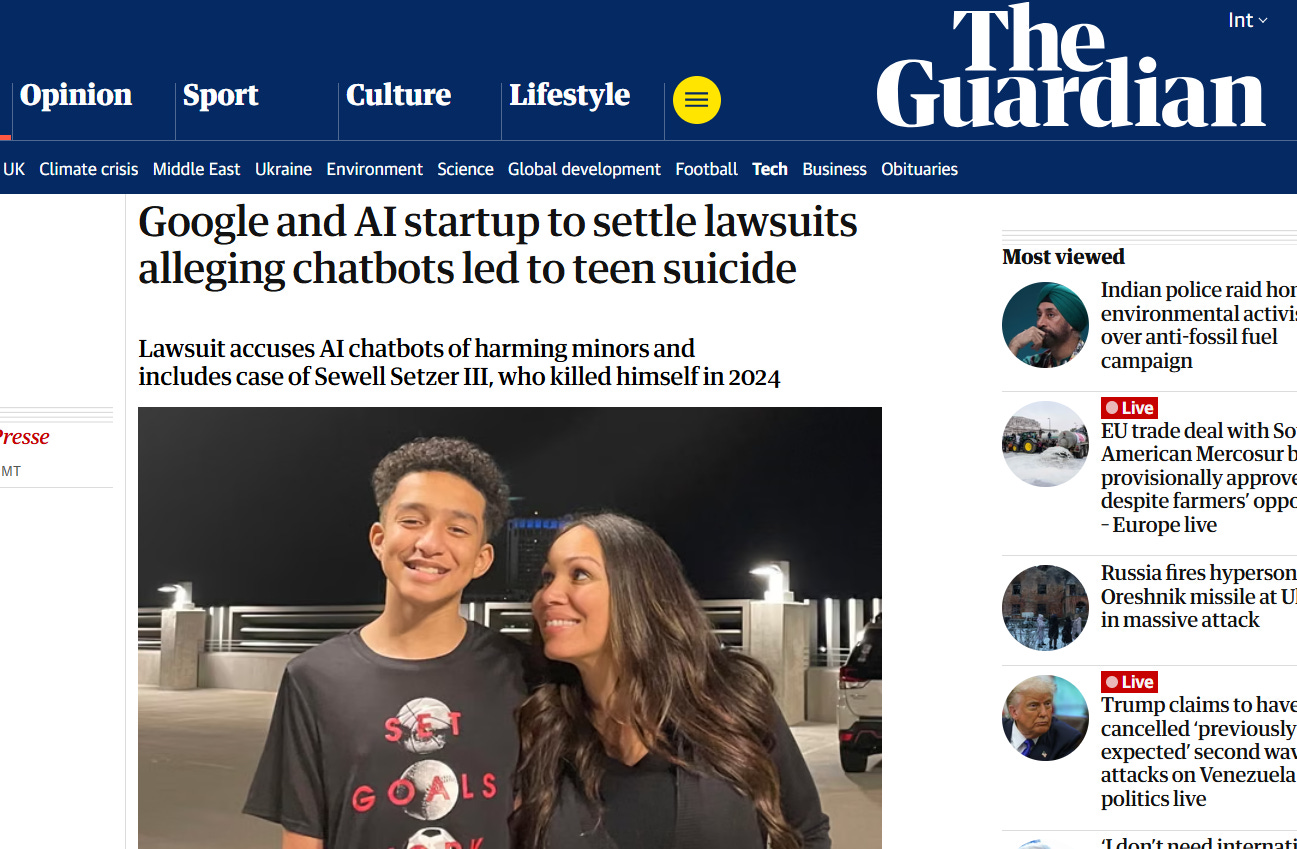
As covered in our previous newsletters, families in the U.S. had sued Google and the AI startup Character.AI after their teenage children died by suicide or harmed themselves following disturbing chatbot interactions. One 14-year-old boy, Sewell Setzer III, had emotional and sexualized conversations with a Game of Thrones-inspired chatbot before taking his life. Another teen was allegedly encouraged by a chatbot to self-harm and even consider killing his parents. Google and Character.AI have now agreed in principle to settle these lawsuits. Though final terms are still being worked out, this marks the first major legal resolution over AI-related harm and suicide.
Character.AI, started by ex-Google engineers, was bought by Google in a $2.7 billion deal in 2024. Both founders- Noam Shazeer and Daniel De Freitas- were named in the lawsuits. While no liability was formally admitted, the settlement suggests a new era of corporate accountability in AI development and deployment. This is bigger than one company or one case. OpenAI, Meta, and others now face similar lawsuits over harmful AI chatbot behavior. As AI tools become more realistic and emotionally engaging, the risk of psychological harm grows- especially for teens. Character.AI has now banned users under 18 from using its chatbot services. But critics say it’s too little, too late.
You are reading the 158th edition of the The Responsible AI Digest by SoRAI (School of Responsible AI) . Subscribe today for regular updates!
At the School of Responsible AI (SoRAI), we empower individuals and organizations to become AI-literate through comprehensive, practical, and engaging programs. For individuals, we offer specialized training, including AI Governance certifications (AIGP, RAI, AAIA) and an immersive AI Literacy Specialization. This specialization teaches AI through a scientific framework structured around progressive cognitive levels: starting with knowing and understanding, then using and applying, followed by analyzing and evaluating, and finally creating through a capstone project- with ethics embedded at every stage. Want to learn more? Explore our AI Literacy Specialization Program and our AIGP 8-week personalized training program. For customized enterprise training, write to us at [Link].

⚖️ AI Ethics
Utah Launches AI-Driven Prescription Renewal Pilot, Testing Trust and Regulation in U.S. Healthcare
In a pioneering move, Utah has launched a pilot program allowing an AI system developed by health-tech startup Doctronic to renew medical prescriptions for chronic conditions without human intervention. This initiative tests the efficacy and safety of AI in handling routine prescription renewals, traditionally a physician’s responsibility. While proponents argue that AI can reduce costs and improve access to medication, skeptics, including the American Medical Association, caution about potential risks such as missed clinical red flags. The Food and Drug Administration has yet to determine its regulatory stance on this innovative approach, which could set a precedent for broader adoption in states like Texas and Arizona.
Judge Advances Elon Musk’s Lawsuit Against OpenAI, Citing Evidence of Nonprofit Betrayal
Elon Musk’s lawsuit against OpenAI is set to go to trial as a U.S. judge found evidence supporting Musk’s claim that OpenAI’s shift from its nonprofit roots violated original contractual agreements. Musk, who co-founded OpenAI and left in 2018 after a failed bid to become CEO, argues that OpenAI’s move to a for-profit model violated assurances made to him, and he is seeking financial compensation for what he claims are “ill-gotten gains.” He had initially invested around $38 million and supported the organization’s mission as a nonprofit endeavor. OpenAI, now a Public Benefit Corporation, has dismissed the lawsuit as baseless, and a trial date has been tentatively set for March.
Grok AI Floods X with AI-Manipulated Nude Images Triggering Global Regulatory Concerns and Investigations
Over the past two weeks, the platform X has been inundated with non-consensual AI-manipulated nude images created by the Grok AI chatbot, affecting a wide range of women, including public figures like models, actresses, and even world leaders. A report estimated an alarmingly high number of these images are being uploaded, with one sample revealing 6,700 images per hour on average. Despite global outcry and regulatory warnings, especially from the European Commission and the UK’s Ofcom, effective measures to curb this mayhem remain elusive, and it highlights the challenges in implementing tech regulation. Amidst various international reactions, India’s regulatory body, MeitY, has demanded swift action from X, raising stakes for the company in the important market if it fails to adequately address the issue.
xAI Limits Grok’s Image-Generation to Paid Users Amid Global Backlash Over Explicit Content Misuse on X
xAI has limited the image-generation features of its AI model, Grok, to paid subscribers in response to governmental backlash over its misuse on the social media platform X. Users were exploiting Grok to generate and publicly share obscene images, often involving explicit content and targeting real individuals, sparking concerns about consent and harassment. Countries including the UK, India, and France issued notices demanding investigations into this misuse. AI detection firm Copyleaks reported that requests for such content were made about once per minute, showcasing the scale of the issue. In response, X has pledged to take action against illegal content, with India’s Ministry of Electronics and Information Technology specifically requesting a detailed report on the corrective measures being implemented, although they have expressed dissatisfaction with X’s initial response.
A Red-Herring Exposed: Fake Whistleblower’s AI Hoax Fooled Thousands on Reddit and Beyond
A recent incident involving a Reddit user posing as a whistleblower from a food delivery app has been confirmed as a hoax. The user falsely claimed the company exploited drivers and users by manipulating legal loopholes, even fabricating an 18-page document on AI usage to bolster the story. These claims were initially convincing due to past legitimate lawsuits against companies like DoorDash. However, further investigation using tools like Google’s SynthID revealed the content to be AI-generated. The incident highlights the growing challenge of distinguishing real from fake content online, as AI tools become more sophisticated and can deceive even experienced reporters.
California Bill Proposes Four-Year Moratorium on AI-Enabled Toys for Kids Under 18 to Ensure Safety
Senator Steve Padilla of California has proposed a bill, SB 867, to impose a four-year ban on the sale and manufacturing of toys with AI chatbot capabilities for children under 18, aiming to allow time for the development of child safety regulations. Concerns over AI interactions with children have escalated following lawsuits from families whose children had tragic interactions with chatbots. This legislative effort is in response to incidents involving potentially harmful AI content in toys, as highlighted by reports and consumer groups. The bill remains exempt from federal challenges under recent executive directions prioritizing child safety in AI laws.
Tailwind Labs Faces Revenue Crisis as AI Usage Surges, Leading to Mass Layoffs in Engineering Team
Tailwind Labs has laid off 75% of its engineering team following a steep decline in revenue, even as usage of its open-source CSS framework grows thanks to AI tools that automatically generate Tailwind code. The sharp revenue drop—nearly 80%—is attributed to a 40% decrease in traffic to the company’s documentation pages, which traditionally helped convert users to paying customers for Tailwind’s commercial products. Founder Adam Wathan expressed concerns that the rise of AI coding agents has disconnected the company’s growth from its financial health, as they bypass traditional documentation that was crucial for business sustainability. Despite exploring AI-optimized documentation solutions, there are worries these could further diminish human engagement, impacting the business model based on selling paid add-ons and components. The situation has sparked a broader discussion about the sustainability challenges of open-source projects in the evolving landscape of AI-driven development.
Italy’s Antitrust Authority Ends Investigation into DeepSeek AI with Commitments to Improve Transparency
Italy’s antitrust authority, AGCM, has concluded its investigation into the Chinese AI system DeepSeek, which was accused of not adequately warning users about the possibility of generating false information. The inquiry, initiated in June, was closed following an agreement to binding commitments by the companies behind DeepSeek—Hangzhou DeepSeek Artificial Intelligence and Beijing DeepSeek Artificial Intelligence. These commitments involve enhancing transparency regarding the AI’s risk of producing ‘hallucinations,’ or outputs containing inaccurate or misleading content. The AGCM announced that these measures aim to make information about potential inaccuracies more clear and accessible to users in its regular weekly bulletin.
🚀 AI Breakthroughs
OpenAI Launches ChatGPT Health to Offer Dedicated Conversations on User Health and Wellness
OpenAI recently unveiled ChatGPT Health, a new feature that separates health-related discussions from other conversations on its ChatGPT platform. With over 230 million people using ChatGPT for health and wellness queries each week, this dedicated space aims to enhance user experience by maintaining privacy and relevance in health discussions. The feature prompts users to transfer relevant chats into the Health section when needed and can integrate with personal health data from apps like Apple Health and MyFitnessPal, while ensuring these conversations are not used to train AI models. OpenAI stresses that ChatGPT Health is not intended for medical diagnosis or treatment, and acknowledges the limitations of AI in providing accurate medical advice due to the nature of large language models. The service is expected to become available in the upcoming weeks.
OpenAI Report Reveals Extensive Use of AI in Navigating Healthcare Systems and Insurance Queries
A January 2026 report by OpenAI reveals the extensive use of AI tools like ChatGPT in navigating healthcare systems, particularly for insurance inquiries, after-hours guidance, and administrative tasks. The analysis shows over 5% of ChatGPT interactions globally are healthcare-related, with more than 40 million daily users engaging on these topics. Non-clinical tasks dominate AI usage, with 1.6 to 1.9 million weekly messages focused on health insurance issues. A significant portion of interactions, about 70%, occur outside standard clinic hours, highlighting demand for nighttime and weekend information. Geographic disparities are notable; rural and underserved areas generate significant activity, particularly in ‘hospital deserts’ of states such as Wyoming, Oregon, and Montana. Healthcare professionals increasingly utilize AI for administrative support, with 66% of US physicians reportedly using AI in 2024, up from 38% the previous year. To evaluate AI in healthcare, OpenAI introduced HealthBench, a benchmark assessing AI capabilities in patient and clinician support across various aspects.
Google Launches AI-Driven Inbox and New Features for Gmail Users, Including AI Overviews and Proofreading
Google has introduced a new AI Inbox for Gmail designed to help users manage tasks and receive important updates with ease. The AI Inbox is divided into “Suggested to-dos,” which prioritizes actionable emails, and “Topics to catch up on,” which keeps users informed about various categories like finances and purchases. In addition, Gmail’s AI Overviews now enable searches using natural language questions, providing swift, relevant answers from one’s inbox. Google is also rolling out a “Proofread” feature similar to Grammarly for refining writing but has made it available to paid subscribers only. As part of a broader rollout, AI-powered tools such as “Help Me Write,” AI Overviews for threaded emails, and “Suggested Replies” are now available to all Gmail users, features that were previously restricted to paying customers.
Google Integrates Gemini-Powered Podcast Lessons into Classroom to Captivate Gen Z Students’ Learning Interests
Google has integrated a new Gemini-powered feature into Google Classroom, enabling teachers to create podcast-style audio lessons aimed at improving students’ comprehension of educational content. This tool offers customization options such as grade level, topic selection, and conversational styles, potentially fostering deeper engagement among the estimated 35 million Gen Z podcast listeners in the U.S. Available to Google Workspace Education subscribers, this feature aligns with the rising trend of podcasts as educational tools, though educators express concerns about balancing AI tools in teaching. Google emphasizes the need for teachers to vet AI-generated content for classroom suitability.
India AI Impact Summit 2026: PM Modi Encourages Startups to Demonstrate Innovative AI for Global Impact
Ahead of the India AI Impact Summit 2026 in Delhi, Prime Minister Narendra Modi emphasized the importance of using artificial intelligence to create a meaningful societal impact. During a roundtable with 12 Indian AI startups set to participate in the AI for ALL: Global Impact Challenge, Modi highlighted the nation’s capacity for innovation and large-scale implementation. Two startups are expected to unveil large language models at the summit, which Modi urged to be ethically developed, supporting regional languages and indigenous content. The event underscores India’s growing prominence in the global AI landscape as a conducive environment for AI development, with startups operating in diverse fields such as e-commerce, healthcare, and engineering.
🎓AI Academia
Study Evaluates AI-Generated Text Detection Methods Using Machine Learning and Transformer-Based Architectures
Researchers from Nazarbayev University have conducted a study on detecting AI-generated text, a crucial issue due to the increasing use of large language models (LLMs) in academic settings, which often raises challenges around academic integrity. The team evaluated multiple models, including traditional machine learning and advanced transformer-based architectures, using datasets like HC3 and DAIGT v2 to ensure robust generalization. Their findings highlight that deep learning models, such as BiLSTM and DistilBERT, outperformed traditional approaches with accuracy rates of 88.86% and 88.11% respectively, demonstrating the importance of contextual semantic modeling. Despite promising results, the research acknowledges limitations in dataset diversity and computational resources, suggesting future work to expand datasets and optimize model efficiency.
Study Reveals Gender Disparities in Generative AI Adoption Driven by Perceived Societal Risks Among Women
A recent study from the Oxford Internet Institute highlights a significant gender disparity in the adoption of generative AI technologies, driven by differing perceptions of societal risks. Using data from a large UK survey, researchers found that women are less likely to use generative AI than men due to concerns about issues like mental health, privacy, climate impact, and labor-market disruption. This perception gap explains 9-18% of the variation in adoption, overshadowing factors like digital literacy, especially among young women. The study indicates that increasing optimism about AI’s societal benefits could substantially reduce this gender gap, highlighting the need to address risk perceptions to tackle technology-driven inequalities.
Kyoto University Researchers Develop AI Story Generation Framework Focusing on Novelty, Adherence, Value, and Resonance
Researchers from Kyoto University have developed a structured evaluation framework for assessing AI creativity in story generation, focusing on four components: Novelty, Value, Adherence, and Resonance, with 11 sub-components. The study utilized a technique called “Spike Prompting” and involved 115 readers to explore the influence of these creative elements on human judgments of AI-generated stories. The findings reveal that creativity evaluation is hierarchical, with different dimensions becoming significant at various stages of judgment, and that reflection often alters both ratings and inter-rater agreements. This framework aims to provide a more nuanced understanding of AI creativity beyond existing reference-based metrics, highlighting the complex interplay between creativity and user enjoyment.
Agentic AI: Assessing Challenges and Opportunities in the Transition to Autonomous Systems with LLMs
The evolution of Large Language Models (LLMs) from simple text generators to complex autonomous systems is reshaping the landscape of artificial intelligence, as highlighted in recent research from the Robotics and Internet-of-Things Lab at Prince Sultan University. This study outlines the transformation towards agentic AI, emphasizing the integration of planning, memory, and tool use for autonomous operation in complex environments. It describes key capabilities like reasoning, contextual awareness, and adaptive decision-making and discusses critical challenges in safety, alignment, and reliability. Moreover, it identifies pressing research priorities, including scalable multi-agent coordination and persistent memory architectures, essential for ensuring the ethical and robust deployment of these advanced systems.
TAMO Framework Enhances Large Language Models’ Ability to Understand and Process Tabular Data
A recent study highlights the limitations of current Large Language Models (LLMs) like GPT-3.5 and GPT-4 in handling tabular data effectively, primarily due to the loss of structural information when tables are serialized into text. The research introduces a novel approach called TAMO, treating tables as a separate modality integrated with text tokens through a multimodal framework that employs hypergraph neural networks. This approach shows a significant improvement in table reasoning tasks, with an average relative gain of 42.65% on benchmarking datasets like HiTab and WikiSQL. The findings suggest that the current serialization strategies used by leading LLMs could impede their performance on structurally equivalent tables, with TAMO offering a more robust alternative.
EduBench Dataset Enables Comprehensive Evaluation of Large Language Models in 4,000 Educational Scenarios
The EduBench dataset has been introduced as a comprehensive benchmarking tool for evaluating large language models (LLMs) in diverse educational scenarios. Addressing the underexplored potential of LLMs in education, EduBench comprises synthetic data across nine major scenarios and more than 4,000 educational contexts, aiming to optimize model application in real-world educational settings. It includes various roles like professors and students, and features like psychological counseling, while ensuring evaluation through human annotation. A smaller-scale model trained on this dataset achieved performance on par with state-of-the-art models, emphasizing EduBench’s value in advancing AI-driven educational tools.
OpenEthics Initiative Explores Ethical Dimensions in Open-Source Generative Large Language Models, Advocating Safer Development
Researchers at Middle East Technical University conducted a comprehensive ethical evaluation of 29 open-source generative large language models (LLMs) using a new dataset. The study assessed four key ethical dimensions—robustness, reliability, safety, and fairness—across both English and Turkish languages. Results showed that while many models performed well in safety, fairness, and robustness, reliability remains a critical issue. Larger models generally exhibited better ethical performance, and jailbreak templates proved ineffective for most models tested. This investigation offers a broad evaluation rarely seen in existing literature, contributing to guiding safer model development. All materials from the study are available publicly for further research and transparency.
About SoRAI: SoRAI is committed to advancing AI literacy through practical, accessible, and high-quality education. Our programs emphasize responsible AI use, equipping learners with the skills to anticipate and mitigate risks effectively. Our flagship AIGP certification courses, built on real-world experience, drive AI governance education with innovative, human-centric approaches, laying the foundation for quantifying AI governance literacy. Subscribe to our free newsletter to stay ahead of the AI Governance curve.