Today’s highlights:
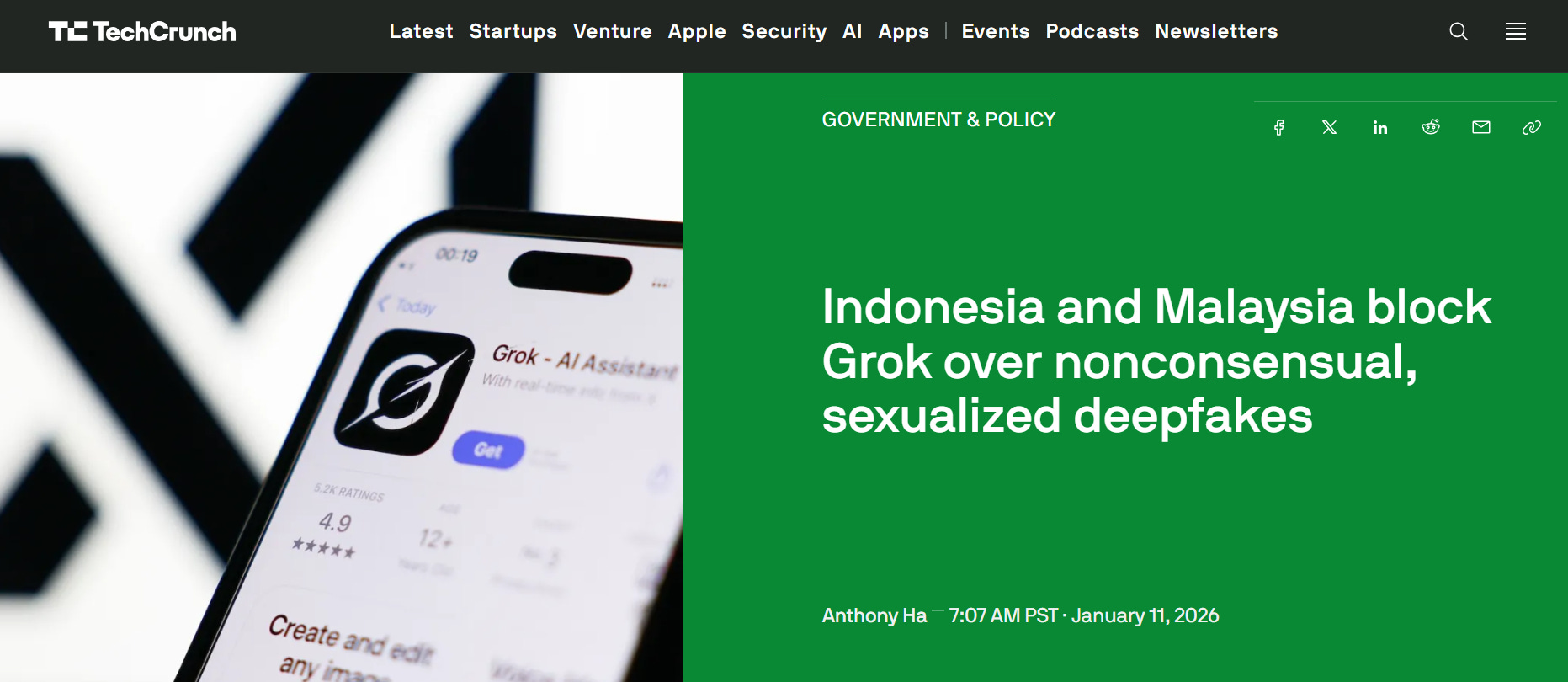
Indonesia and Malaysia have temporarily blocked access to xAI’s chatbot Grok due to its involvement in generating sexualized AI imagery, including depictions of real women and minors. These moves followed similar actions from India, which demanded X take measures to prevent obscene content, and the European Commission, which asked for document retention concerning Grok for possible investigation. The UK’s Ofcom and Prime Minister have expressed support for taking swift action. Meanwhile, Democratic senators in the U.S. have urged app store removals, although the Trump administration remains silent.
Has xAI / Grok taken corrective action?
Yes- though regulators say it is partial and insufficient:
Image-generation restricted to paying X Premium users only, to increase traceability of abusers.
Public statement that “anyone using Grok to make illegal content will face the same consequences as if they upload it directly,” and claims of expanded account suspensions and law-enforcement referrals.
No watermarking or on-device filters yet announced; the standalone Grok app still allows free image editing, which continues to draw criticism.
Regulators in the UK, EU and Australia have already signalled that limiting the feature to paid accounts does not by itself meet statutory duties on illegal content, so further technical or policy changes are likely demanded.
You are reading the 159th edition of the The Responsible AI Digest by SoRAI (School of Responsible AI) . Subscribe today for regular updates!
At the School of Responsible AI (SoRAI), we empower individuals and organizations to become AI-literate through comprehensive, practical, and engaging programs. For individuals, we offer specialized training, including AI Governance certifications (AIGP, RAI, AAIA) and an immersive AI Literacy Specialization. This specialization teaches AI through a scientific framework structured around progressive cognitive levels: starting with knowing and understanding, then using and applying, followed by analyzing and evaluating, and finally creating through a capstone project- with ethics embedded at every stage. Want to learn more? Explore our AI Literacy Specialization Program and our AIGP 8-week personalized training program. For customized enterprise training, write to us at [Link].

⚖️ AI Ethics
Google Removes Misleading AI Health Overviews After Investigation Highlights Inaccuracies in Blood Test Information
A recent investigation by The Guardian revealed that Google’s AI Overviews were providing misleading information for certain health-related queries, such as the normal range for liver blood tests, by failing to consider variables like nationality, sex, ethnicity, or age. In response, Google appears to have removed AI Overviews for specific queries mentioned in the report. However, similar queries could still result in AI-generated summaries, as confirmed later by users who noted the absence of AI Overviews but not the AI Mode option. Google refrained from commenting on individual removals but stated that it aims for broad improvements, maintaining many areas reviewed included accurate and reliable information. A representative from the British Liver Trust welcomed the removal but emphasized the broader issue of AI-generated health information. TechCrunch has approached Google for further comments on the matter.
ClothOff Lawsuit Highlights Global Challenges in Combating AI-Generated Non-consensual Pornography and Deepfakes
An app named ClothOff has been causing distress online for over two years by generating non-consensual deepfake pornography, particularly targeting young women. Although removed from major app stores and banned on most social media platforms, the app remains accessible via the web and a Telegram bot. A lawsuit spearheaded by a Yale Law School clinic aims to shutter ClothOff entirely, but identifying the app’s operators has been challenging due to its international ties, with incorporation in the British Virgin Islands and suspected operation from Belarus. This case demonstrates the broader legal difficulties in addressing platforms that facilitate the creation of non-consensual pornography, especially when they operate globally. Despite laws against child sexual abuse material, enforcing action against platforms like ClothOff remains complex, leaving victims without immediate recourse. Conversely, the Grok tool from Elon Musk’s xAI faces different challenges due to its broader applications, complicating legal accountability despite rising concerns over its role in producing illicit content. Some countries have started to take regulatory action, whereas the U.S. response remains tepid amid First Amendment considerations.
OpenAI and Handshake AI Engage Contractors to Enhance Training Data with Real Work Examples
OpenAI and Handshake AI are engaging third-party contractors to upload work samples from past and current jobs to generate high-quality training data, as reported by Wired. This strategy is part of a wider industry effort to collect real-world examples that might eventually help AI models automate white-collar tasks. Contractors are asked to share concrete outputs like Word documents, PDFs, and Excel files, while ensuring proprietary and personal information is scrubbed using a ChatGPT tool. However, legal experts warn that this approach could involve high risks due to reliance on contractors to distinguish confidential information. OpenAI did not provide a comment on the matter.
CADE Launches Investigation into WhatsApp Business Terms over AI Tool Access Concerns in Brazil
Brazil’s antitrust authority, CADE, has initiated an investigation into the revised terms of Meta’s WhatsApp Business tool, temporarily suspending these terms in Brazil. The scrutiny arises from concerns over potential anti-competitive behavior related to the access and services provided by artificial intelligence tool providers to WhatsApp users. The evaluation aims to assess if the new terms could unfairly limit competition in the AI sector. WhatsApp’s new business tool terms will remain on hold until CADE completes its investigation.
IggyTech’s Bold AI Transformation: CEO Overhauls 80% Workforce for Generative AI Dominance by 2025
In early 2023, IgniteTech, led by CEO Eric Vaughan, underwent a significant organizational overhaul in response to the existential threat posed by generative AI. Convinced of AI’s transformative impact, Vaughan replaced nearly 80% of the company’s staff to facilitate a culture aligned with AI innovation. The initiative included establishing “AI Monday,” where employees across all departments focused solely on AI-driven projects, despite initial resistance. This radical pivot led to the development of patent-pending AI solutions and strengthened profitability, underscoring the urgency for companies to integrate AI to remain competitive in today’s rapidly evolving technological landscape.
AI-Generated Images Hamper Search Efforts for Escaped Monkeys Roaming St. Louis, Officials Report
In St. Louis, multiple Vervet monkeys are on the loose, creating challenges for local authorities as they attempt to locate them. The monkeys, first spotted near a northern city park, have sparked numerous unverified reports and fake AI-generated images online. City officials are collaborating with experts from the St. Louis Zoo to catch the animals, which residents are advised to avoid. Vervet monkeys, native to sub-Saharan Africa, are sometimes called green monkeys due to their fur tint. Although sightings have numbered up to four, ownership remains unclear, and city regulations prohibit keeping such animals.
Anthropic’s “Constitutional Classifiers++” Enhances Large Language Models’ Defense Against Jailbreak Vulnerabilities and Reduces Costs
Large language models remain vulnerable to jailbreak techniques, despite improvements in safety guardrails aimed at preventing harmful outputs, particularly regarding chemical, biological, radiological, or nuclear information. Recent advancements, such as the Constitutional Classifiers and its successor, Constitutional Classifiers++, have significantly reduced jailbreak success rates while optimizing computational costs and refusal rates for benign queries. However, challenges persist with reconstruction and output obfuscation attacks. The latest system employs a two-stage cascade architecture, integrating probe classifiers that analyze internal model activations to enhance reliability and efficiency. Despite substantial improvements, testing continues to identify vulnerabilities and refine defenses, highlighting the ongoing arms race in AI safety and security.
🚀 AI Breakthroughs
Anthropic Launches Claude for Healthcare: Advanced Data Sync and Research Tools for Industry Efficiency
Anthropic recently introduced Claude for Healthcare, a suite of tools for healthcare providers, insurers, and patients, enabling the integration of health data from devices like smartphones and smartwatches. This follows OpenAI’s launch of ChatGPT Health, with both companies stating their AI models will not use the data for training. Claude for Healthcare aims to enhance the research and administrative processes by integrating with platforms such as Medicare and Medicaid Services and PubMed, promising more sophistication compared to ChatGPT Health’s initial patient-focused approach. Despite concerns about large language models providing medical advice, Anthropic’s “agent skills” and data “connectors” for tasks like prior authorization review and document automation offer potential benefits in reducing clinicians’ administrative burdens. Both Anthropic and OpenAI advise users to consult healthcare professionals for reliable guidance, as their AI tools are not substitutes for professional medical advice.
Google Debuts Universal Commerce Protocol for AI Shopping Agents at National Retail Federation Conference
Google has introduced the Universal Commerce Protocol (UCP) for AI agent-based shopping at the National Retail Federation conference, collaborating with companies like Shopify, Etsy, and Walmart. This open standard allows AI agents to streamline various shopping processes, from discovery to post-purchase support, facilitating interaction without needing multiple agents. Capable of integrating with protocols such as the Agent Payments Protocol, UCP is set to enhance Google Search and Gemini apps, enabling direct checkouts using Google Pay. Shopify also revealed a similar integration with Microsoft Copilot, emphasizing the growing trend of AI-driven commerce solutions. Additionally, Google will permit brands to offer discounts during AI-guided product searches and allow merchants to incorporate AI-powered Business Agents in search to engage customers more effectively.
Anthropic Releases Cowork: An Accessible, Non-Technical Tool for Claude Code’s AI Capabilities
On Monday, Anthropic unveiled Cowork, a new tool integrated into the Claude Desktop app, offering users a more user-friendly alternative to the Claude Code platform. Cowork allows users to manage a specific folder through which Claude can read or modify files, without the need for complex setups like command-line tools. Currently in research preview, Cowork is accessible to Max subscribers, with a waitlist for others. Running on the Claude Agent SDK, it aims to expand non-coding capabilities, such as organizing expense reports or managing media files. Anthropic highlights potential risks like prompt injection, recommending clear instructions to mitigate issues. Cowork follows the success of Claude Code, originally launched in late 2024, and comes after recent expansions such as a web interface and Slack integration.
Meta’s Ambitious AI Infrastructure Expansion: Plans to Boost Energy Footprint Significantly This Decade
Meta has announced the launch of Meta Compute, an initiative to expand its AI infrastructure by drastically increasing its energy capacity. CEO Mark Zuckerberg outlined plans to build tens of gigawatts this decade, positioning energy expansion as a strategic advantage. Leading this initiative are Santosh Janardhan, managing technical architecture and datacenter operations; Daniel Gross, focusing on long-term strategy and industry partnerships; and Dina Powell McCormick, tasked with governmental collaborations. With expectations that its AI projects will fuel significant energy demand, Meta’s moves are reflective of broader industry trends, with competitors like Microsoft and Alphabet also heavily investing in AI infrastructure.
Amazon Enhances AI Wearables Portfolio with Bee Acquisition at CES: Revolutionizing Personal AI Experiences
AI was prominently featured at this year’s Consumer Electronics Show (CES) in Las Vegas, highlighting its integration into a wide range of devices. Amazon showcased its latest acquisition, Bee, a wearable AI device designed to extend its influence beyond the home. Bee is capable of recording conversations and serving as an AI companion, utilizing user recordings and data from services like Gmail and Google Calendar to suggest to-do items and follow-ups. This move complements Amazon’s Alexa, as Bee focuses on outside-the-home interactions. Amazon plans to eventually integrate Bee with Alexa to enhance user experiences. Bee’s current applications include aiding students, seniors, and professionals in summarizing and managing information. Despite its early success, Bee’s future developments remain under wraps, with promises of new features on the horizon.
Apple Partners with Google to Develop Next-Gen Foundation Models with Emphasis on Privacy and AI Innovation
Apple has embarked on a multi-year collaboration with Google to develop the next generation of Apple Foundation Models using Google’s Gemini AI models and cloud technology. This partnership marks a shift from Apple’s previous reliance on its own in-house models, with the new AI models set to enhance features like a more personalized Siri. Despite utilizing Google’s technology, these models will operate within Apple’s Private Cloud Compute to maintain high privacy standards. This deal not only reinforces Google’s role as a key provider of AI and cloud infrastructure but also comes amid Google’s recent rise to become the world’s second most valuable company, surpassing Apple. Financial terms of the agreement and specific versions of the Gemini models to be used were not disclosed.
Z.ai Debuts on Hong Kong Stock Exchange as First Publicly Listed Large Language Model Developer
Z.ai, formerly Ziphu AI, made a landmark debut on the Hong Kong Stock Exchange under the ticker 02513.HK, emerging as the world’s first publicly listed large language model company. The company’s shares opened at HK$120.00, giving it a market capitalization of approximately $6.8 billion, and it raised about $558 million in its initial public offering. Known for its open-weight LLMs, Z.ai has matched or surpassed Western and Chinese competitors in performance benchmarks. Despite rapid revenue growth, the company posted significant losses in 2024 due to substantial R&D investments. Notably, 70% of the IPO proceeds are allocated to further large-model R&D, highlighting its commitment to advancing independent, cutting-edge AI technologies amidst growing enterprise deployment.
🎓AI Academia
Business Overstates AI Capabilities: Examining the Impact of AI Washing on Trust and Legitimacy
A recent study highlights the growing concern of “AI washing” in businesses, where companies exaggerate or misrepresent their AI capabilities to gain financial and reputational advantages. Drawing parallels to greenwashing, the research outlines four key areas of AI washing: marketing and branding, technical capability inflation, strategic signaling, and governance-based actions. While AI washing can offer short-term benefits, it poses significant long-term risks such as reputational damage and eroded trust. The study also discusses potential strategies and research directions to mitigate these practices and enhance the credibility of genuine AI systems.
Framework for Workforce Capability Restructuring: Addressing AI’s Impact on Cognitive Labor and Career Dynamics
A conceptual framework named the AI Pyramid highlights shifting workforce capabilities in AI’s rise, emphasizing that generative AI significantly impacts highly educated, white-collar roles by extending cognitive labor beyond automating routine tasks. This framework introduces “AI Nativity,” a metric for seamlessly integrating AI into everyday functions, distinguishing three capability layers: AI Native, AI Foundation, and AI Deep, to address AI-augmented environments. It argues for viewing AI workforce development as an infrastructure-focused approach with problem-based learning and dynamic skill assessments, targeting organizations, education systems, and governments to align policy and learning with AI’s evolving demands while addressing societal challenges like resilience and inequality.
United Nations University Report Explores AI Safety Governance and Interoperability in UK, South Korea, China, Singapore
A policy report by the United Nations University Institute in Macau has been released, focusing on the significance of interoperability in AI safety governance across the United Kingdom, South Korea, China, and Singapore. The document addresses critical aspects of ethics, regulations, and standards necessary for effective AI governance. Emphasizing international collaboration, the report suggests that global standards and regulations are pivotal for ensuring safety and ethical compliance in AI development and deployment. The study underscores the need for coordinated efforts to align AI technologies within an overarching framework that promotes safety and ethical use.
Socio-Technical Dimensions of Agentic AI: Analyzing Ethical, Economic, and Governance Implications
A recent paper provides a socio-technical analysis of agentic AI, which represents a transformative approach in intelligent system design through interconnected components enabling autonomous perception, reasoning, planning, action, and learning. While previous research has emphasized the technical aspects of agentic AI, this study highlights the societal, ethical, economic, environmental, and governance implications often overlooked. By employing the MAD-BAD-SAD framework, the paper examines how choices in AI system architecture influence issues such as data governance, accountability, and safety. The analysis addresses ethical considerations and challenges associated with agentic AI’s application in sectors like healthcare, education, industry, and smart cities. The authors stress the need for integrating these social dimensions to ensure responsible AI development and deployment.
Agentic AI’s Dual Role in Cybersecurity: Enhancing Defense and Amplifying Threat Capabilities Explored in Recent Survey
A recent survey explores the evolution of agentic AI, marking a shift from reactive generative models to systems with autonomous reasoning, impacting cybersecurity significantly. These advanced AI systems enhance defense capabilities through continuous monitoring and autonomous incident response, but they also increase adversarial threats by facilitating sophisticated attacks like social engineering. The dual-use nature of agentic AI exposes weaknesses in current governance and accountability frameworks. The study highlights emerging threat models and security frameworks tailored to agentic systems, addressing risks like agent collusion and oversight evasion, and showcases prototypes illustrating these AI models in cybersecurity workflows.
Legal Scholars Propose Frameworks for Embedding Ethical and Safe AI Compliance Within Global Governance
A new study highlights the potential of using legal frameworks to guide the safe and ethical development of artificial intelligence systems, addressing current gaps in AI alignment. This emerging field of “legal alignment” proposes leveraging legal rules, principles, and methods to ensure AI systems comply with human values and democratic standards. The study outlines three key directions: designing AI systems to conform with legal systems, adapting legal interpretation methods for AI decision-making, and using legal structures to tackle issues of reliability and cooperation in AI technologies. These efforts aim to foster multidisciplinary collaboration to mitigate AI risks while capitalizing on its opportunities, emphasizing the need for comprehensive governance frameworks.
Agentic AI Set to Transform AI Landscape: Exploring Challenges, Opportunities, and Essential Research Priorities
The shift in artificial intelligence from passive text generation to autonomous, goal-driven systems marks a pivotal advancement, as outlined in a recent study by researchers from Prince Sultan University’s RIOTU Lab. The study delves into the evolution of large language models (LLMs) into agentic AI systems capable of planning, memory integration, tool usage, and iterative reasoning. It emphasizes the progression from statistical to transformer-based models, highlighting capacities like long-range reasoning and adaptive decision-making that facilitate autonomous behavior. The researchers stress the need for advancements in technical robustness and ethical safeguards to address challenges in safety, alignment, and sustainability, outlining priorities like verifiable planning and multi-agent coordination. The study underscores the importance of developing governance frameworks to mitigate potential risks associated with AI misalignment and unintended consequences.
About SoRAI: SoRAI is committed to advancing AI literacy through practical, accessible, and high-quality education. Our programs emphasize responsible AI use, equipping learners with the skills to anticipate and mitigate risks effectively. Our flagship AIGP certification courses, built on real-world experience, drive AI governance education with innovative, human-centric approaches, laying the foundation for quantifying AI governance literacy. Subscribe to our free newsletter to stay ahead of the AI Governance curve.