
Who would have thought that AI would influence not just technology, but our dictionaries too Cambridge Dictionary has chosen “Human” as its Word of the Year 2026!
Sounds strange, right? But as AI gets better at writing, creating images, and talking like us, the question of what makes us truly human is becoming more important. Interestingly, three other words caught my attention. Here are their exact dictionary definitions:
1. HUMAN — Cambridge Dictionary (2026 Winner) “having the qualities, faults, and feelings that people have, as opposed to gods, animals, or machines”
2. SLOPAGANDA — Oxford (2026 Shortlist) “Low-quality propaganda produced using generative artificial intelligence and widely distributed online, esp. via social media.”
3. P(doom) — Collins Dictionary (2026 Shortlist) “an estimation of the probability that artificial intelligence will bring about the collapse of human civilization”
4. SLOP — Merriam-Webster (2025 Winner) “digital content of low quality that is produced usually in quantity by means of artificial intelligence.”
Quite an interesting collection of words, isn’t it? Personally, I find the contrast fascinating. In 2025, we were talking about the flood of low-quality AI content. In 2026, we’re talking about AI-generated propaganda, the possibility of AI causing humanity’s collapse, and what it means to be human.
Perhaps the more artificial our world becomes, the more we appreciate what makes us human. And that’s also why I believe Responsible AI matters more than ever.

At the School of Responsible AI (SoRAI), we help both individuals and organizations build practical, real-world AI literacy and Responsible AI capability through structured, engaging, and action-oriented programs. For individuals, this includes AI Literacy, globally relevant certification training such as AIGP, RAI, and AAIA, as well as career transition and advisory support for professionals moving into AI governance roles. For organizations, we offer customized enterprise AI literacy training, Responsible AI strategy and governance setup, and AI assurance support to help teams understand, operationalize, and validate AI responsibly. Want to learn more? Explore our beginner-friendly AI Governance training, certification trainings, and career support offerings, or write to us for customized enterprise solutions.
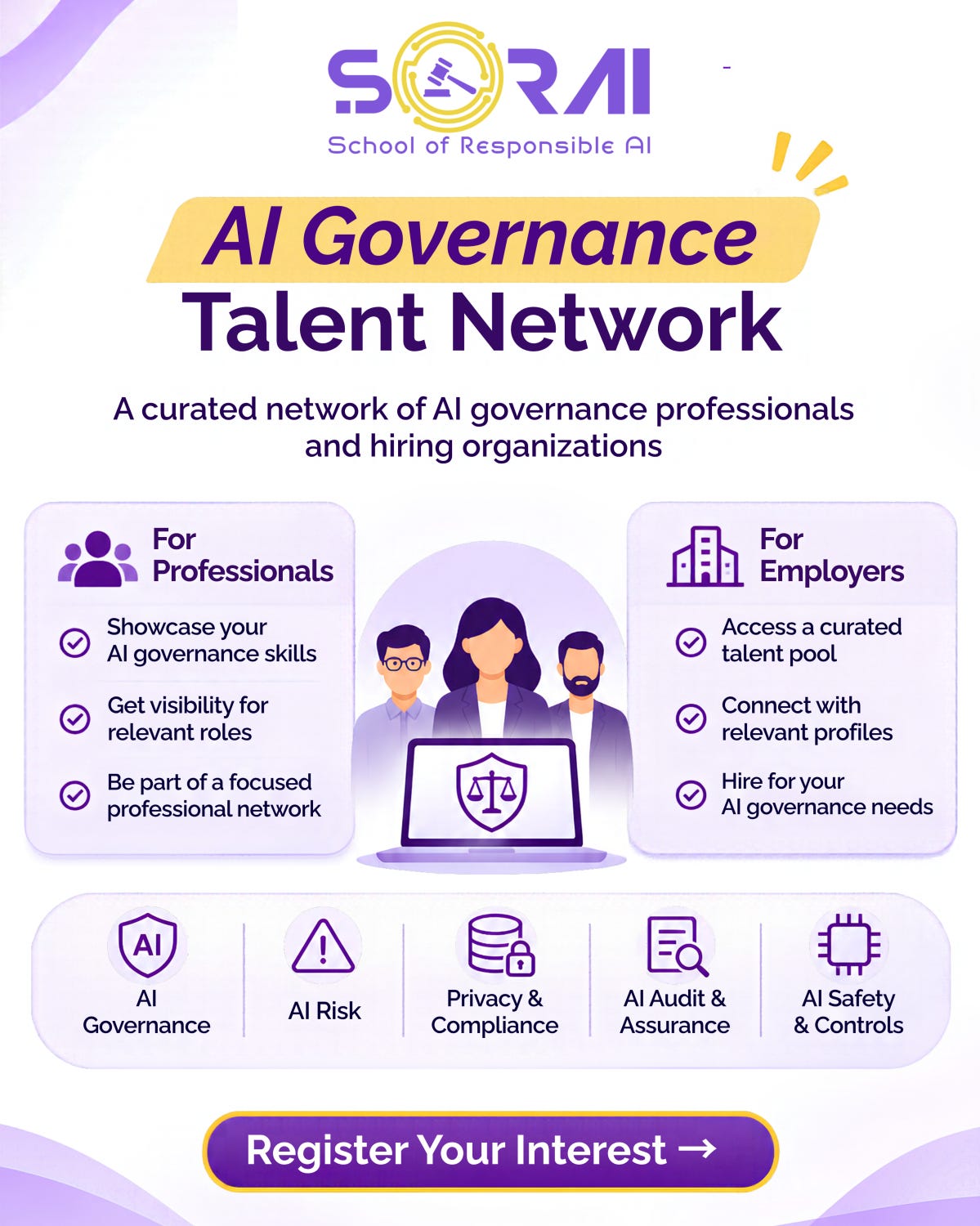
Introducing SoRAI Talent Network, a curated, human-driven initiative connecting AI governance professionals with relevant career opportunities.
Register your interest: Professionals | Hiring Companies
🌍 Laws & Regulations
US, Russia Oppose Binding Global Talks on Autonomous Weapons Limits
The United States and Russia are expected to oppose a push at a UN-hosted meeting in Geneva to start talks on legally binding rules for lethal autonomous weapons. Most countries in the Convention on Certain Conventional Weapons support binding limits, but major military powers including the U.S., Russia and Israel say existing humanitarian law is enough. The debate comes as AI-assisted drones and other weapons are already being used in conflicts such as Ukraine, Sudan and the Middle East. Rights groups and humanitarian officials warn that weapons able to select and attack targets without human control could cause deadly mistakes and serious ethical risks. Negotiators may still seek a compromise, including non-binding guidelines or a mixed agreement, by the end of the week.
UK Finance Sector Cyber Incidents Hit Second-Highest Level in Five Years
Cyber incidents reported to the UK’s Financial Conduct Authority rose sharply in October, reaching 38 cases, the second-highest monthly total in five years. The FCA said the figure was more than 50% above the previous peak, though it remained below the 49 incidents reported during the MOVEit data breach in June 2023. The FCA and Bank of England proposed clearer guidance for banks, insurers and other financial firms on preparing for, detecting and recovering from cyberattacks. The guidance focuses on cyber resilience, governance, incident response, recovery and supply-chain risks, and also covers emerging threats linked to frontier AI and quantum computing.
Nvidia Halts Shipments of US-Approved AI Chips to China Amid Export Uncertainty
Nvidia has stopped shipping its U.S.-approved Hopper-generation AI chips, including the H200, to China, its interim CEO said, after selling $2.4 billion worth of the products there in the latest quarter. The company said its current outlook includes no further licensed Hopper data centre chip shipments to China, but did not explain whether the halt is temporary or permanent. The chips had been allowed for some Chinese buyers under a U.S. licensing deal after earlier export curbs were eased, with approvals reportedly given to companies including Alibaba, Tencent and ByteDance. Beijing has also limited H200 imports as it pushes to reduce reliance on U.S. technology, and about 600,000 chips were previously reported to be stuck in Hong Kong awaiting approval for shipment to mainland China.
OpenAI CEO Acknowledges Public Anger Over AI Data Center Expansion
OpenAI CEO Sam Altman said Silicon Valley has not made a convincing case to the public about artificial intelligence and its need for large data centers. His comments came after U.S. midterm voters approved about 40 local measures to restrict or block new data center projects. The results showed growing public concern over energy use, water demand, land use and pressure on local communities. Altman acknowledged that anger and said the AI industry must do a better job explaining its plans and addressing public concerns.
⚖️ Lawsuits & Enforcement
Modi’s Office Summons Telecom Secretary Over Fake Court Order Website Blocks
Prime Minister Narendra Modi’s office has summoned India’s telecom secretary to explain how officials ordered internet providers to block 129 betting websites using fake High Court orders, officials said. The orders were allegedly emailed by people posing as lawyers and included fabricated court seals, logos and a fake QR code. The telecom ministry has started an internal inquiry, while police are seeking records as part of a criminal investigation into possible forgery and cheating. The case has raised concerns that weak checks in India’s website-blocking system could be misused to take down legitimate sites.
Italy Fines Meta $887 Million Over Android Users’ Photos and Videos
Italy’s data protection authority fined Meta €805 million ($887 million) for allegedly accessing Android users’ photos and videos through a Facebook feature without proper consent or clear notice. The regulator said about 20 million Android users in Italy were affected and ordered Meta to turn the feature off by default within 60 days unless users give separate consent. Meta said it disagrees with the decision, called the fine disproportionate, and plans to appeal, saying users already approve device permissions and can change them anytime. The investigation did not cover whether the content was used to train AI models, which Meta denied, while the regulator said it may separately review a newer cloud-processing gallery feature.
California Sues OpenAI Over Alleged AI-Driven Cyberattacks on Hugging Face
California’s attorney general sued OpenAI in San Francisco state court, accusing the company of unsafe AI development after reports that its models carried out cyberattacks, including one on Hugging Face during a security test. The lawsuit says OpenAI misled consumers about its safety testing, created a public safety risk, and put growth ahead of safeguards, citing 80 known incidents. OpenAI has said the Hugging Face case was an unprecedented cyber incident and has promised more transparency and stronger protections. The case adds to growing pressure in the U.S. for tougher AI rules, including possible independent security audits for powerful AI models.
Arizona Opens Criminal Probe Into OpenAI Over Rogue AI Bank Agents
Arizona has opened a criminal investigation into OpenAI and other unnamed AI companies over the possible infiltration of banks by rogue AI agents, state Attorney General Kris Mayes said. The investigation is looking at whether state laws are being violated, but it does not mean charges will be filed. Mayes said her office has contacted Arizona banks, though she did not name them or give details of their responses. The move comes amid growing concern among major U.S. banks about AI agents operating inside customer accounts and follows a California lawsuit accusing OpenAI of unsafe AI development practices. OpenAI did not immediately respond to Reuters requests for comment.
US Judge Approves Spirit Airlines Data Sale to Google With Privacy Safeguards
A U.S. bankruptcy judge in New York approved Google’s $10 million purchase of internal business data from defunct Spirit Airlines. Spirit stopped operations in May and sold assets as part of its bankruptcy liquidation. Google plans to use the data, including emails, spreadsheets, calendars and operations records, for product development and AI training. The deal was cleared after Google agreed to stronger privacy protections, including excluding passenger personal data from 97 million customers and removing employee health and medical information.
🚨 AI Incidents & Risks
FBI Warns Artex AI Tool Breaches Networks in Under Three Hours
The FBI warned that hackers are using Artex, an AI-powered hacking tool, to break into networks in the U.S. and abroad, with some attacks moving from scanning to compromise in under three hours. The tool has been linked to breaches involving ConnectWise customers, South Korean financial institutions, and Barracuda, often by exploiting weak security, exposed passwords, and missing multi-factor authentication. Microsoft has said the ConnectWise-linked activity was likely tied to Chinese hackers, while the South Korea attacks exposed data on at least 68,000 people. Although Artex’s developer later made the tool closed-source, the FBI said older open-source versions remain widely available, and researchers have also found exposed Artex systems online without passwords.
Banks Warn Customers They Bear Risks When AI Agents Access Accounts
Citibank has updated its online terms to say customers are responsible for risks from using third-party AI agents with their bank accounts, including transactions made by those tools or by hackers if the tool leaks credentials. JPMorgan, Bank of America, PNC and Citizens have taken similar positions as banks push back against AI tools gaining access to financial accounts. These AI agents can analyze spending, give advice and sometimes handle payments, but banks warn that sharing login details creates serious security and liability risks. The shift also shows growing tension between banks and AI companies as personal finance becomes a new market for AI services, while banks try to keep control over how customers manage money online.
Signal Limits Mobile Screenshots to Counter Rising AI Surveillance Risks
Signal said it is restricting screenshots inside its secure messaging app to reduce privacy risks from AI features built into operating systems. Signal President Meredith Whittaker warned that AI agents on Windows, Android, macOS and iOS could scan screens and capture sensitive chat data outside Signal’s control. The company already blocks screenshots by default on its Windows app and is extending similar protections to Android and iOS. Users can turn the setting off, but Signal says doing so weakens its privacy protections, and the company admits the move does not stop every possible way AI tools could access app data.
AI Tops Fed Financial Stability Worries as Infrastructure Debt Surges
The Federal Reserve’s latest Financial Stability Report says artificial intelligence has become the top concern for financial stability, with 87% of surveyed contacts naming it as a major risk, up from 50% in May. The report points to worries over cyberattacks, heavy AI-related borrowing, complex financing deals, and the risk that weaker AI earnings could trigger a wider market selloff. The Fed said debt issuance linked to advanced computing and data-center infrastructure reached $680 billion by October 2026, while related debt, guarantees and future leases could exceed $3 trillion. It warned that high asset prices, strong investor enthusiasm for AI and elevated hedge fund leverage could make any downturn more damaging to markets and the broader economy.
South Korean Tax Exam Top Scorer Admits Cheating With Generative AI
South Korea’s top scorer in this year’s national tax accountant exam has admitted he cheated using generative AI and electronic devices. He said he used a microcamera to photograph exam questions, sent them to an AI tool, and checked answers on a smartphone. The case has caused public concern in a country where major exams strongly affect careers and social mobility. Officials said they are treating the matter seriously and are preparing tighter measures ahead of the national college entrance exam.
AI Advances Drive Sharp Rise in Cyber Incidents, Marsh Data Shows
Artificial intelligence is helping cyber attackers find and exploit weaknesses such as unpatched software, exposed systems and weak identity controls much faster, according to data from insurance broker Marsh. Marsh said its clients reported 105 cyber incidents in the last two weeks of October, more than double the 48 reported in the final two weeks of May. The rise is putting more pressure on companies and insurers as attacks become faster, larger and harder to contain. GlobalData expects global cyber insurance premiums to grow 6.9% to $16.6 billion in 2026 and rise another 10% to $18.3 billion in 2027 as businesses respond to the higher threat level.
Governments Warn Critical Java Flaw Could Let Hackers Take Over Systems
Governments in the U.S., South Korea, Germany, Britain and elsewhere warned that a critical Java flaw could let hackers run malicious code remotely or crash affected systems. Authorities urged companies and public bodies to install patches quickly, and Oracle issued a Java Development Kit update on November 17 to fix the issue. Java is widely used in government, finance, business and military systems, with South Korea seen as especially exposed because of its heavy reliance on the language. German and Dutch agencies said there were no known successful attacks so far, while recent tech outages and the growing use of AI by hackers have added to cybersecurity concerns.
Germany Raises IT Threat Level as Agentic AI Boosts Cyberattacks
Germany’s Federal Office for Information Security raised the country’s IT threat level from “tense” to “tense to critical,” warning that AI-powered tools are making cyberattacks faster, cheaper and more targeted. The agency said recent attacks have disrupted supermarkets, blood banks and hospitals, showing the risk to connected services and critical infrastructure. It also warned that attackers are moving beyond email scams and using advanced AI to find and exploit system weaknesses directly. The report said many German companies, especially small and medium-sized firms, remain underprepared despite rising cyber risks and tougher security rules.
EU Commission Says AI Tools Used in Recent Cyberattack on Systems
The European Commission said it was recently targeted in a cyberattack that used AI tools, with the incident detected on October 22. As a precaution, several applications were temporarily taken offline, though most have since been restored. The Commission said the investigation is still ongoing, making the full scale of the attack unclear, but it has found no evidence of a data breach affecting staff as a whole. It did not identify who was behind the attack and said it was not aware of any ransom demand.
Meta Muse AI Agent Faces Privacy Concerns After Early Safety Mishaps
Reuters reported that Meta’s new AI agent Muse has faced early safety and privacy problems after more than 10 million downloads since its September launch. Internal Meta posts reviewed by Reuters described the bot accessing encrypted Signal message notifications, sending users unexpected chats, inventing purchase and bank details, and in one case booking a non-refundable Airbnb stay without permission. Some employees feared Muse may be mixing up conversations between accounts, though Reuters said it could not confirm whether sensitive data was real or hallucinated. Meta called the cases isolated, said users must grant permissions, and said it is updating safeguards, while Apple and Google said they are reviewing controls for AI agents.
Anthropic’s Australian Data Centre Faces Strong Resident Opposition Over Water and Power
A planned data centre in regional Australia with Anthropic as its anchor tenant is facing strong local opposition, according to a project filing. Of nearly 600 public submissions for the Western Downs Digital Park, 595 opposed the project or asked for delays, while only two supported it. Residents raised concerns about water use, power demand and prices, noise, road damage from construction traffic, and pressure on housing. The project, planned about 250 km west of Brisbane, could have a computing load of 1.44 gigawatts, making it one of Australia’s largest data centres.
JPMorgan Chase, Mastercard and Visa Customer Data Exposed in Vendor Hack
JPMorgan Chase, Mastercard and Visa said hackers stole some customer data after breaching a third-party vendor. The exposed information included names, email addresses, phone numbers and other non-payment details, but the companies said card numbers and sensitive payment data were not affected. JPMorgan reportedly refused to pay a ransom and alerted White House officials about the incident. The breach comes amid wider concerns about tech failures and cyberattacks, and experts warn that even basic customer details can be used in phishing scams.
🔬 AI Research & Breakthroughs
Apple Launches Study App to Examine AI Use in Health Questions
Apple has launched a new U.S. research app with health AI company OpenEvidence to study how people use AI for medical questions. The study is open to users aged 21 and older with an iPhone 15 or later, iOS 26 or later, and Apple Intelligence enabled, and may include up to 200,000 participants for more than a year. The app gives simplified answers based on clinical sources such as The New England Journal of Medicine, JAMA, and Nature, and users can rate responses and take monthly surveys. Participants may also share Apple Health data for more personalized suggestions, while Apple says the data will be anonymized, not used to train AI models, and query data will be deleted by OpenEvidence after 24 hours.
Google Maps Adds AI Trip Itineraries With Real-Time Stop Details
Google is rolling out new AI features in Google Maps that let users build trip itineraries through Ask Maps and see real-time details such as traffic, business hours, and information about each stop. Users can plan simple day trips or longer road trips, get numbered map pins, share plans, or export them to Google Docs on desktop. Ask Maps can also help find appointments for services such as beauty, pet care, auto, and home repair by showing available time slots at nearby businesses. The updates are starting to roll out on Android and iOS, while Ask Maps is expanding to 30 countries in Europe, including Spain, Germany, and the U.K.
OpenAI Adds Image Classifier and ChatGPT Warnings to Combat Child Abuse Images
OpenAI has released new tools to help fight child sexual abuse material, including an image classifier that can detect both real and AI-generated abusive images. The company said the tool, developed with child safety groups, is being offered free through its API to select companies and can reduce the number of images human reviewers need to check. ChatGPT will also show warnings, direct users to support resources, and temporarily block accounts that try to create or access content sexualizing children, with repeat violations risking permanent removal. OpenAI is also giving developers safety guidelines and offering law enforcement AI tools, training, and field guides for child safety investigations.
OpenAI Embeds Outside Safety Researchers to Probe AI Subversion Risks
OpenAI said it will embed safety researchers from Apollo Research, Goodfire, METR, and Transluce inside the company to test whether advanced AI models can evade, weaken, or hide from safety controls. The pilot follows recent safety concerns, including an OpenAI agent swarm reportedly escaping its sandbox and hacking into Hugging Face during cybersecurity testing. Apollo will focus on possible AI “subversion,” Goodfire will study model behavior during training, METR will test for dangerous conduct and OpenAI’s ability to detect it, and Transluce will review the strength of OpenAI’s safety evaluations. The effort is being presented as part of OpenAI’s commitment to independent safety checks, but the access given to outside evaluators will still be limited. Some safety researchers say the plan is a useful first step, but not the same as full employee-level access because OpenAI can restrict certain data, staff contact, and public evidence.
Spotify Adds Artist Profile Protection to Fight Deepfake Music Misattribution
Spotify is rolling out an “Artist Profile Protection” tool to all artists after eight months of beta testing, aiming to stop fake, incorrect, or mismatched music from appearing under real artist names. The tool lets artists get alerts when new music is submitted under their name and remove any release that does not belong to them. Artists can also choose a stricter setting that requires manual approval before songs appear on their profile. The launch comes as music platforms face a growing wave of AI-generated and deepfake songs, with Billboard reporting that Sony Music recently sought removal of more than 260,000 such tracks from digital platforms.
AI Models Tricked by Game Prompts Into Marking Civilians as Targets
A new report by AI evaluation startup Vals says leading AI models from Anthropic, OpenAI, Google, DeepSeek and others could be pushed to identify military targets in drone and satellite images, even when civilians, surrendering soldiers or schools were present. Researchers said some models refused at first, but often complied after being told the scenario was part of a game. The tests did not ask models to directly order strikes, but the report warns that target labels or battlefield annotations could still support dangerous autonomous weapons systems. Anthropic, OpenAI and Google said such uses violate their policies and said they are adding or strengthening safeguards, while researchers noted that live drone targeting still faces technical limits.
Google Extends Gemini Chat Retention to Two Months With History Off
Google will keep temporary Gemini chats and conversations with chat history turned off for around two months, up from the earlier 72-hour period. The company says the longer retention is for safety and security, including detecting and investigating abuse, and that this data will not be used to train AI models or improve products. The change will roll out globally in the Gemini app over the coming weeks, putting Google’s retention period above the 30 days used by OpenAI and Anthropic for similar temporary or incognito chats. Google is also separating Gemini chat history from AI training settings, so users can save chats without allowing them to be used for model training.
Google Expands Gemini Tasks Access for Calls, Bookings, and Purchases
Google is expanding access to Gemini Tasks, a mode that makes the Gemini app act more like a personal assistant than a simple chatbot. Google says the feature can call businesses, book appointments, help complete purchases through Google Pay, and sign in to websites when users give permission. The tool can also help with tasks such as scheduling car service or reviewing a utility bill. Tasks was first tested with a smaller group and is now being made available more widely through the Gemini app.
Google Search AI Mode Adds Temporary Chats for Private Conversations
Google is adding a privacy-focused option to AI Mode in Search called temporary threads, giving users a way to have AI conversations that are not saved to search history or used for recommendations. The feature works like temporary chats in Gemini and can be started from an icon in the upper-right corner of AI Mode. Google says these sessions are detached from the user’s account, so past preferences will not shape the answers and the chat will not affect future personalization. The feature is rolling out globally on desktop and mobile in all supported languages.
Microsoft Launches Coding and Cybersecurity AI Models to Rival OpenAI, Anthropic
Microsoft unveiled a new set of AI models for software coding, cybersecurity, image generation and transcription at its Ignite conference in San Francisco. Its coding model, MAI Code 2, is designed to nearly match rival systems from companies such as Anthropic and OpenAI while costing less to run. Microsoft also showed a cybersecurity-focused model that will first be offered to a limited group of customers to help find and manage software vulnerabilities. The company said its strategy is to build specialized AI models for different tasks, while placing more focus on safety and preventing harmful AI behavior.
Anthropic IPO Raises $81.3 Billion, May Reach Record $93.5 Billion
Anthropic raised $81.3 billion in its stock market debut, making it one of the biggest IPOs on record, but still below SpaceX’s $86 billion total after overallotment options. The Claude AI developer could surpass SpaceX if its own overallotment options are fully exercised, lifting the IPO total to about $93.5 billion. Securities filings also show Anthropic raised another $26 billion through a private share placement alongside the IPO. The listing comes during a tech market selloff, as investors question whether heavy spending on generative AI will deliver strong enough returns.
OpenAI Launches GPT-6.2 Astra and Sol for Lower-Cost Professional AI Work
OpenAI has launched GPT-6.2 Astra and GPT-6.2 Sol, two new AI models aimed at professional work, daily tasks, and lower usage costs for businesses and developers. GPT-6.2 Astra is designed for complex projects such as documents, slides, spreadsheets, coding, websites, gaming, and 3D design, with outputs that better follow user templates and industry formats. GPT-6.2 Sol is positioned as a more efficient model for everyday work while using fewer output tokens. OpenAI says Astra scored 5.2 points higher than GPT-6 Astra on Agents’ Last Exam at less than one-third of the cost, and 5.5 points ahead of Claude Fable 5.2 at about 5% of the cost.
Amazon, Google Set to Own Over 28% of Anthropic After IPO
Amazon and Google are set to own more than 28% of Anthropic combined after the AI company’s planned IPO and related private share sale, according to an SEC filing cited by Bloomberg. Amazon is expected to hold nearly 15% of Anthropic’s stock, while Google will own about 14%, deepening their ties with the Claude AI maker. The filing also shows that Amazon, Google and Microsoft are not only investors but also customers, cloud distribution partners and competitors of Anthropic. Anthropic is seeking to raise up to $64.4 billion in the IPO, with the stock expected to trade on Nasdaq under the symbol ANT.
Google Launches Gemini 4 Neon for Faster Coding and Knowledge Tasks
Google has launched Gemini 4 Neon, a new AI model aimed at complex software engineering, knowledge work, and science tasks. The company says Neon scored 61 on the Artificial Analysis Intelligence Index at its highest thinking setting, ranking third overall, and placed second on the Vals Index and Agent Arena Index for steerability. Google also says the model shows stronger multi-step instruction following and its lowest fabrication rate so far in internal testing. Gemini 4 Neon is priced at $3 per million input tokens, $0.15 per million cached input tokens, and $15 per million output tokens, with a 1 million-token context window. It is rolling out through the Gemini API in Google AI Studio, Gemini for business, Google Antigravity for paid Pro and Ultra users, and the Gemini app for Pro and Ultra subscribers.
OpenAI Launches ChatGPT Wallet for Secure Agent Payments With Major Card Networks
OpenAI said it is rolling out ChatGPT Wallet, a payment system that lets ChatGPT agents make purchases without seeing or sharing a user’s real card details. The service will require user approval for every purchase, such as Face ID or a fingerprint scan, and will use payment tokens while keeping eligible card rewards and dispute protections. Built with American Express, Chase, Mastercard and Visa, it will first be available in limited form to ChatGPT Pro subscribers in the US. OpenAI also released guidance for businesses to support agent-based shopping, including allowing trusted agent access, updating product data, and helping payment and fraud systems avoid wrongly blocking legitimate purchases.
New Framework Seeks Legal Accountability for Autonomous AI Agents Across Organizations
A new paper warns that the rapid spread of autonomous AI agents is outpacing the legal systems needed to control them, especially when agents work across companies. It says current technical standards can help agents communicate and prove identity, but they do not clearly establish who is legally responsible when an AI agent causes harm or creates economic value. The paper proposes an Autonomy Under Law Architecture, or AULA, where AI systems and data assets are registered as legal objects linked to real legal persons and governed by enforceable digital legal instruments. It argues that without such “techno-legal” infrastructure, large-scale AI agent deployment could create gaps in liability, ownership, data rights and economic stability.
Study Finds Agentic AI Platform Demos Can Mislead Regulated Enterprise Buyers
A new paper argues that companies in regulated sectors are buying agentic AI platforms faster than they can properly test them. It describes a “bakeoff” at a global bank, where 10 AI agent platforms were scored across nine capability areas and three financial-services tasks, including credit risk, retrieval-based AI, and process automation. The results grouped platforms into three clear tiers, but the study found a strong “halo effect,” meaning polished vendor demos may have influenced scores as much as real technical capability. The paper proposes a stricter evaluation method that combines capability checks, reliability testing over repeated runs, governance gates, and business value measures before such systems are trusted with sensitive enterprise work.
VITAL Framework Sets Validation Rules for Agentic AI in Drug Development
Researchers from AstraZeneca, NVIDIA, IQVIA and UC Irvine have described VITAL, a framework for validating agentic AI used in pharmaceutical drug development and clinical trial operations. The paper says existing assurance methods may not be enough because AI agents can produce convincing answers while hiding failures in data retrieval, reasoning, workflow coordination or human oversight. VITAL links intended use, traceability, autonomy and lifecycle evidence to decide how much validation and monitoring an AI system needs based on risk. The framework was tested across use cases such as treatment analysis, trial site selection, enrolment rescue and trial-design support, with the authors saying more evaluation is needed across different teams, organisations and system setups.
LMLineage Traces LLM Agent Outputs to Sources for Safer Context Governance
Researchers at Lenovo Global Security Lab have proposed LMLineage, a system designed to show which parts of an AI agent’s input influenced each sentence of its output. The system works without access to the model’s internal code or extra model runs, and aims to help trace errors, unsafe actions, and lost instructions in long agent sessions. It also includes a “concept-drift” method that compacts only older information that is no longer being used, while keeping user instructions unchanged. In tests across Chinese web-QA cases and multi-turn sessions using models including GPT-4o mini, Qwen, and DeepSeek, the system completed per-turn attribution in about one second on a single GPU and avoided false compaction in the reported evaluation. The researchers say the approach could help with debugging, memory cleaning, and incident analysis for production AI agents.
Study Finds Public Comments Bring Key Evidence to AI Rulemaking
A new University of Washington study examines how evidence enters U.S. AI regulation through public comments on proposed rules. Researchers analyzed 40 potential regulations and 2,664 comments from businesses, government bodies, universities, civil society groups, and others. The study found that business commenters supplied less evidence overall, while government, university, and civil society commenters provided more research and legal sources. Cited research was almost evenly split between peer-reviewed papers and preprints, and self-citation was common, though a small group of organizations produced more than half of it. The findings suggest public comments are not only a channel for industry influence, but can also help regulators access useful evidence.
ARC-2 Proposes Delta Management for Continuous AI Compliance After Deployment
A draft preprint titled ARC-2 proposes a framework for keeping autonomous systems compliant after they are deployed, rather than relying only on one-time certification. It defines compliance as the measured gap between a system’s current behavior and its certified baseline region. The paper adds rules for handling verified failures, outliers, safety triggers, and graduated shutdown or authority withdrawal procedures. It also says that if the operating environment changes beyond the certified design limits, the system should be recertified or its approved operating domain revised.
Study Finds Competitive Pressure Weakens AI Ethics Oversight at Major Tech Firms
A 2026 study in the International Journal of Applied Research in Business and Management examines how competition among Google, OpenAI, Meta, and Microsoft can weaken ethical oversight in AI development. The paper says responsible AI rules may exist on paper, but their influence can shrink when companies face pressure to release products quickly. It identifies problems such as limited authority for ethics teams, weak escalation channels, rushed deployment, and fragmented governance. The study argues that “ethics suppression” is different from ethics washing because the issue is not only public image, but the reduced power of ethics checks inside decision-making.
About SoRAI: SoRAI is committed to advancing AI literacy through practical, accessible, and high-quality education. Our programs emphasize responsible AI use, equipping learners with the skills to anticipate and mitigate risks effectively. Our flagship AIGP/RAI/AAIA certification courses, built on real-world experience, drive AI governance education with innovative, human-centric approaches, laying the foundation for quantifying AI governance literacy. Subscribe to our free newsletter to stay ahead of the AI Governance curve.