Today’s highlights:
The European Parliament has backed an “omnibus” simplification proposal to amend the EU Artificial Intelligence Act, voting 569-45 with 23 abstentions, to delay parts of the rollout for some high-risk AI rules while guidance and standards are finalised. Lawmakers added fixed application dates, setting 2 December 2027 for high-risk AI systems explicitly listed in the Act and 2 August 2028 for AI covered by sectoral safety and market-surveillance laws, while giving providers until 2 November 2026 to comply with watermarking requirements for AI-generated content.
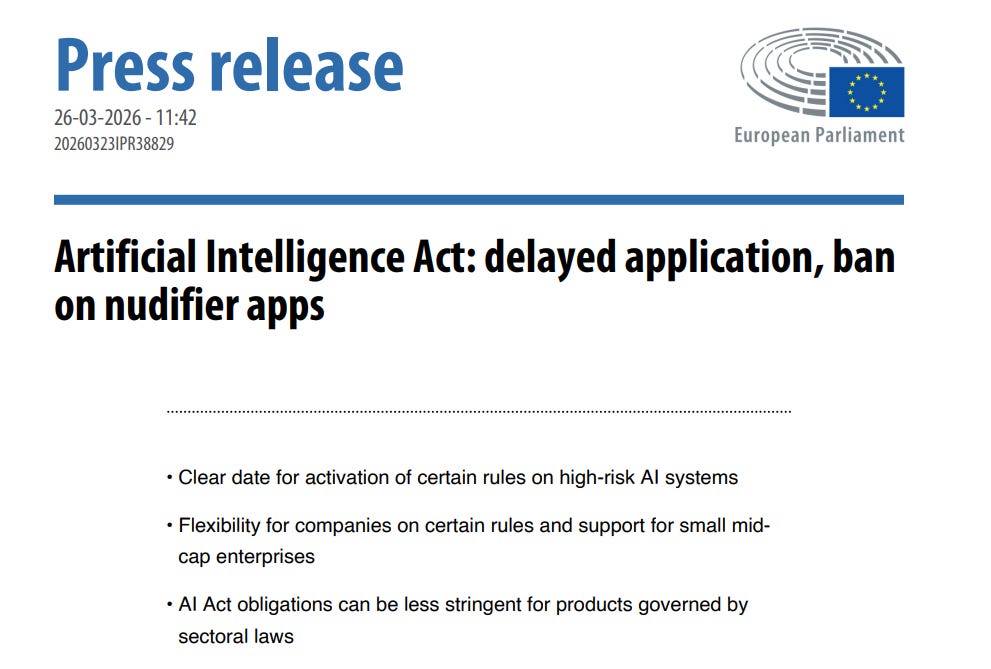
The Parliament also endorsed a new ban targeting AI “nudifier” systems that create or manipulate sexually explicit images resembling an identifiable person without consent, with an exemption for tools that effectively prevent such outputs. The text also supports more flexibility for bias-testing using personal data under safeguards, extends some SME-style support to small mid-cap firms, and seeks to reduce overlap where products are already regulated under EU sectoral rules, with talks with the Council now set to begin.
At the School of Responsible AI (SoRAI), we empower individuals and organizations to become AI-literate through comprehensive, practical, and engaging programs. For individuals, we offer specialized training, including AI Governance certifications (AIGP, RAI, AAIA) and an immersive AI Literacy Specialization. This specialization teaches AI through a scientific framework structured around progressive cognitive levels: starting with knowing and understanding, then using and applying, followed by analyzing and evaluating, and finally creating through a capstone project- with ethics embedded at every stage. Want to learn more? Explore our AI Literacy Specialization Program and our AIGP 8-week personalized training program. For customized enterprise training, write to us at [Link].

⚖️ AI Ethics
US Judge Temporarily Blocks Pentagon Blacklisting of Anthropic Amid AI Battlefield Safety Dispute
A U.S. federal judge temporarily blocked the Pentagon from blacklisting Anthropic after the Defense Department labeled the Claude maker a national security supply‑chain risk, a move that would bar it from some military contracts. Anthropic argues the defense secretary exceeded his authority, retaliated against the company’s public stance on AI safety, and denied it a chance to contest the designation, violating First and Fifth Amendment rights. The Pentagon maintains the risk designation is lawful and tied to national security. The judge said the record suggests the action was aimed at punishing Anthropic rather than protecting security interests, but the order is paused for seven days to allow an appeal and the case remains pending.
Campaigners hail landmark LA verdict as Meta and YouTube lose social media addiction trial
A Los Angeles jury delivered a landmark win to a 20-year-old plaintiff who said she became addicted to Instagram and YouTube as a child, finding that Meta and Google intentionally built addictive products that harmed her mental health. The jury awarded $6m in damages, split into $3m compensatory and $3m punitive after concluding the companies acted with “malice, oppression, or fraud,” with Meta responsible for 70% and Google 30%. Meta and Google said they disagreed with the verdict and plan to appeal, while campaigners and some political figures said the decision could pressure platforms and lawmakers to tighten protections for children. The ruling follows a separate New Mexico jury decision a day earlier holding Meta liable in a case involving children’s exposure to sexual content and predators, and it may influence hundreds of similar lawsuits moving through US courts.
OpenAI Releases Open-Source Teen Safety Prompts for Developers Using gpt-oss-safeguard Model
OpenAI said it has released open-source, prompt-based teen safety policies designed to help developers build safer AI apps, particularly when used with its open-weight safety model, gpt-oss-safeguard. The prompt set targets risks such as graphic violence and sexual content, harmful body-ideal behaviors, dangerous challenges, romantic or violent role play, and age-restricted goods and services, and can be adapted for other models. The company said developers often struggle to turn safety goals into clear, enforceable rules, leading to gaps or overly broad filtering, and that these prompts aim to set a consistent baseline. OpenAI said the work was developed with input from Common Sense Media and everyone.ai and builds on earlier efforts like parental controls, age prediction, and updated guidance for users under 18, even as the company faces lawsuits tied to alleged harms from extreme ChatGPT use.
Spotify Tests Artist Profile Protection Tool to Block AI Tracks Misattributed to Artists
Spotify is beta testing an “Artist Profile Protection” feature aimed at reducing AI-generated “slop” and other misattributed tracks from appearing on real artists’ pages. The tool lets participating artists review releases delivered to Spotify under their name and approve or decline them before they go live, with only approved tracks counting toward stats and recommendations. Spotify said the problem has grown with easy-to-produce AI music and can also stem from metadata errors, shared artist names, or malicious uploads. The move follows Sony Music’s recent statement that it has requested the removal of more than 135,000 AI-generated songs impersonating its artists on streaming services. Artists in the beta can enable the setting in Spotify for Artists and receive email alerts when a release is submitted with their name attached.
Anthropic Adds Claude Code Auto Mode to Run Safe Actions While Blocking Risky Ones
Anthropic has added an “auto mode” to Claude Code in a research preview, aiming to reduce the trade-off between babysitting every AI action and letting the model run unchecked. The feature lets Claude decide which actions are safe to execute automatically, using safeguards to screen for unrequested risky behavior and prompt-injection attacks, while blocking higher-risk steps. It effectively builds on Claude Code’s “dangerously-skip-permissions” option by adding a safety layer, though the company has not shared detailed criteria for how actions are classified. Auto mode is set to roll out to Enterprise and API users in the coming days, works only with Claude Sonnet 4.6 and Opus 4.6, and is recommended for use in isolated, sandboxed environments rather than production systems.
Kentucky Farmer Rejects $26 Million AI Data Center Offer to Preserve Family Land
A northern Kentucky farming family has declined a $26 million offer from an unnamed “major artificial intelligence company” to buy part of its roughly 1,200-acre property outside Maysville for a proposed data center, according to WKRC Local 12. The family said it wants to preserve the land and raised concerns about water shortages and potential contamination linked to data center development, while questioning whether the project would deliver meaningful jobs or growth for Mason County. WKRC reported the company later revised its plans and filed a zoning request to rezone more than 2,000 acres in the area, indicating a data center could still be built near the farm despite the rejected offer.
Wikipedia Prohibits LLM-Generated or Rewritten Article Content, Allows Limited AI Copyedits After Review
Wikipedia has tightened its rules on generative AI in article writing, prohibiting editors from using large language models to generate or rewrite article content. The updated policy replaces earlier, narrower guidance that discouraged creating new articles from scratch with AI, reflecting growing concern about accuracy and sourcing. The change was approved by editors in a vote reported as 40–2, highlighting broad support within the volunteer community. However, the rules still allow limited AI help for basic copyedits to an editor’s own text, as long as humans review the suggestions and the tool does not add new content or alter meaning beyond what sources support.
OpenAI Indefinitely Pauses ChatGPT Erotic Mode as Focus Shifts to Business Tools
OpenAI has indefinitely paused plans for an “erotic” or adult mode in ChatGPT, after the idea drew criticism from watchdog groups and internal debate, according to the Financial Times, following earlier reporting by The Wall Street Journal about safety concerns. A company spokesperson told TechCrunch there was nothing further to add, and no new timeline has been provided. The move comes as OpenAI scales back other non-core efforts, including deprioritizing a ChatGPT shopping feature called Instant Checkout and shutting down its AI video generator Sora. The pullbacks align with a reported strategy shift toward business users and coding tools, amid rising competition in enterprise AI and a widening push into defense work, including a recently disclosed $200 million U.S. Department of Defense contract.
Senators Seek Mandatory EIA Reporting on Data Center Power Use, Grid Impacts, Rates
Two U.S. senators have asked the Energy Information Administration (EIA) to start mandatory annual reporting on data centers’ electricity use, warning that fast-rising demand and limited standardized data could hinder grid planning and oversight. The request seeks granular details such as hourly, annual, and peak loads, the power rates paid, required grid upgrades and who pays for them, and participation in demand-response programs. The letter also asks the EIA to differentiate energy used for AI workloads versus general cloud computing, as political scrutiny of data-center growth intensifies, including separate calls to pause new builds until AI rules are set. The EIA, created in 1977 under the Department of Energy, would likely need an Office of Management and Budget review to change surveys, a process that can take up to two years, and it has been asked to respond by April 9.
Melania Trump Promotes Figure AI Humanoid Robot as Future Homeschooling Educator at White House
Claims in the provided text about a White House press conference where Melania Trump appeared with a Figure AI humanoid robot and promoted a robot “educator” are not supported by reliable public records and appear to be fabricated. There is no verified evidence of a “Fostering the Future Together” global summit at the White House or of Figure AI posting about such an invitation. The broader theme—that parts of the tech industry are pushing AI-driven education models and that Alpha School has drawn attention for using AI-heavy instruction—is consistent with ongoing debates, but the specific White House event details and quotes cannot be confirmed.
Reddit Targets Suspected Bots With Human Verification Checks and Labels for Automated Accounts
Reddit is tightening controls on automated activity by labeling service-style “good bots” and requiring human verification for accounts that show bot-like signals, such as unusual posting speed or other technical markers, rather than rolling out sitewide checks. Accounts that fail verification could face restrictions, while using AI to write posts or comments remains allowed under Reddit’s policies, subject to individual community rules. The platform plans to rely on third-party verification options including passkeys, biometric services, and, where required by local age-verification laws, government IDs in places such as the U.K., Australia, and some U.S. states. The move targets growing bot-driven manipulation and spam, as Reddit says it removes about 100,000 accounts per day and expects improved tooling alongside user reports.
OpenAI Expands Safety Bug Bounty to Address AI Misuse and Vulnerability Risks
OpenAI has expanded its bug bounty efforts with a dedicated safety programme aimed at finding AI misuse risks and safety vulnerabilities beyond traditional software flaws. The company is seeking reports on real-world abuse scenarios tied to increasingly capable systems, including agent-related threats such as prompt injection and data exfiltration, as well as ways AI tools could enable harmful actions at scale. The scope also covers exposure of proprietary model or system information and platform integrity issues like bypassing safeguards or manipulating trust mechanisms, while routine jailbreaks without clear safety impact are excluded. Submissions will be filed through a dedicated platform and triaged by OpenAI’s safety and security teams, with some reports routed to existing security channels.
Accenture and Anthropic Launch Cyber.AI, Using Claude to Automate and Govern Security Operations
Accenture has rolled out Cyber.AI, a cybersecurity operations platform built on Anthropic’s Claude model, aimed at shifting security teams from manual, human-speed response to continuous, AI-driven detection and remediation. The system pairs Accenture’s library of cybersecurity agents with Claude’s reasoning to automate workflows across the security lifecycle, while a built-in “Agent Shield” feature is designed to monitor and govern autonomous AI agents in real time. The move comes as AI-related vulnerabilities are cited as a fast-growing risk, with the World Economic Forum’s Global Cybersecurity Outlook 2026 reporting that nearly nine in 10 organisations see them as a critical concern. Accenture said early deployments include a Fortune 500 agriculture company improving IAM and migrations, and internal use securing 1,600 applications and more than 500,000 APIs, cutting scan turnaround from days to under an hour and expanding security coverage from about 10% to over 80%.
RBI Deploys AI to Counter Hacking Surge, Urges Payments Industry to Trust Regulation
The Reserve Bank of India said its website is among the most frequently targeted platforms for hacking attempts and that it is deploying AI to spot attack patterns and trace their origins, helping block threats earlier. A senior official said hacking attempts doubled in the December quarter versus prior quarters, but were successfully thwarted by the central bank’s existing security systems. The RBI also urged the payments industry to back regulatory changes, citing the standing instruction framework for recurring payments and card tokenisation as examples that scaled after initial pushback. It said UPI AutoPay saw 86.8 million mandates created in February 2026 with a success rate above 99%, while card tokenisation has reached 117 crore tokens and supported 119 crore transactions worth about Rs 15 lakh crore with minimal latency. The official added that AI is expected to play a larger role in India’s digital public infrastructure, including reconciliation, fraud controls, grievance handling, and voice-based payments in regional languages.
AI-Generated Text Surpassed Human Writing in 2025, Reshaping the Internet’s Content Economy
Recent figures cited by ARK Invest indicate AI-generated text surpassed human-written output in 2025, suggesting machines are now producing the majority of the world’s written content rather than just marketing copy or blogs. Separate research referenced by AIhub also claims more than half of newly published online articles are created with AI, reinforcing the scale of the shift. Analysts attribute the surge to the speed and low cost of AI tools that let businesses publish at volumes humans cannot match, often with text that readers struggle to distinguish. The trend is raising concerns about low-quality “AI slop” and about future models training on AI-made material, while pushing human creators to compete more on originality, credibility, and lived experience than on volume.
🚀 AI Breakthroughs
Google Launches Lyria 3 Pro Across Vertex AI, Gemini, Vids, and Developer Tools
Google has made its Lyria 3 Pro music-generation model available across more products, aiming to help users create longer, high-fidelity tracks in more workflows. The model is now in public preview on Vertex AI for businesses that need on-demand audio at scale, and it is also available to developers via Google AI Studio alongside Lyria RealTime, with access through the Gemini API. Google Vids is rolling out support for Lyria 3 and Lyria 3 Pro to Google Workspace customers and Google AI Pro and Ultra subscribers starting this week, enabling custom music for videos. Longer generations with Lyria 3 Pro are also being added to the Gemini app for paid subscribers, while ProducerAI is using Lyria 3 Pro to offer an agent-based, collaborative song-building experience for free and paid users globally.
Google Details TurboQuant AI Memory Compression as ‘Pied Piper’ Comparisons Spread Online
Google Research detailed TurboQuant, an AI memory-compression approach aimed at shrinking the key-value (KV) cache used during model inference without degrading output quality, using vector-quantization techniques to ease cache bottlenecks. The work is slated for presentation at ICLR 2026 and includes two components described as enabling the gains: a quantization method called PolarQuant and a training/optimization method called QJL. Researchers claim TurboQuant can cut inference “working memory” needs by at least 6x, potentially lowering the cost of running large models and improving throughput. Online, the technology has been compared to the fictional “Pied Piper” compression algorithm from HBO’s “Silicon Valley,” but the research remains a lab result and targets inference memory rather than the much larger memory demands of training.
Google Launches Gemini 3.1 Flash Live to Improve Real-Time Audio AI Reliability
Google has launched Gemini 3.1 Flash Live, a real-time audio and voice model aimed at making AI conversations sound more natural while improving reliability for voice-first applications. The company said the model is its highest-quality audio offering so far and is being made available across Google products for developers, enterprises, and everyday users. Gemini 3.1 Flash Live is positioned to support faster dialogue along with stronger reasoning and task execution for building voice agents that can handle complex, multi-step work at scale. Google reported that the model scored 90.8% on ComplexFuncBench Audio, a benchmark for multi-step function calling under constraints, outperforming its previous model.
Google Launches TurboQuant to Cut Vector Quantization Overhead and Ease AI Cache Bottlenecks
Google has detailed TurboQuant, a vector-compression method aimed at improving AI efficiency by shrinking high-dimensional vectors used in tasks like similarity search and transformer key-value (KV) caching, where memory limits can become a bottleneck. The company says classical vector quantization cuts vector size but often adds “memory overhead” because it must store full-precision quantization constants for many small blocks, effectively adding 1–2 extra bits per value. TurboQuant is designed to reduce that overhead while keeping model quality intact, and it is paired with related techniques called Quantized Johnson-Lindenstrauss (QJL) and PolarQuant. Google reports tests showing these methods can ease KV-cache pressure and lower memory costs without hurting performance, with the work slated for presentation at ICLR 2026 and AISTATS 2026.
Meta’s TRIBE v2 Tri-Modal Foundation Model Predicts Brain Activity Across Tasks and Subjects
Meta’s FAIR researchers described TRIBE v2, a tri-modal foundation model that processes video, audio, and language to predict human brain activity across a wide range of naturalistic and lab-style conditions. The system was trained on a unified dataset totaling more than 1,000 hours of fMRI scans from 720 people, and it is reported to generalize to new stimuli, tasks, and subjects. The paper says TRIBE v2 outperforms traditional linear encoding models, delivering several-fold gains in prediction accuracy while producing high-resolution brain-response estimates. It also reports that the model can replicate outcomes from classic vision and neurolinguistics experiments in silico and can yield interpretable features that map fine-grained multisensory integration across the brain.
Figma Enables Claude Code and Other AI Agents to Write Directly on Canvas
Figma has added a new capability that lets AI agents write directly into Figma files, enabling tools such as Claude Code, Codex and other Model Context Protocol (MCP) clients to generate and edit design assets inside the canvas. The feature works through the Figma MCP server and uses existing design systems—components, naming conventions and variables—as shared context so outputs stay consistent with team standards. Figma said users can create agent “Skills” as markdown instruction sets without writing code or building plugins, with examples for generating components, creating designs and syncing design tokens between code and Figma variables. The access is offered as a paid API but remains free during the beta, and support currently includes several MCP clients such as Augment, Copilot and Cursor.
Google Adds Switching Tools to Import Chat Histories and Memories From Rival Chatbots into Gemini
Google has rolled out “switching tools” for Gemini that let users bring over saved “memories” and chat histories from other AI chatbots, lowering the friction of moving to its assistant. The memory transfer works by having Gemini suggest a prompt for the current chatbot to summarize key personal details, which users then copy and paste into Gemini so it can retain preferences and context. For chat history, users can upload exported logs as a zip file—supported by common exports from services such as ChatGPT and Claude—and then search those past conversations inside Gemini. The move targets consumer retention as ChatGPT remains the market leader, with OpenAI recently citing 900 million weekly active users, while Google has said Gemini passed 750 million monthly active users.
ByteDance Rolls Out Dreamina Seedance 2.0 AI Video Model in CapCut, Starting Select Markets
ByteDance has started rolling out its new AI audio-and-video generation model, Dreamina Seedance 2.0, inside CapCut, letting creators draft, edit and sync clips using text prompts, images or reference videos. The phased release begins in Brazil, Indonesia, Malaysia, Mexico, the Philippines, Thailand and Vietnam, a limited launch that follows reports the wider rollout had been paused amid intellectual property concerns and Hollywood criticism. The model can generate up to 15-second videos in six aspect ratios and is positioned for uses ranging from product explainers to motion-heavy scenes, with ByteDance claiming improved realism in textures, movement and lighting. ByteDance said the system blocks generation from real-face imagery, restricts unauthorized IP creation, and adds an invisible watermark to help identify AI-made content shared off-platform, while also making the model available in China via its Jianying app and planning expansion to Dreamina and Pippit.
Mistral Releases Open-Source Voxtral TTS Model for Multilingual, Low-Latency Enterprise Voice Agents
Mistral has released a new open-source text-to-speech model called Voxtral TTS, aimed at voice assistants and enterprise uses such as sales and customer support, putting it up against rivals including ElevenLabs, Deepgram, and OpenAI. The company said the model supports nine languages—English, French, German, Spanish, Dutch, Portuguese, Italian, Hindi, and Arabic—and is designed to run on edge devices like smartwatches, phones, and laptops at lower cost. Mistral claimed Voxtral TTS can clone a custom voice from under five seconds of audio, preserve accents and intonation, and switch languages without losing voice characteristics for use cases like dubbing and real-time translation. It also cited real-time performance figures of about 90 ms time-to-first-audio for a 500-character input and a 6x real-time factor, as it builds out a broader suite of voice products following earlier transcription model releases.
Anthropic Report Warns AI Skills Gap Widens as Power Users Gain Workplace Advantage
Anthropic’s latest economic impact research says AI is rapidly reshaping how work gets done, but shows little evidence so far of broad job losses, with unemployment not materially different between roles heavily using its Claude model for core tasks and jobs less exposed to AI. The report warns, however, that displacement could appear quickly as adoption spreads, echoing separate claims from the company’s leadership that entry-level white-collar roles could be hit hard in coming years. Even without widespread layoffs yet, Anthropic finds a widening AI skills gap: early adopters are getting more value by using AI for sustained work and higher-level “thought partner” workflows, while newer users lag. Usage is also more intense in high-income countries and U.S. regions with more knowledge workers, suggesting AI benefits may be concentrating among wealthier, more specialized users.
Data Leak Exposes Anthropic’s Claude Mythos, a Capybara-Tier Model Beyond Opus 4.6
A data leak has exposed internal Anthropic materials describing a new AI model called Claude Mythos, which the company confirmed exists and is being developed as a general-purpose system with advances in reasoning, coding, and cybersecurity. The documents, reportedly found in a publicly accessible cache due to a configuration error, refer to Mythos as part of a higher “Capybara” tier that exceeds the current Opus line, including Opus 4.6, in both capability and cost. The leaked draft also flags heightened misuse risks, claiming the model is far ahead in cyber capabilities and could accelerate vulnerability exploitation faster than defenders can respond, prompting plans to prioritize early access for cyber-defense organizations. Anthropic has not formally detailed the model’s release timeline, as it continues limited testing, while separate reporting says the company is also weighing an IPO as early as late 2026.
Yann LeCun’s LeWorldModel Runs on a Single GPU, Plans Up to 48x Faster
Researchers from NYU, MILA University, and Brown University have detailed LeWorldModel (LeWM), a compact “world model” that learns from raw pixels and can run on a single GPU. The system is reported to have about 15 million parameters, train in a few hours on one GPU, and plan up to 48 times faster than some existing world-model approaches while keeping competitive performance. The paper says the design simplifies training by using just two loss functions, aiming to reduce fragility and avoid representation collapse without heavy training hacks. The model is trained in a reward-free, task-agnostic way on image-and-action sequences, with early signs of capturing basic physical properties, though it still faces limits in long-horizon planning and relies on large datasets.
🎓AI Academia
HyperAgents Paper Details DGM-H System That Self-Edits Meta-Improvement Across Multiple Domains
A new arXiv paper (arXiv:2603.19461v1, posted March 19, 2026) describes “HyperAgents,” a self-improving agent design that merges a task-solving agent and a self-modifying meta agent into one editable program, so the method used to generate improvements can also be rewritten. Built as an extension of the earlier Darwin Gödel Machine concept, the system—called DGM-Hyperagents (DGM-H)—is reported to improve over time on multiple domains including coding, paper review, robotics reward design, and grading Olympiad-level math solutions. The authors claim it outperforms baselines without self-improvement or open-ended exploration, as well as the prior DGM approach, and that meta-level upgrades like persistent memory and performance tracking can transfer across domains and accumulate across runs. The work reports safety precautions such as sandboxing and human oversight, and provides code at https://github.com/facebookresearch/Hyperagents.
Agentic AI research points to social “societies of thought” driving the next intelligence explosion
A new arXiv paper (arXiv:2603.20639v1, posted March 21, 2026) argues that the popular “AI singularity” idea of one monolithic supermind is likely misguided, and that the next leap in AI will look more plural and social, resembling past evolutionary “intelligence explosions.” It says intelligence should be understood as relational and collective, not a single number that can be cleanly compared to “human-level,” especially since human intelligence is already distributed across groups and institutions. The paper reports evidence that some frontier reasoning models gain accuracy not just by generating longer outputs, but by producing internal, multi-perspective debate-like chains of thought—described as a “society of thought”—and that reinforcement learning for accuracy can increase these conversational patterns even without explicit training for them. It also argues that AI research has barely applied decades of organizational and social-science findings on how group structure, hierarchy, specialization, and disagreement norms shape performance, and suggests these ideas may become central as agent-based and human-AI “centaur” systems mature.
Citation-Constellation Tool Maps Citation Networks with Auditable BARON and HEROCON Outreach Scores
A new arXiv preprint describes Citation-Constellation, a free, open-source, no-code, and auditable web tool for citation network decomposition that can be used without installation, registration, or payment. The system lets users enter an ORCID or OpenAlex ID to generate a decomposition of a researcher’s citation network within minutes, and its source code is publicly available on GitHub. The paper argues that common metrics like the h-index and raw citation counts treat all citations as equal, masking whether influence comes from independent researchers or from close collaborators. It outlines two companion scores: BARON, a strict count of citations from outside an identified collaboration network, and HEROCON, a configurable weighted score that gives partial credit to citations from within that network.
Study of 177,000 MCP Agent Tools Finds Rising Action Use and Oversight Risks
An analysis of 177,436 AI agent tools created between November 2024 and February 2026 from public Model Context Protocol (MCP) server repositories shows software development dominates the ecosystem, accounting for 67% of tools and 90% of MCP server downloads. The dataset classifies tools by impact—perception (reading data), reasoning (analyzing), and action (changing external systems)—and finds action tools grew sharply in use, rising from 27% to 65% of total usage over the 16-month period. Most action tools are aimed at medium-stakes work such as editing files or sending emails, but the repository monitoring also identifies tools capable of higher-stakes actions such as financial transactions. The work argues that tracking the “tool layer,” not just model outputs, can help governments and regulators monitor where agent deployments may introduce security and safety risks.
EU AI Act Faces Enforcement and Oversight Gaps as Autonomous AI Agents Go Mainstream
A new paper argues that fast-growing AI agents—systems that can autonomously take actions toward complex goals with limited human oversight—are exposing gaps in the European Union’s AI Act, which was drafted before agents became widely used. It says these tools are already being used to write software, run business activities, and automate personal tasks, raising risks such as autonomous performance failures, malicious misuse, and unequal access to economic benefits. The analysis finds that key parts of the AI Act, including how monitoring and enforcement are assigned, its reliance on industry self-regulation, and the level of government resourcing, may be poorly matched to agent-style systems. The paper concludes that EU regulators and other policymakers may need to adjust existing approaches soon to effectively govern the next generation of AI.
Study Finds Four Key Security Barriers to Trustworthy AI-Driven Threat Intelligence in Finance
A new practitioner-focused study examines why “trustworthy” AI for cyber threat intelligence (CTI) is still rare in financial institutions despite growing hype and regulatory pressure. Using a mixed-methods approach—screening 330 papers from 2019–2025 (keeping 12 finance-relevant studies), plus six interviews and 14 survey responses from banks and consultancies—the research identifies four recurring failure modes: unsanctioned “shadow” use of public AI tools, buying licenses without integrating tools into security workflows, gaps in modeling how attackers adapt, and weak security controls for the AI models themselves (monitoring, robustness testing, and audit-ready evidence). Survey data suggests expectations are high (71.4% think AI will be central within five years), but current use remains limited (57.1% report infrequent use due to interpretability and assurance concerns), and 28.6% say they have encountered adversarial risks. The paper argues that explainability, auditability, and regulatory defensibility—not just accuracy—are the main blockers to production deployment of AI-driven CTI in finance.
Study Finds Data Infrastructure Gaps, Not Algorithms, Blocking Scalable AI in Indian Agriculture
A new arXiv paper argues that India’s limited use of AI in farming is driven less by weak algorithms and more by gaps in the country’s agricultural data infrastructure, despite large volumes of public data. Reviewing major programmes such as Soil Health Cards, crop insurance systems, AgriStack, and state digital platforms, it flags problems including data arriving too late for farm decision cycles, lack of shared geocodes to link soil, weather and yield records, dependence on static non-machine-friendly formats, and unclear rules that limit access and reuse. The paper says these issues make it hard to merge datasets and build automated decision support, hitting smallholders—about 86% of India’s farmers—hardest because they cannot offset poor data systems. It outlines what “AI-ready” farm data should look like, such as persistent identifiers, machine-accessible formats, interoperability and transparent governance, and finds even the most advanced initiatives only partly meet those requirements.
Paper Proposes Morality-as-a-System Framework for LLMs, Emphasizing Lifecycle Monitoring and Cultural Plurality
A new conceptual paper argues that current efforts to shape “morality” in large language models—such as constitutional AI, RLHF, DPO, and benchmarking—still fall short on linking internal model behavior to regulatory duties, supporting cultural plurality across the full development stack, and tracking how moral behavior changes after deployment. It says these gaps stem from a common assumption that morality is “installed” during training and then stays fixed. Instead, it proposes treating morality as an emergent property of a sociotechnical system, drawing on social systems theory, where behavior is continuously produced through interactions across seven coupled components, from the neural model and training data to prompts, moderation, runtime dynamics, and user interface. The paper is not an empirical study, but it reframes key alignment and governance problems as failures of coordination between system components and calls for lifecycle monitoring infrastructure to detect drift and support oversight.
EU AI Act Positions Fundamental Rights as Enforceable Thresholds Across AI System Lifecycles
A new open-access law review article in the Review of European and Comparative Law analyzes how the EU’s AI Act (Regulation (EU) 2024/1689) makes fundamental rights a central “risk-based” governance tool for AI, tying compliance duties to protections in the EU Charter of Fundamental Rights. It notes the Act was published in the EU’s Official Journal on 12 July 2024, entered into force on 1 August 2024, and is set to apply generally from 2 August 2026, with staggered obligations starting in 2025 and extending to 2027. The paper argues that rights are treated not just as broad principles but as legal thresholds and procedural triggers across an AI system’s lifecycle, supporting a human-centric approach. It also concludes the framework could become a template for rights-preserving AI regulation, while warning that major challenges are likely to surface during implementation.
EU Law Journal Article Examines Path From AI Act Toward Establishing European AI Agency
A new “online first” legal research article in the Croatian Yearbook of European Law and Policy examines how the EU’s AI Act could evolve into a more complete regulatory setup, including the potential role of a dedicated European AI agency. The piece is published by the University of Zagreb’s Faculty of Law in the journal’s 2025 volume and is available on the journal’s website with DOI 10.3935/cyelp.21.2025.610. It was posted online on 7 November 2025 and is identified with ISSN 1848-9958 (online) and 1845-5662 (print). The publication is open to read and share for lawful, non-commercial use under a Creative Commons BY-NC-ND 4.0 license with proper attribution.
About SoRAI: SoRAI is committed to advancing AI literacy through practical, accessible, and high-quality education. Our programs emphasize responsible AI use, equipping learners with the skills to anticipate and mitigate risks effectively. Our flagship AIGP certification courses, built on real-world experience, drive AI governance education with innovative, human-centric approaches, laying the foundation for quantifying AI governance literacy. Subscribe to our free newsletter to stay ahead of the AI Governance curve.