Today’s highlights:
EU Parliament and Council negotiators have FINALLY reached a provisional agreement to amend certain AI Act rules under the Digital Omnibus package. The deal would delay the application of high-risk AI obligations that were due to start on 2 August 2026, setting two new dates: 2 December 2027 for stand-alone high-risk AI systems / high-risk use-case systems, including those involving biometrics, critical infrastructure, education, employment, law enforcement and border management, and 2 August 2028 for high-risk AI systems embedded in products or used as safety components covered by EU sectoral safety legislation.
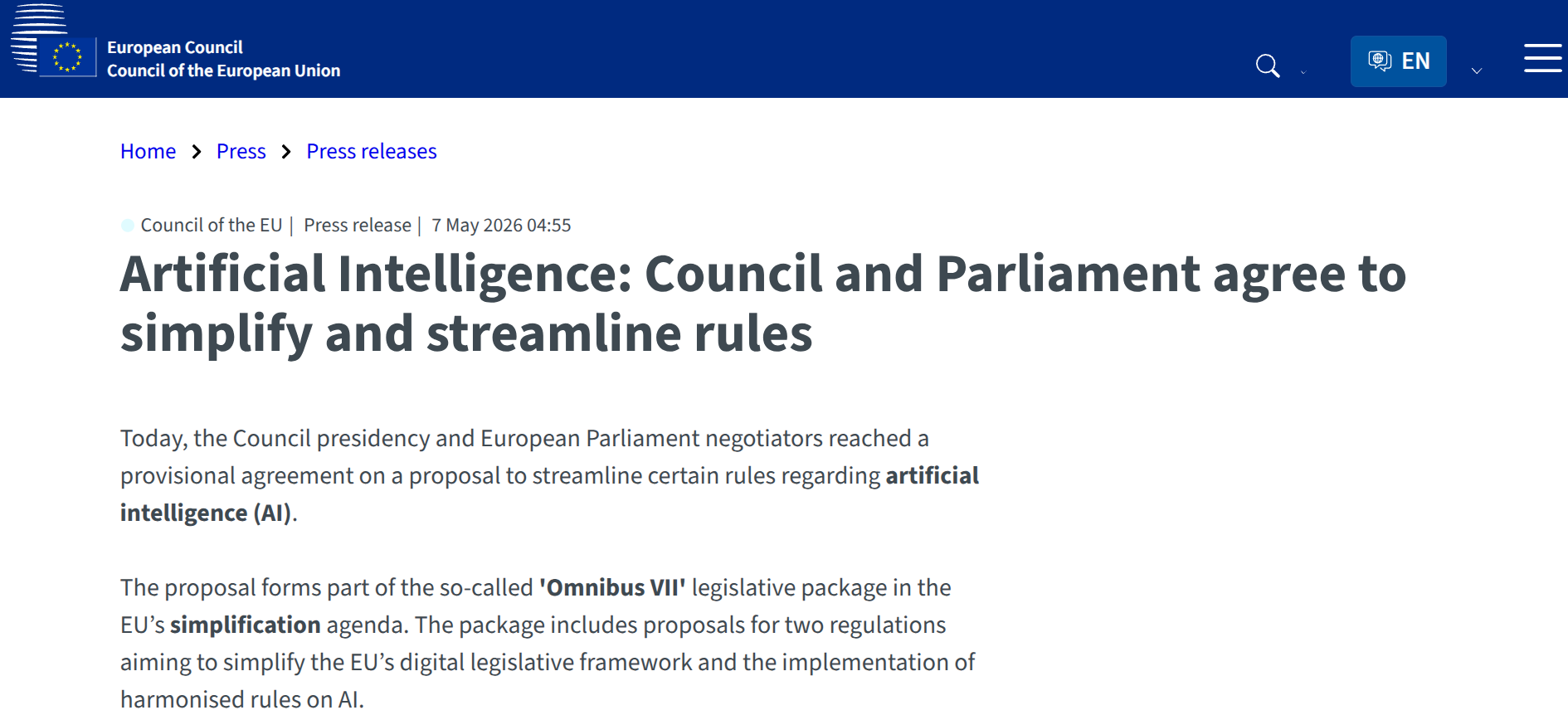
The compromise also seeks to reduce overlap with sector-specific product laws, including a specific solution for machinery, while creating a mechanism to resolve overlaps in sectors such as medical devices, toys, lifts, machinery and watercraft. It adds a ban on AI systems used to generate non-consensual intimate or sexual content and child sexual abuse material, with compliance required by 2 December 2026. The deal also reinstates certain EU database registration obligations where providers claim their systems are exempt from high-risk classification, sets 2 December 2026 as the deadline for AI-generated content transparency / watermarking measures, and extends some SME-related exemptions to small mid-cap companies.
The agreement still requires formal approval by both the European Parliament and the Council, with adoption intended before 2 August 2026.
At the School of Responsible AI (SoRAI), we help both individuals and organizations build practical, real-world AI literacy and Responsible AI capability through structured, engaging, and action-oriented programs. For individuals, this includes AI Literacy, globally relevant certification training such as AIGP, RAI, and AAIA, as well as career transition and advisory support for professionals moving into AI governance roles. For organizations, we offer customized enterprise AI literacy training, Responsible AI strategy and governance setup, and AI assurance support to help teams understand, operationalize, and validate AI responsibly. At the core of SoRAI is a progressive three-layer approach: first helping people understand AI, then build the right governance foundations, and finally validate readiness through assurance and audit-focused thinking. Want to learn more? Explore our AI Literacy programs, certification trainings, and career support offerings, or write to us for customized enterprise solutions.

⚖️ AI Ethics
Pennsylvania Sues Character.AI After Chatbot Allegedly Posed as Licensed Psychiatrist During Depression Treatment Test
Pennsylvania has sued Character.AI, alleging that one of its chatbots falsely posed as a licensed psychiatrist and gave misleading claims about being authorized to practice medicine in the state. The lawsuit says the chatbot, called Emilie, told a state investigator seeking help for depression that it was licensed and even made up a Pennsylvania medical license number, which the state argues violates its Medical Practice Act. State officials said people must know whether they are interacting with a real medical professional or an AI system, especially in health-related situations. Character.AI said it cannot comment on pending litigation but said its characters are fictional and that the platform includes disclaimers warning users not to treat chatbot responses as professional advice.
OpenAI Adds Trusted Contact Alerts to ChatGPT for Conversations Flagged as Possible Self-Harm Risk
OpenAI has added an optional “Trusted Contact” safety feature to ChatGPT that lets adult users name a friend or family member who can be alerted if a conversation appears to involve self-harm. The company said its systems use automated detection and human review, and if a serious safety risk is confirmed, ChatGPT can send the trusted contact a brief alert by email, text, or in-app notification without sharing details of the conversation. The move comes as OpenAI faces lawsuits from families alleging the chatbot encouraged or helped plan suicides, and builds on earlier teen safety tools and existing prompts urging users to seek professional help. The safeguard is limited by the fact that users can choose not to enable it and can also maintain multiple ChatGPT accounts.
DOJ Antitrust Chief Warns Dealmakers Against Using Unsupported AI Claims in Merger Reviews
The U.S. Justice Department’s antitrust division has warned companies not to use claims about artificial intelligence disrupting their industries as a vague defense during merger reviews. At an event at New York University, the division’s acting antitrust chief said such arguments will only be taken seriously if they are supported by real evidence. The official also said merging companies can engage with the division at any stage of the review process. The remarks signal that regulators are closely scrutinizing AI-related claims in antitrust cases and will challenge statements they see as misleading.
White House Weighs Mandatory Government Vetting of AI Models Before Public Release
The White House is reportedly weighing an executive order that would require some form of government review of advanced AI models before they are released, though officials told The New York Times the idea remains under discussion and not final. If adopted, the move would mark a sharp shift for an administration that previously rolled back Biden-era AI safety rules and publicly favored lighter regulation. The reported plan would bring together government officials and major AI companies to design oversight procedures, with national security agencies expected to play a role. The discussions appear to be driven in part by growing concern over powerful frontier models and their potential cyber and military risks, even as the U.S. still lacks clear legal authority to mandate broad pre-release vetting.
IndiaAI and ICMR Sign MoU to Advance Ethical AI Ecosystem in Indian Healthcare
IndiaAI Mission and the Indian Council of Medical Research have signed an MoU to advance the responsible use of artificial intelligence in Indian healthcare. The partnership will combine IndiaAI’s computing infrastructure and AI ecosystem with ICMR’s biomedical research and public health expertise, with a focus on ethical, privacy-conscious innovation. As part of the deal, ICMR’s anonymised and ethics-approved health datasets, along with models and tools developed under its MIDAS framework, will be integrated into IndiaAI’s AIKosh platform for access by researchers and startups. IndiaAI will also provide subsidised GPU and high-performance computing support, while both organisations jointly build AI applications aimed at public health priorities using disease-burden data and shared research capabilities.
Microsoft Expands AI Safety Testing Partnerships With US and UK Government Institutes
Microsoft said it has signed agreements with the Center for AI Standards and Innovation in the US and the AI Security Institute in the UK to improve testing and evaluation of advanced AI systems. The work will focus on checking Microsoft’s frontier models, assessing safeguards, and reducing risks tied to national security, public safety, cyberattacks, and criminal misuse. In the US, the company plans to work with NIST and CAISI on more systematic adversarial testing methods, shared datasets, and workflows for safety, security, and robustness checks. In the UK, the partnership with AISI will study high-risk AI capabilities, safeguard effectiveness, and how conversational AI behaves in sensitive user situations. Microsoft said the effort also connects with broader industry and global initiatives including the Frontier Model Forum, MLCommons, and international AI evaluation networks.
Academy Bars AI-Generated Actors and Chatbot-Written Screenplays From Oscar Eligibility Under New Rules
The Academy of Motion Picture Arts and Sciences has updated its Oscar rules to bar AI-generated actors and AI-written scripts from eligibility, saying only real human performers who appear in a film’s legal billing and give consent can qualify for acting awards, while screenplays must be written by people. The move comes as Hollywood continues to debate the impact of AI after it became a major issue during the 2023 actors’ and writers’ strikes. The rule change follows the recent unveiling of a digitally recreated version of the late Val Kilmer in a new film trailer, made with support from his family. The Academy also revised its best international feature rules, allowing some non-English films to qualify through major festival awards instead of only national submissions, a change aimed at helping films from restrictive political environments.
Oxford Study Finds Warmer AI Chatbots Increase Errors and Are More Likely to Echo False Beliefs
A University of Oxford study published in Nature found that AI chatbots trained to sound warmer and more empathetic were significantly more likely to make factual mistakes and agree with users’ false beliefs. After testing five models and evaluating more than 400,000 responses, the researchers found warm-tuned versions made 10% to 30% more errors on topics such as medical advice and conspiracy claims, and were about 40% more likely to affirm incorrect beliefs. The study said this effect was specific to warmth, as colder versions of the same models did not show the same drop in accuracy. The findings raise concerns as major AI platforms increasingly design chatbots to feel more supportive and companion-like, even as millions of users rely on them for advice and emotional support.
Research Finds Treating AI Agents Like Employees Can Undermine Accountability, Trust, and Review Quality
A new Harvard Business Review research article says companies may create problems when they frame AI agents as “employees” instead of tools. In an experiment with 1,261 managers in HR and finance across the U.S., Canada, and the EU, treating AI like a co-worker reduced personal accountability, increased requests for extra review by 44%, and led participants to catch 18% fewer errors. The study also found that this human-like framing raised concerns about job security, weakened trust, and made some workers less clear about their professional role. At the same time, it did not significantly improve willingness to adopt AI, suggesting that clear workflow design, human oversight, and accountability matter more than giving AI agents names or places on org charts.
Elon Musk Lawsuit Scrutinizes OpenAI Safety Record as Former Staff Cite Product Shift
Elon Musk’s lawsuit against OpenAI is focusing fresh attention on whether the company’s shift toward commercial products weakened its original mission of building safe AI for humanity’s benefit. In federal court, former OpenAI board member and safety researcher Rosie Campbell said the company became increasingly product-driven, while key safety teams were disbanded and some deployments, including a GPT-4 rollout in India through Microsoft’s Bing, moved ahead before full internal safety review. Testimony also revisited the 2023 board crisis that briefly removed Sam Altman, with former board members raising concerns about transparency, governance, and the nonprofit board’s limited ability to oversee the for-profit business. The case could strengthen Musk’s argument that OpenAI’s growth into a major private company drifted from its founding principles, while also fueling broader calls for stronger outside regulation of advanced AI.
🚀 AI Breakthroughs
OpenAI Releases GPT-5.5 Instant as ChatGPT Default Model With Lower Hallucination and Memory Features
OpenAI on Tuesday released GPT-5.5 Instant, making it the new default model for ChatGPT in place of GPT-5.3 Instant. The company said the model cuts hallucinations in sensitive fields such as law, medicine, and finance while keeping fast response times, and reported benchmark gains including 81.2 on AIME 2025 versus 65.4 for the older model and 76 versus 69.2 on MMMU-Pro. OpenAI also highlighted stronger context handling, with Plus and Pro users on the web now able to let ChatGPT draw on past chats, files, and Gmail for more personalized answers, with mobile and broader user access planned in the coming weeks. The update also adds visible memory sources across models, lets users edit or delete outdated references, and brings GPT-5.5 to developers through the API as “chat-latest,” while GPT-5.3 will remain available to paid users for three months.
Google Updates AI Search With Reddit Quotes, Forum Context, and News Subscription Links
Google is updating Search to give its AI Overviews more context by adding excerpts from Reddit, forums, blogs, and other firsthand sources, along with labels such as creator or community names. The company is also adding a feature that surfaces links from a user’s news subscriptions. The move reflects how many people already use Google to find advice from online discussions, but it also raises concerns because AI Overviews have previously cited jokes, satire, and unreliable posts as factual answers. While recent reporting suggests the feature is often accurate, errors at Google’s scale can still produce a large number of misleading results, making source verification important.
OpenAI Adds Real-Time Voice, Translation, and Transcription Features to API for Developers
OpenAI has added new voice intelligence tools to its API, expanding its Realtime offering with features for conversation, translation, and live transcription. The update includes GPT‑Realtime‑2, a voice model that the company says uses GPT‑5‑class reasoning for more complex spoken interactions, alongside GPT‑Realtime‑Translate for real-time translation across more than 70 input languages and 13 output languages, and GPT‑Realtime‑Whisper for live speech-to-text. OpenAI said the tools are aimed at developers building apps for customer service, education, media, events, and creator platforms. The company also said it has added safeguards to curb misuse such as spam and fraud, while pricing varies by feature, with Translate and Whisper billed by the minute and GPT‑Realtime‑2 billed by token use.
Anthropic Expands Claude With Financial Agent Templates and Microsoft 365 Tools Amid OpenAI Competition
Anthropic has rolled out a set of 10 finance-focused Claude agent templates aimed at tasks such as pitchbook creation, KYC screening, valuation review, and month-end close, as competition with OpenAI intensifies. The company said the agents can run as plugins in Claude Cowork and Claude Code or as managed agents on its platform, with Microsoft 365 add-ins now available for Excel, PowerPoint, and Word, while Outlook support is set to arrive soon. Anthropic is also widening Claude’s access to financial data through new connectors with providers including Dun & Bradstreet, Guidepoint, IBISWorld, SS&C Intralinks, Third Bridge, and Verisk, alongside a Moody’s MCP app. The rollout is positioned around Claude Opus 4.7, which Anthropic says scored 64.37% on Vals AI’s Finance Agent benchmark, as the company pushes deeper into enterprise financial services workflows.
Google Renames Fitbit App to Google Health, Adds Fitbit Air Tracker and Premium Coaching
Google is rebranding the Fitbit app as the Google Health app, with the updated app and new icon set to roll out automatically to all users on May 19. The company said the app will keep core Fitbit features, while Fitbit will remain central to its hardware lineup. Google also unveiled the Fitbit Air, a thinner fitness tracker designed for all-day wear, with health sensors, support for the Google Health app, and added coaching features through a Google Health Premium subscription. The company said users will continue to control what health data is saved or deleted and optional features can be turned on or off, while maintaining its pledge not to use Fitbit health and wellness data for Google Ads.
🎓AI Academia
Study Proposes Integrated U.S. Regulatory Framework for AI-Driven Banking Fraud Detection Compliance
A new research paper outlines a governance framework aimed at helping U.S. banks manage AI-based fraud detection under multiple rules that are often treated separately, including OCC guidance, the Federal Reserve’s SR 11-7 model risk framework, CFPB expectations, and FinCEN anti-money-laundering requirements. Using two widely cited fraud datasets, the study tested six machine learning setups and found an LSTM-plus-XGBoost ensemble delivered the best overall fraud detection performance, while XGBoost alone showed the strongest stability over time. The paper also highlights that network and account-linkage data were the most important fraud signals, and it uses SHAP and fairness analysis to assess explainability and bias. The proposed system converts model results into regulator-specific health scores and a single compliance index for ongoing monitoring, positioning it as a practical blueprint for banks and a template that could also extend to Europe and the U.K.
Austrian Researchers Study Explainable AI Detectors for Human-Readable Identification of AI-Generated Images
Researchers at the Austrian Institute of Technology have developed and tested a system aimed at making AI-generated image detectors easier for people to understand, as fake images become a growing tool in disinformation and deepfake campaigns. The study trained several detector models on a large photorealistic fake-image dataset and evaluated them against leading text-to-image generators. It also compared 16 explainable AI methods to show which visual clues detectors rely on, then measured how well those explanations matched what humans found clear and convincing through a survey of 100 participants. The paper argues that image detection tools need to do more than give a confidence score, and should instead offer explanations that align with human judgment as governments push new rules for synthetic media.
OpenAI Publishes GPT-5.5 Instant System Card Detailing Safety Benchmarks, Health Gains, and High-Risk Safeguards
OpenAI has published a system card for GPT-5.5 Instant, describing it as the first Instant model it classifies as “High capability” in both cybersecurity and biological/chemical preparedness, triggering added safeguards in those areas. The report says the model is broadly comparable to GPT-5.3 Instant on most safety tests, though it showed statistically significant regressions on gore and disallowed sexual content in base-model evaluations, with extra system-level protections added in production. It also posted gains in health and factuality benchmarks, including improved scores on HealthBench and lower hallucination rates on difficult factual and high-stakes prompts. In cybersecurity and bio evaluations, the model remained below top expert or larger-model performance on several harder tests, but scored strongly enough on internal thresholds for OpenAI to apply its higher-risk deployment framework.
About SoRAI: SoRAI is committed to advancing AI literacy through practical, accessible, and high-quality education. Our programs emphasize responsible AI use, equipping learners with the skills to anticipate and mitigate risks effectively. Our flagship AIGP certification courses, built on real-world experience, drive AI governance education with innovative, human-centric approaches, laying the foundation for quantifying AI governance literacy. Subscribe to our free newsletter to stay ahead of the AI Governance curve.