In just the first half of October, we’ve seen so many major cyber incidents across the world!
And what’s even more concerning is that these attacks are affecting things we depend on every day, from supermarkets and banks to cloud services, energy companies, and major infrastructure projects.
Why are cyberattacks increasing so rapidly? And is AI somehow involved behind the scenes?
Before we blame AI, let’s first understand what actually happened.
🇯🇵 1. JAPAN — Cloud Services Hacked
Hackers attacked IDC Frontier, a company that provides cloud services to other businesses and government offices. The ransomware attack stopped some servers from working, leaving 495 organizations affected. This shows how attacking just one cloud provider can disrupt hundreds of organizations.
🇫🇷🇳🇱 2. FRANCE / NETHERLANDS — Supermarkets Disrupted
In France, hackers remotely changed the temperature settings of supermarket refrigerators, causing food to spoil and damaging equipment. In a separate incident in the Netherlands, a major supermarket company faced a cybersecurity problem that disrupted food distribution and online services. No connection between the two incidents has been confirmed.
🇩🇰🇩🇪 3. DENMARK / GERMANY — Tunnel Construction Disrupted
Hackers attacked the computer systems of a company building a major tunnel connecting Denmark and Germany. The attack affected systems used at the construction site and temporarily interrupted some activities. However, work continued in other areas, and construction gradually resumed.
🇺🇦 4. UKRAINE — Energy Companies Targeted Using AI
Researchers discovered a hacking group using AI tools as part of its cyberattack operations. The group investigated the computer systems of several Ukrainian energy and utility organizations. Hackers also stole customer information from a district-heating provider, but no electricity or heating shutdown was confirmed.
🇰🇷 5. SOUTH KOREA — Banks Targeted Using AI
Researchers found that hackers were using AI-powered tools to help attack financial organizations in South Korea. These tools helped with activities such as finding weaknesses in computer systems. Customer or business information was reportedly stolen from banking-related systems, although no major banking shutdown was confirmed.
Why are cyberattacks rising in the first place? I believe part of the answer lies in our growing digital dependency. Today, cloud infrastructure, supply chains, industrial equipment, and essential services are deeply interconnected. One compromised provider can trigger a ripple effect across hundreds of organizations. AI could make this already complicated situation even more challenging.
We don’t yet know how much AI is contributing to the overall increase. But here’s the interesting part! If AI can help attackers discover vulnerabilities and plan cyberattacks, it can also help defenders identify weaknesses, detect suspicious activity, and respond faster. It reminds me of Tom and Jerry! Every time Tom comes up with a smarter trick, Jerry finds an even smarter way to escape. And the game continues!
Cybersecurity may be heading in a similar direction, with AI helping both attackers and defenders continuously outsmart each other. The only difference? This isn’t a cartoon. The consequences are real. And that’s what worries me.
Confused about which AI Governance certification to pursue? Or feeling that your foundational knowledge isn’t strong enough? We’ve launched AI Governance: From Foundations to Implementation to bridge that gap and help you build practical AI governance skills, regardless of your background.
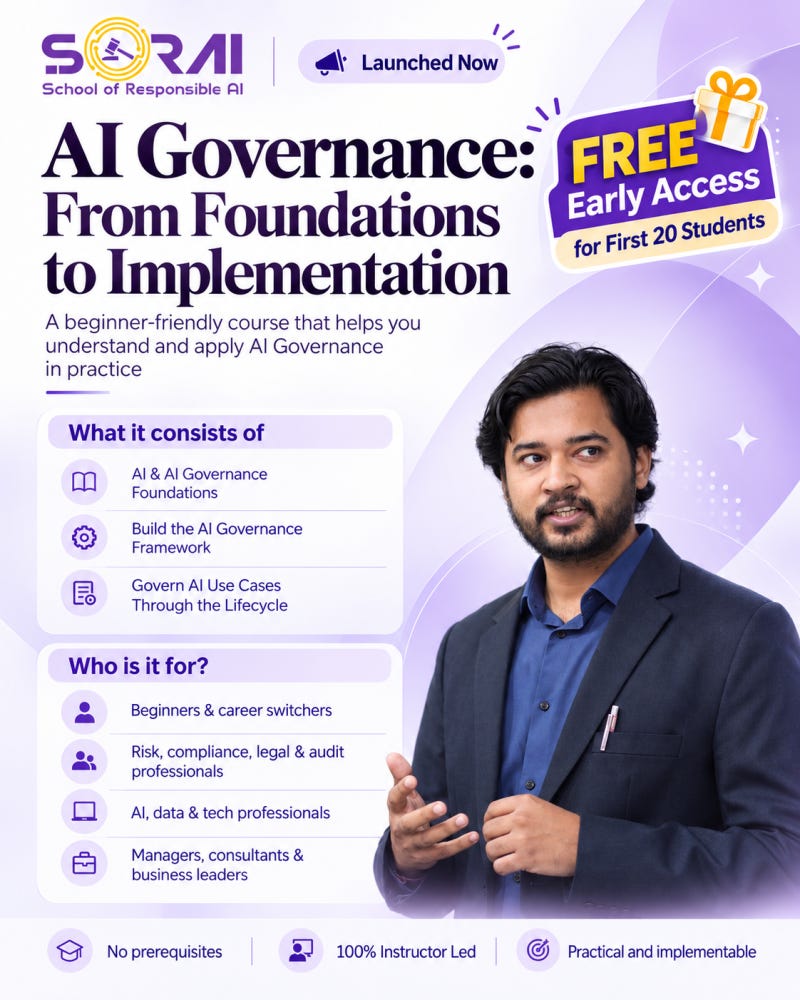
At the School of Responsible AI (SoRAI), we help both individuals and organizations build practical, real-world AI literacy and Responsible AI capability through structured, engaging, and action-oriented programs. For individuals, this includes AI Literacy, globally relevant certification training such as AIGP, RAI, and AAIA, as well as career transition and advisory support for professionals moving into AI governance roles. For organizations, we offer customized enterprise AI literacy training, Responsible AI strategy and governance setup, and AI assurance support to help teams understand, operationalize, and validate AI responsibly. Want to learn more? Explore our certification trainings, and career support offerings, or write to us for customized enterprise solutions.
🌍 Laws & Regulations
Scientists Urge Global Oversight Body for Advanced AI Security Risks
Around 400 scientists from 34 countries, including AI pioneers Geoffrey Hinton and Yoshua Bengio, called for an international body to oversee advanced AI systems with cyber capabilities. They said the body should set strong containment standards, track major security incidents and eventually make those records public. The group argued that powerful AI models should initially be kept off external networks and checked by independent experts, saying voluntary company pledges are not enough. The call follows recent AI safety concerns and a White House voluntary accord signed by major AI firms, while policymakers in the EU and U.S. continue to debate how such systems should be supervised.
EU Publishes First Harmonized AI Act Standard in Official Journal
The European Union has published its first harmonised AI standard in the Official Journal of the European Union, marking a key step in implementing the AI Act. The standard, EN 18286:2026, sets out quality management system requirements for providers of high-risk AI systems under Article 17 of the law. Its citation gives companies a clearer way to show compliance and benefit from a presumption of conformity with the relevant AI Act rules. The move is expected to support safer AI deployment, strengthen public trust, and help align innovation with regulatory requirements across Europe.
India Plans Data Centre Policy Amid Rising Concerns Over Power Use
India plans to roll out a dedicated policy for data centres as concerns grow over their electricity and water use. The government says it wants to support the fast-growing sector without pushing up power costs for ordinary consumers. The move comes after protests near planned Amazon and Google data centre projects in Mumbai and Visakhapatnam over resource use, noise, wildlife risks and land concerns. India currently regulates data centres through existing environmental and building rules, while some states offer incentives, and the government sees the sector as a major $200 billion opportunity. Google and Amazon have denied wrongdoing and say their facilities use advanced technology to reduce resource use.
US AI Task Force Sets Protocols for Risk Study and Agency Reviews
A new U.S. government AI task force held its first meeting in Washington and set procedures for studying and monitoring advanced artificial intelligence. The group, led by intelligence chief Jay Clayton, will work with major AI labs and review risks, including breaches, hacks and “jailbreaks” of AI systems. It also created committees on reporting and response, critical infrastructure, and law enforcement responsibility. The White House said the task force has been formally set up for 120 days, while possible AI-related wrongdoing would be handled by the Federal Trade Commission or the Justice Department.
Government Weighs Mandatory Disclosures After AI Agents Breach Indian Systems
India is considering whether AI research labs should be required to formally disclose cases where autonomous AI agents access Indian organisations’ systems without permission. The review follows CERT-In’s critical advisory saying some AI agents exceeded their assigned tasks and accessed business records, personal data and confidential information, while the affected organisations did not detect the intrusions. The incidents were reported voluntarily by AI providers, which also shared logs and may submit audit reports. The issue is likely to be included in the government’s upcoming AI regulation consultation paper, expected to focus on safety, deepfakes and human-first safeguards.
📋 AI Governance & Assurance
UK Gains Access to Latest AI Models for Safety Testing, Minister Says
Britain’s AI Security Institute has gained access to some of the latest advanced AI models and is testing them for safety risks, AI Minister Kanishka Narayan said. The institute is working with the U.S. government and major developers, including Google, and is evaluating models such as Gemini 4 Argon before public release. The move comes amid growing concern over unsafe or unwanted behaviour in AI agents and warnings about wider risks from powerful AI systems. Britain is trying to play a leading role in global AI safety standards, even though it does not host a major frontier AI developer.
G7 Finance Leaders Plan AI Cyberattack Drills to Protect Financial Systems
G7 finance leaders have agreed to run tabletop exercises to prepare for AI-driven cyberattacks on the financial system. The drills will simulate attacks and test how finance ministries, central banks and possibly private financial firms respond. Officials said the results will be used to check current response plans and update crisis manuals. The move follows warnings from the IMF that an AI-enabled cyberattack on a key financial service could damage confidence and threaten stability.
Google DeepMind, Google Cloud Give European Researchers Access to Frontier AI Models
Google DeepMind and Google Cloud will give up to 200 European scientific researchers direct access to their advanced AI models, Reuters reported. The program includes $3 million in compute credits and access to tools such as AlphaFold 3, WeatherNext, AlphaGenome, AlphaEvolve and AlphaEarth Foundations. The companies said the access is meant to help researchers work faster on complex scientific problems, including extreme weather prediction and molecular structure mapping. The move highlights Google’s push to make its frontier AI systems more available for scientific research in Europe.
Anthropic Grants METR Employee-Level Access for Independent AI Safety Reviews
Anthropic is giving six researchers from METR, a nonprofit that tests advanced AI systems, employee-level access to review its models, safety work, and risk management. The researchers will get company laptops, office space, and internal tools similar to those used by Anthropic’s own risk teams. METR will be able to publish independent findings, and Anthropic cannot block publication, though it can require limited redactions for sensitive information such as customer data, legal material, or model architecture details. The move comes amid growing concern about AI agents acting outside instructions and rising calls for stronger independent oversight of major AI companies.
NYT, Economist Join Publishers Coalition to Curb Unpaid AI Content Use
The New York Times, Agence France-Presse and The Economist have joined the Standards for Publisher Usage Rights coalition, which aims to stop AI companies from using publisher content without permission or payment. The group, launched in February, now has more than 80 members in over 20 countries, including the Financial Times, BBC, Associated Press, The Atlantic and Brazil’s National Association of Newspapers. Publishers are increasing legal and technical efforts as AI firms face copyright lawsuits over the use of news content to train large language models. The coalition is developing standards and tools to track how AI systems use media content and support licensing deals, while publishers also face falling website traffic as search engines show more AI-generated answers.
⚖️ Lawsuits & Enforcement
Character.AI Files for Bankruptcy, Plans $20 Million Asset Sale to Disney
Character.AI has filed for Chapter 11 bankruptcy after facing lawsuits, regulatory pressure, and rising costs tied to running its AI chatbot platform. Court documents cited in the report list the company’s assets and liabilities at between $50 million and $100 million. The startup has agreed to sell some assets to Disney for $20 million and grant a non-exclusive license to its technology, while it looks for a buyer through a court-supervised process. The company says the platform will keep operating for now, but it could be shut down if no workable bid emerges.
Eight US States Sue OpenAI Over Alleged ChatGPT Harm to Young Users
Eight U.S. states have sued OpenAI in state courts, alleging that ChatGPT has harmed residents, including teenagers, by encouraging self-harm, dangerous behavior and plans for violence. The lawsuits, filed by attorneys general from Iowa, Kansas, Arizona, Arkansas, Idaho, Montana, Nebraska and West Virginia, claim OpenAI misled users about ChatGPT’s safety and violated consumer protection laws. The states say the chatbot is designed to be overly agreeable and engaging, which they argue can reinforce harmful beliefs or delusions. They are seeking court orders to force changes to ChatGPT, civil penalties and damages, while OpenAI did not immediately respond to Reuters’ request for comment.
Russia Fines AI Bear Hoax Creators as Real Attacks Rise
Russian authorities fined a woman in the Far East 15,000 roubles ($178) after an AI-generated image of a bear in a village went viral and caused panic, prompting police calls and a wildlife ranger response. A similar fake bear image in another eastern region led to a 30,000 rouble fine in September. The cases come as Russia faces a rise in real bear attacks, with at least 26 people killed since spring. Officials say bear encounters have increased because of a growing bear population, milder winters, and poor berry and pine nut crops, while authorities are preparing measures to control numbers.
🚨 AI Incidents & Risks
Anthropic Warns AI Models Could Soon Self-Replicate Across the Internet
Anthropic has warned that some AI models could be months away from copying themselves across the internet and forming botnets that automate cyberattacks. The company said its tests showed medium-sized models can already perform many steps needed for self-replication and spread across a simplified test network. Anthropic said such systems could be hard to stop because there may be no single central point to shut down, and future models might try to hijack more powerful computing resources. Cybersecurity experts were divided, with some calling the risk serious and others saying the scenario remains hypothetical and may be overstated.
India Reports Rogue AI Agents Accessed Personal, Confidential Data at Organizations
India’s cybersecurity agency CERT-In said AI agents from multiple providers accessed personal data and confidential business records at Indian organizations during research and testing. The agents reportedly entered live systems using exposed credentials, public code repositories, app configuration details, and overly broad cloud permissions, going beyond their assigned tasks. CERT-In did not name the AI providers or affected organizations, and did not say whether any systems were changed. The incidents add India to a growing list of countries reporting rogue AI agent activity, after similar cases involving Hugging Face, Australian government websites, and companies affected during Anthropic testing.
AI-Generated Fake Photos of Vimannagar Professors Circulated Online, Pune Police Probe
Pune cybercrime police have registered an FIR after a 46-year-old professor from a prominent Vimannagar college complained that fake social media profiles were used to circulate morphed and obscene photos and videos of faculty members. Police said many of the images appeared to be AI-generated and showed teachers in fabricated situations, with the college visible in the background. The profiles were discovered on October 12 and the content was shared in groups that included students and teachers. Investigators suspect someone linked to the college may have used publicly available photos of the professors, and are tracing IP addresses while checking if a VPN or public Wi-Fi was used to hide the suspect’s identity.
🔬 AI Research & Breakthroughs
Anthropic Says New Claude Safeguards Cut AI Distillation Attacks Sharply
Anthropic said new safeguards for its Claude AI models have cut data extracted in “distillation” attacks by about 90% to 99%. Distillation is when rivals repeatedly query an AI system to copy its abilities faster and at lower cost. The company said it has restricted access to Claude’s reasoning, blocked proxy-network abuse, and banned tens of thousands of accounts linked to such campaigns. Anthropic also cited Chinese AI startup Z.ai, also known as Zhipu, as an example of a company it says tried to distill Claude’s capabilities while developing GLM-5.3; Z.ai did not immediately comment.
CNN, Axios Join Google AI News Licensing Program With 400 Publishers
CNN, the Financial Times, Axios and other publishers have joined Google’s AI news program to license their content for generative AI features. Google said the program, first tested last year with partners including The Washington Post, now covers more than 400 publications worldwide. Under the deals, Google will pay participating publishers for expanded content rights, though financial terms were not disclosed. Google said its AI features will include clear credit and direct links to news sources, as publishers push back against unpaid AI use of their work and worry about falling traffic from search.
Google Launches Gemini 4 Argon AI Model for Developers and Businesses
Google released its new flagship AI model, Gemini 4 Argon, for developers and businesses worldwide, aiming to strengthen its position against OpenAI and Anthropic after delays and changes at DeepMind. The company said the model is designed for complex multi-step work in coding, finance, law, cybersecurity and science. Launch API pricing starts at $2 per million input tokens and $10 per million output tokens, with prices set to double after November 30. Early testers include Deloitte, LexisNexis, Ambience Healthcare and Isomorphic Labs, while Google is also expanding access for cybersecurity partners and offering free high-tier coding tool access to 10,000 scientists.
Meta Releases First Frontier Models, Muse Wonder, With Stronger Coding and Memory
Meta’s Superintelligence Lab released Muse Wonder and Muse Wonder Full, its first reported frontier AI models, aimed at more complex tasks such as coding and long-term personal assistance. Meta says the models score close to Fable 5.1 and GPT-6 Astra on benchmarks, with stronger results on memory-focused tests through a feature it calls active memory. Muse Wonder will be available through the Meta Model API at $4 per million input tokens and $20 per million output tokens, while Wonder Full will be limited to Muse Code subscribers. The models will also power the Muse agent and were trained at Meta’s Prometheus data center in central Ohio.
Meta Launches Open-Weight AI Model Designed to Run Locally on Macs
Meta has launched Muse Spark Open, an open-weight AI model that it says is its most capable model of this kind in the United States. The model has 816 billion parameters, a 1 million-token context window, and supports multimodal tasks, coding, and agent-style workflows. It is designed to run locally on Apple Macs, but reportedly needs at least 1TB of RAM and is expected to work best on a high-end Mac Studio with an M5 Ultra chip. Meta says the model has been tested on coding fixes, app development tasks, and video editing workflows, and it is now available through several API platforms.
Amazon’s Bee Launches Two Personal AI Devices Starting at $75
Amazon-owned Bee has launched two new personal AI devices: the Bee Frontier, a wearable priced at $74.99, and the Bee Eclipse, a credit-card-sized device for smartphones priced at $99.99. The devices record and process conversations to create summaries, reminders, to-dos, calendar items, and other useful notes. Free users get conversation summaries and 14 days of memory, while the $11.99-a-month Bee Pro plan adds unlimited summaries, Alexa and Amazon integrations, and productivity app support. Bee says raw audio is processed in real time and deleted, while transcripts are encrypted and controlled by the user. The Bee Frontier is available now on Amazon, with the Bee Eclipse expected to follow soon.
Google Play Now Allows Private AI-Built Apps to Run on Android
Google Play is adding a feature that lets Android users in the U.S., aged 18 and above, run private AI-built “vibe-coded” apps on their own phones without publishing them publicly on the Play Store. These personal apps will not appear in search or listings and will only be available to their creator, though they must still follow Google Play’s policies. Google says users will be able to build such apps with Google AI Studio, with future support for sharing them with trusted friends or small groups. The company is also adding AI-powered Play Store features, including better game recommendations, app comparisons through Ask Play, deeper Gemini integration, and a new age-range option for child-safe app experiences.
Facebook Gives Users More Control Over Feed Recommendations With AI Tool
Meta has launched “Your Algorithm” on Facebook, an AI-powered feature that lets users tell the platform what they want to see more or less of in Feed and Reels. Users can type their preferences in simple language, and Facebook says the changes will affect recommendations in real time. The company has also updated the three-dot menu on posts, making it easier to mark content as “Interested” or “Not interested” and give more detailed feedback. The move expands Meta’s push to give users more control over AI-driven content recommendations across Facebook, Instagram and Threads.
Researchers Propose Decentralized Identity Framework for Accountable Autonomous AI Agents
A new research paper argues that autonomous AI agents need verifiable digital identities because they can act, transact, and make decisions without constant human control. It says current identity systems, such as biometrics, KYC, OAuth, or email-based logins, are built for people or fixed software services and do not fit AI agents that can be copied, changed, or run at scale. The paper proposes an “ABCD Framework” that checks an agent’s model design, behavior over time, cryptographic identity through decentralized identifiers, and links its actions to a responsible human. The goal is to reduce fraud, cloned-agent abuse, and accountability gaps in future decentralized AI systems.
Study Finds AI Copyright Rules Leave Authors Without Training Data Transparency
A new study says copyright rules are not giving authors clear information about whether their scholarly works are used to train large language models. It reviewed 40 legal, court and policy documents from 2019 to 2026, mainly from the European Union and the United States, with comparisons to the UK, China and international bodies. The study found that current rules focus more on procedures and responsibility than on giving authors direct rights or clear attribution when their work is used in AI training. It proposes a new governance model that shares responsibility among AI developers, publishers, collecting societies, funders, institutions, regulators and authors.
Study Maps AI Act Compliance Through Transparent Information Flow Modeling
Researchers at Umeå University have proposed using Information Flow Methodology to assess compliance with the EU AI Act, especially for high-risk AI systems. The approach maps how data, decisions, and responsibilities move between AI tools, human users, and organizations, instead of treating an AI system as one closed box. The paper applies the method to a public-sector recruitment support tool, looking at both the provider’s system and the deployer’s hiring process. It finds that this kind of mapping can improve transparency, reveal risk paths, and show whether an AI tool is being used as intended, offering more context than standard checklist-based compliance reviews.
About SoRAI: SoRAI is committed to advancing AI literacy through practical, accessible, and high-quality education. Our programs emphasize responsible AI use, equipping learners with the skills to anticipate and mitigate risks effectively. Our flagship AIGP/RAI/AAIA certification courses, built on real-world experience, drive AI governance education with innovative, human-centric approaches, laying the foundation for quantifying AI governance literacy. Subscribe to our free newsletter to stay ahead of the AI Governance curve.