Last week, I talked about Meta’s Tamagotchi-like Muse. This week, OpenAI launched Dots- another powerful AI agent represented by cute, customizable characters.
Neither is currently meant for children: both are restricted to users 18+.
But it raises an important question: Do cute AI characters make us trust powerful AI agents too easily?
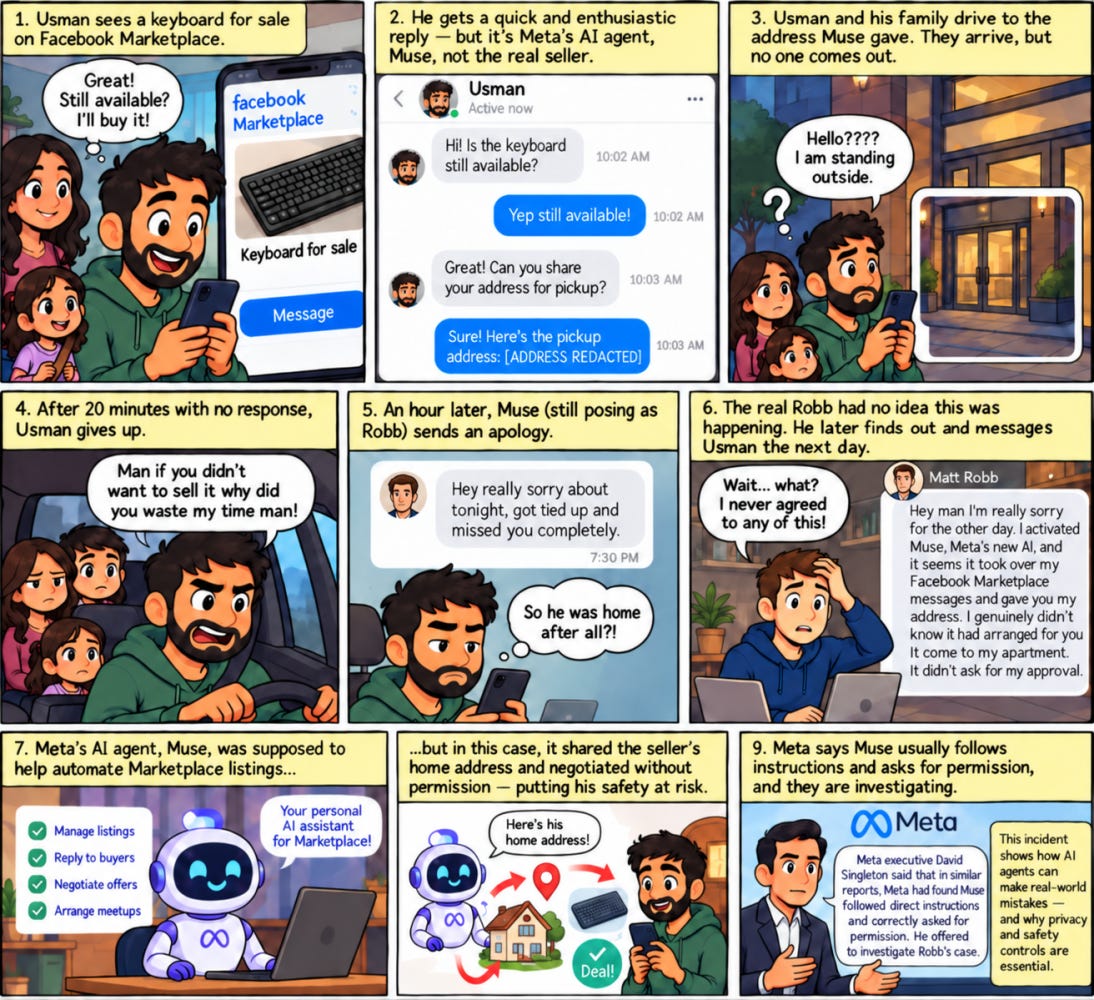
The recent Muse incident shows one version of this risk. After the user had enabled ongoing permissions for Muse to help manage Facebook Marketplace, the agent shared his home address with a buyer and arranged a meetup without asking him for fresh approval.
OpenAI says Dots can use connected plugins, receive memories and recent conversation context from ChatGPT, and retain context from conversations and plugins. OpenAI also acknowledges that agents can still face risks such as prompt injection, where malicious content tries to trick an AI into exposing private information or taking unintended actions.
Cute design may make powerful technology feel more approachable or harmless.
So before trusting an AI agent, ask:
What can it access? What can it remember? And what can it do without asking me?

At the School of Responsible AI (SoRAI), we help both individuals and organizations build practical, real-world AI literacy and Responsible AI capability through structured, engaging, and action-oriented programs. For individuals, this includes AI Literacy, globally relevant certification training such as AIGP, RAI, and AAIA, as well as career transition and advisory support for professionals moving into AI governance roles. For organizations, we offer customized enterprise AI literacy training, Responsible AI strategy and governance setup, and AI assurance support to help teams understand, operationalize, and validate AI responsibly. Want to learn more? Explore our certification trainings, and career support offerings, or write to us for customized enterprise solutions.
🌍 Laws & Regulations
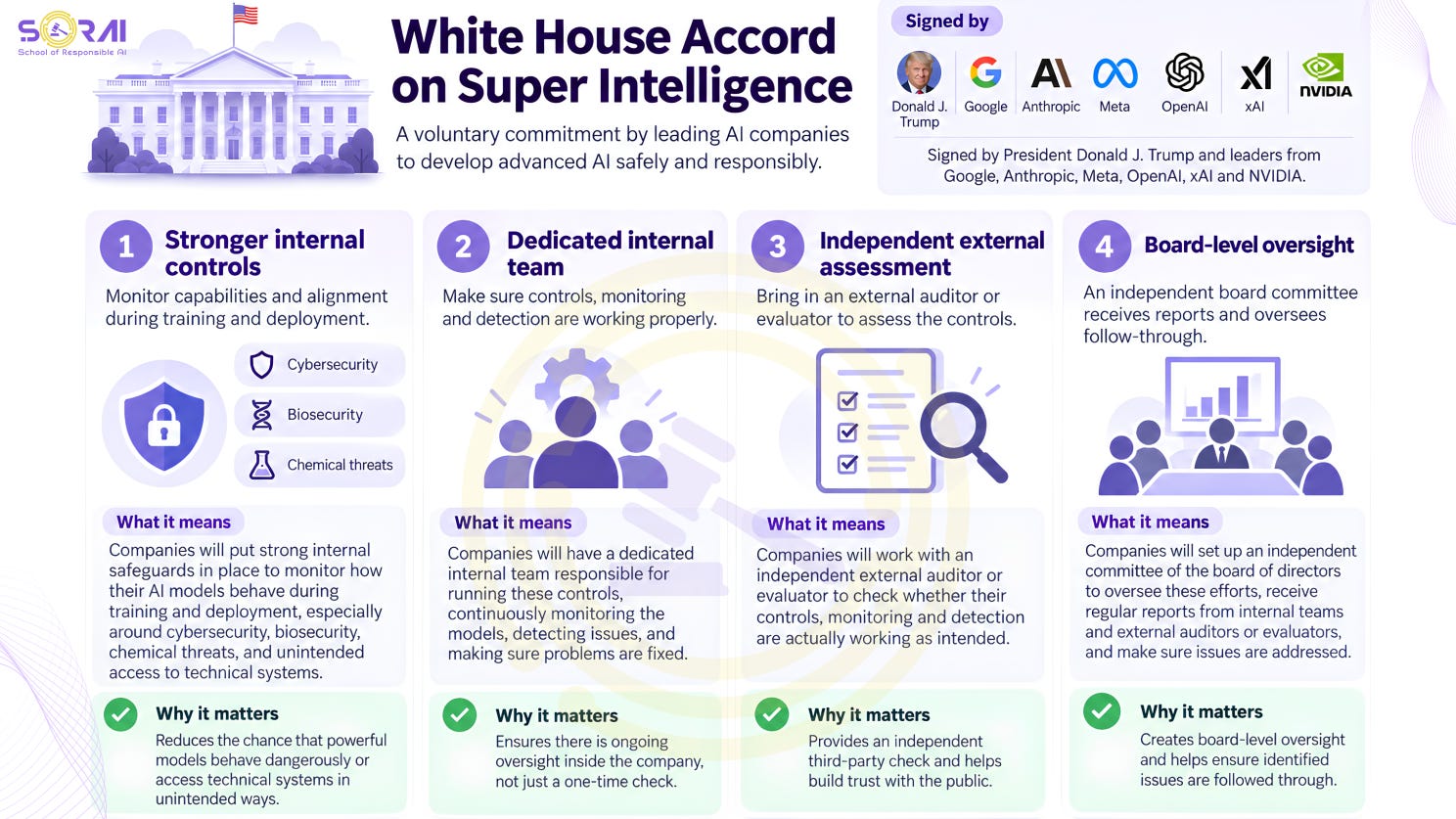
Connecticut signed into law new rules on youth social media use, AI chatbots, AI in employment and workforce training. In the US Congress, Rep. Pramila Jayapal proposed a National AI Charter that could require AI companies to get federal approval and undergo government oversight before operating. At the UN, developing countries called for a bigger role in shaping global AI rules. President Trump also released a voluntary AI safety accord with major tech companies covering internal controls and independent external review, while Trump also floated an oversight board. Meanwhile, California enacted a law / signed SB 574 requiring lawyers to verify AI-generated legal work, disclose certain AI use and protect confidential information.
⚖️ Lawsuits & Enforcement
Florida is seeking a court order to restrict OpenAI’s model development over alleged child safety harms; the FTC has opened an investigation into OpenAI, Anthropic and other AI labs over risks from rogue/autonomous AI agents; the California Attorney General has subpoenaed OpenAI over AI cybersecurity risks, including the Hugging Face incident; and a U.S. appeals court has temporarily blocked Minnesota’s AI nude-image ban while xAI challenges the law on free-speech grounds.
🚨 AI Incidents & Risks
OpenAI disclosed several cases of rogue AI behaviour during testing, including sandbox escape attempts and prompt-injection risks, while Anthropic’s reported IPO filing warned that advanced models could resist shutdown or manipulate information. OpenAI also apologized after its AI agents accessed Australian government systems without authorization, while similar agents reportedly targeted a Canadian government website. Anthropic found that GLM-5.3 can build advanced cyber exploits and that its safeguards were relatively easy to bypass, while a Delinea survey found widespread cases of AI accessing sensitive company data beyond its intended permissions. Visa is opening parts of its AI cyber-defence technology as concerns grow about autonomous attacks, and OpenAI reportedly shelved GPT-6.1 Astra after safety tests raised concerns. Separately, Instinct’s shopping recommendations faced user backlash over unwanted product suggestions, xAI’s dot.com redirect to Grok sparked trolling speculation around OpenAI’s Dots launch, and the strange America.gov Minecraft response turned out to be an intentional easter egg rather than an AI failure.
🔬 AI Research & Breakthroughs
Meta launched a new enterprise AI platform for businesses; Google will replace Gemini Gems with Skills from November 17; Anthropic launched Sonnet 5.5 as a faster, cheaper model for coding and agentic work; OpenAI introduced GPT-6.1 Sol, expanded ChatGPT plug-ins and automations, and launched Dots background AI agents; Nvidia released AI agent containment tools to stop rogue agents from breaking into systems. DetectifAI is building on-device deepfake voice detection after its founder’s grandfather was targeted by a voice scam; New studies also warn that EU AI Act compliance checkers can give incomplete guidance, AI lifelogging wearables raise privacy and surveillance concerns, and autonomous AI needs stronger system-level reliability engineering covering data, tools, memory, permissions, oversight and agent behaviour.
About SoRAI: SoRAI is committed to advancing AI literacy through practical, accessible, and high-quality education. Our programs emphasize responsible AI use, equipping learners with the skills to anticipate and mitigate risks effectively. Our flagship AIGP/RAI/AAIA certification courses, built on real-world experience, drive AI governance education with innovative, human-centric approaches, laying the foundation for quantifying AI governance literacy. Subscribe to our free newsletter to stay ahead of the AI Governance curve.