Today’s highlights:
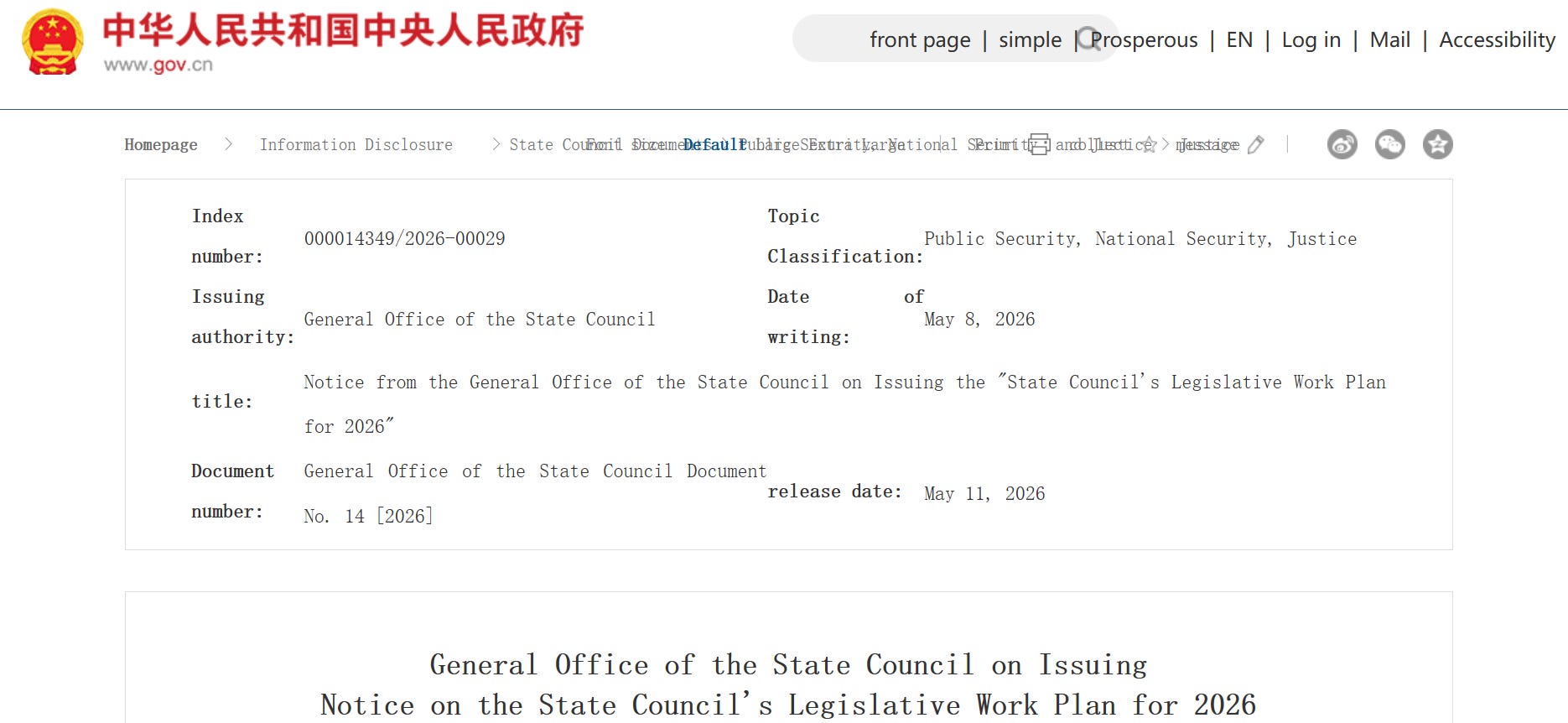
China’s State Council 2026 legislative work plan calls for accelerating comprehensive legislation for the healthy development of AI, marking a move toward a more unified governance framework after years of sector-specific rules on algorithms, deep synthesis, and generative AI. The plan points to future legislation covering core AI-related elements such as data, algorithms, computing power, property rights, cybersecurity, supply-chain security, and key application scenarios. The move fits China’s broader treatment of AI as a strategic technology linked to economic growth, technological self-reliance, national security, and global competitiveness. It also comes against the backdrop of intensifying U.S.-China AI competition, with both countries advancing different regulatory and industrial-policy approaches to AI governance.
At the School of Responsible AI (SoRAI), we help both individuals and organizations build practical, real-world AI literacy and Responsible AI capability through structured, engaging, and action-oriented programs. For individuals, this includes AI Literacy, globally relevant certification training such as AIGP, RAI, and AAIA, as well as career transition and advisory support for professionals moving into AI governance roles. For organizations, we offer customized enterprise AI literacy training, Responsible AI strategy and governance setup, and AI assurance support to help teams understand, operationalize, and validate AI responsibly. At the core of SoRAI is a progressive three-layer approach: first helping people understand AI, then build the right governance foundations, and finally validate readiness through assurance and audit-focused thinking. Want to learn more? Explore our AI Literacy programs, certification trainings, and career support offerings, or write to us for customized enterprise solutions.

⚖️ AI Ethics
European Union Ratifies Council of Europe AI Convention, Strengthening Human Rights and AI Governance Rules
On 18 May 2026, the European Union ratified the Council of Europe’s Framework Convention on Artificial Intelligence and Human Rights, Democracy and the Rule of Law during the Committee of Ministers session in Chișinău, Moldova. The treaty is regarded as the first legally binding international agreement focused specifically on AI governance and its impact on human rights, democracy, and the rule of law. By joining as a party, the EU adds political and legal weight to the convention alongside its member states. The framework sets out principles such as transparency, accountability, oversight, non-discrimination, and protections against harmful uses of AI across the technology’s lifecycle, while also reinforcing links with the EU AI Act.
California Signs First-in-the-Nation Executive Order to Prepare Workers and Businesses for AI Disruption
California has issued a first-of-its-kind executive order aimed at preparing workers and businesses for possible disruption from artificial intelligence, as the state deepens its broader AI policy framework. The order directs agencies to track AI’s effect on jobs through new reports, a sector-wide dashboard, business feedback in monthly jobs data, and possible updates to the state’s WARN law within 180 days. It also calls for steps to support workers and small businesses, including job training, higher education preparation, worker ownership models, stronger safety-net access, and a single online portal for government services. The move builds on California’s earlier AI actions on transparency, privacy, civil rights, child safety, deepfakes, digital likeness protections, and robocall scams, while a statewide public engagement effort is being used to gather residents’ input on AI policy.
Trump Delays AI Security Executive Order Over Language Seen as Potential Blocker to Innovation
President Donald Trump has delayed signing a planned executive order that would let the U.S. government assess advanced AI models for security risks before they are released. He said parts of the draft language could have held back American leadership in AI, especially in competition with China. Reports also said the signing was postponed because several tech executives could not reach Washington on short notice. The proposed order would have directed federal agencies to create a review process for powerful models, amid concerns about systems such as Anthropic’s Mythos and OpenAI’s GPT-5.5 Cyber, which can identify and exploit software vulnerabilities.
ArXiv to Impose One-Year Bans on Authors Who Submit Unchecked AI-Generated Research Papers
ArXiv, the major preprint repository used widely in computer science and math, is tightening its rules on careless use of AI in research papers. The platform said authors can face a one-year ban if a submission shows clear evidence that they let a large language model generate content without properly checking it, such as fake references or leftover AI prompts in the text. After the ban, future submissions from those authors must first be accepted by a reputable peer-reviewed venue. The move does not ban AI tools outright, but makes clear that authors remain fully responsible for any errors, plagiarism, bias, or misleading claims produced with AI.
AI Mentions Trigger Boos at 2026 Commencement Speeches as Graduates Voice Job Fears
This year’s commencement season showed that praise for artificial intelligence can quickly turn into a flashpoint, with graduating students at the University of Central Florida and the University of Arizona loudly booing speakers who framed AI as an opportunity or “the next industrial revolution.” At Arizona, the reaction was intensified by protests tied to allegations against the speaker, but students also jeered direct remarks about helping shape AI. The backlash reflects a wider unease among young people facing a weak job market, rising economic anxiety, and fears that AI could worsen career prospects rather than expand them. Not every ceremony saw the same response, but the incidents suggest that for many graduates, AI has become a symbol of an uncertain and increasingly fragile future.
xAI Plans $2.8 Billion More Gas Turbine Purchases Amid Memphis Data Center Lawsuit
xAI is facing a lawsuit over its use of gas turbines at its Memphis-area data center, even as it plans to spend $2.8 billion on more turbines over the next three years, including $2 billion for mobile gas turbines, according to a recent filing. The NAACP sued the company last month, alleging it operated dozens of unregulated turbines in a heavily polluted area; while xAI has permits for 15 turbines, reports said it was using 46 as of a few weeks ago. Federal regulators have said the turbines are subject to air-pollution rules, despite xAI’s argument that their “mobile” status lets them run for up to a year without permits. The filing also said xAI depends heavily on natural gas and gas-turbine power, and warned that injunctions or permit losses could hurt its AI business.
Standard Chartered CEO Apologises After AI Comments Spark Concern Over Jobs and Regulatory Scrutiny
Standard Chartered CEO Bill Winters has apologized for the upset caused by his recent comments on artificial intelligence and jobs, after suggesting the technology could replace some workers. The bank said it is investing in AI to improve operations, a shift that has raised concerns about possible job cuts. Winters later clarified that his remarks were not meant to signal a lack of commitment to employees. The issue has also drawn regulatory attention, with authorities in Hong Kong and Singapore seeking more details from the bank.
Social Media Post Flags Three Dangerous Signs of AI Dependence and Eroding Independent Thinking
A social media post has highlighted three warning signs of unhealthy dependence on artificial intelligence, arguing that overuse may weaken independent thinking and confidence. The post said the first sign is using AI to do the thinking itself, such as drafting ideas, emails, presentations, or websites, instead of using it as a support tool. The second sign is replacing real learning and research with instant AI-generated answers, which can lead to shallow understanding and reduced curiosity. The third and biggest sign is feeling unable to handle even basic tasks without AI help, such as proofreading or writing simple messages. The post clarified that AI is not the problem on its own, but blind reliance on it can gradually affect creativity, critical thinking, and self-reliance.
Commonwealth Short Story Prize 2026 Faces Backlash as AI Detectors Flag Winning Entries
The 2026 Commonwealth Short Story Prize has drawn backlash after online users ran winning entries through AI-detection tools and claimed they were machine-written, sparking a wider debate over literary authenticity. The Commonwealth Foundation said it did not use AI detectors during judging, citing concerns about the reliability of such tools and the risks of uploading unpublished work, and added that shortlisted writers had twice confirmed their stories were original and not AI-generated. The dispute widened as more prize-winning stories came under similar scrutiny, while judges, writers and academics remained divided over whether AI-written fiction can be identified with confidence. The controversy has highlighted the limits of current AI-detection software and raised broader concerns about trust, originality and false accusations in writing competitions.
Health Minister Says AI in Healthcare Requires Ethical Oversight Regulation and Equity Commitment
At the 79th World Health Assembly in Geneva, Union Health Minister J P Nadda said artificial intelligence can significantly improve healthcare delivery, but only if it is guided by regulation, ethical oversight, research and equity. He said India’s digital health push, built on Digital India, the 2017 National Health Policy and the Ayushman Bharat Digital Mission, has created the foundation for responsible AI use in healthcare. He also highlighted the Strategy for AI in Healthcare for India (SAHI), unveiled in February 2026, and BODH, a platform designed to test health AI systems on real-world data for safety and fairness. Nadda said AI could help close healthcare gaps, but warned it could also widen inequalities if not designed responsibly, urging global cooperation on trusted data systems, research and ethical development.
Raghav Chadha Moves Delhi High Court Seeking Curbs on AI-Generated Deepfakes and Fake Speeches
Rajya Sabha MP Raghav Chadha has moved the Delhi High Court seeking protection of his personality rights against the misuse of artificial intelligence and digitally altered content. The petition asks the court to restrain the creation and circulation of AI-generated deepfakes, including fake speeches and manipulated videos attributed to him. The case highlights growing concerns over how generative AI can be used to spread misleading political content and damage reputations. The Delhi High Court is expected to hear the matter soon.
Apple’s Revamped Siri Reportedly to Add Auto-Deleting Chats and Context Retention Controls
Apple’s revamped Siri app is reportedly set to include auto-deleting chat options, letting users choose to keep chat history for 30 days, one year, or forever. The update may also let users decide whether Siri should continue from a previous conversation or start a fresh chat each time. The feature reflects Apple’s privacy-first approach, even though limiting stored chat data could reduce how much the AI can personalize responses compared with rival chatbots. The report says Apple relies more on synthetic data than real user conversations for AI training, and the new Siri is expected to debut at WWDC 2026 on June 8.
OpenAI Expands AI Content Provenance With C2PA Conformance, SynthID Watermarking, and Image Verification Tool
OpenAI has expanded its content provenance efforts to make AI-generated media easier to identify and verify across platforms. The company said it is now a C2PA Conforming Generator Product, which means its images can carry standardized metadata, or Content Credentials, that help platforms preserve information about where content came from and how it was made. It is also adding Google DeepMind’s SynthID invisible watermarking to images created through ChatGPT, Codex, and the OpenAI API, giving the system a second layer of provenance that can survive some edits and screenshots. In addition, OpenAI is previewing a public verification tool that checks uploaded images for both C2PA metadata and SynthID signals, though it cautioned that no detection method is fully reliable if those signals have been removed.
🚀 AI Breakthroughs
Innovations from Google I/O 2026- Highlights Gemini 3.5, Antigravity 2.0, Android and Web Tools
Google announced focus on autonomous AI agents, headlined by the Gemini 3.5 model series and expanded capabilities for its Antigravity agent-development platform. The company said Antigravity 2.0, a new CLI, and managed agents in the Gemini API are aimed at helping developers build, orchestrate, and deploy agents with less infrastructure work, while AI Studio gained tighter support for Android, Cloud Run, Firebase, and Google Workspace. On Android, Google highlighted a stable Android CLI, open-source Android skills, an updated Android Bench leaderboard, and a preview feature in Android Studio that can migrate apps from React Native, web frameworks, or iOS into native Kotlin Android apps. For web developers, Google detailed WebMCP, Modern Web Guidance, Chrome DevTools for agents, and the HTML-in-Canvas API, all designed to help AI agents build, test, and optimize modern web experiences.
Google Details Next Phase of AI Search as AI Mode Passes One Billion Users
Google said at its I/O event that it is pushing Search further into AI, aiming to handle everything from simple fact-finding to more complex and highly specific questions. The company said AI Mode has crossed 1 billion monthly users just one year after launch, with query volume more than doubling every quarter. It also reported that overall Search usage hit a record high last quarter as more people used AI-powered features. The update reflects Google’s broader effort to combine its traditional search engine with generative AI tools.
Amazon Rolls Out Alexa+ Feature That Generates On-Demand Podcast Episodes for U.S. Users
Amazon has started rolling out “Alexa Podcasts” in the U.S., a new Alexa+ feature that creates AI-generated podcast episodes on demand from a user’s prompt. The tool researches a topic, drafts an episode outline, lets users adjust the length, tone, and focus, and then produces a narrated podcast using synthetic host voices. Finished episodes are delivered through Echo Show devices and the Alexa app, where they can also be replayed later. The move expands Alexa+ beyond a voice assistant into a personalized content tool, while also raising familiar questions about the accuracy, ethics, and impact of AI-generated media. Amazon said it is relying in part on partnerships with major news outlets and hundreds of local newspapers to improve reliability, and is also testing other personalized audio formats such as custom news briefings.
OpenAI Co-Founder Andrej Karpathy Joins Anthropic Pre-Training Team to Advance Claude Research
Anthropic has hired OpenAI co-founder and former Tesla AI leader Andrej Karpathy to join its pre-training team, where he started this week under team lead Nick Joseph. The company said he will help build a team focused on using Claude to speed up pre-training research, a compute-heavy stage that shapes a model’s core knowledge and capabilities. Karpathy said he is excited to return to research, while adding that he still plans to resume his education-focused work later. In a separate hire, Anthropic also added cybersecurity veteran Chris Rohlf to its frontier red team, which tests advanced AI systems against serious threats.
OpenAI Says New Reasoning Model Produced Original Proof Disproving 80-Year-Old Geometry Conjecture
OpenAI says one of its new reasoning models has produced an original proof that disproves a long-standing geometry conjecture first posed in 1946, a claim the company says marks the first time AI has autonomously solved a major open problem in mathematics. The claim carries extra weight because a similar OpenAI statement months ago about unsolved Erdős problems was later shown to refer to solutions already known in existing research. This time, the company released supporting remarks from independent mathematicians, including experts who had previously criticized the earlier claim. OpenAI says the result was generated by a general-purpose reasoning model rather than a tool built only for math, and argues it shows AI is improving at sustained, complex reasoning with possible relevance for science and engineering.
OpenAI Adds C2PA Metadata and SynthID Watermarks to Help Verify AI-Generated Images
OpenAI said it is adding two safeguards to help people check whether an image was made by its AI tools: C2PA metadata tags and Google’s invisible SynthID watermark. The company said the two methods are designed to work together, with metadata offering clear provenance details and watermarking being harder to remove through edits, screenshots, or resizing. OpenAI is also previewing a public verification tool that can check for both signals, though it will initially work only on images created by OpenAI products. The move does not affect images from other AI generators, but it is meant to make OpenAI-made content easier to identify as synthetic.
OpenAI Opens Singapore Applied AI Lab as IMDA Updates Agentic AI Governance Framework
OpenAI is opening its first Applied AI Lab outside the US in Singapore under a partnership with the Ministry of Digital Development and Information, part of a wider “OpenAI for Singapore” effort backed by more than S$300 million. The lab is expected to create over 200 technical jobs, make Singapore a hub for forward-deployed engineers, and focus on AI use in public services, finance, and digital infrastructure, alongside education, workforce training, and startup support. At the same time, Singapore’s Infocomm Media Development Authority has updated its agentic AI governance framework after input from more than 60 organisations, adding guidance on multi-agent systems, third-party agents, automation bias, and human accountability. The revised framework also includes more than ten case studies from companies and public agencies showing how controls such as tiered risk levels, permission settings, human approval, and logging can help manage the risks of AI agents.
OpenAI Expands ChatGPT for PowerPoint Beta With Slide Creation and Editing Tools Worldwide
OpenAI has rolled out ChatGPT for PowerPoint in beta, letting users create new slides, edit existing decks, turn notes and documents into presentations, and polish content directly inside Microsoft PowerPoint. The tool is available globally for ChatGPT Business, Enterprise, Edu, Teachers, K-12, and consumer tiers including Free, Go, Pro, and Plus. According to the company, the add-in can read deck structure, help keep slides editable, summarize presentations, identify weak narrative points, and turn screenshots or tables into editable slides and charts. OpenAI also said data shared with ChatGPT is not used to train its models by default for Business, Enterprise, Edu, and Teachers users, while workspace administrators can manage access through plan and admin settings.
Spotify Launches ElevenLabs-Powered Audiobook Creation Tool for Authors, Expands Audiobook Features and Language Support
Spotify has added an ElevenLabs-powered AI audiobook creation tool to Spotify for Authors, with an invite-only beta set for June and English-language support at launch. The tool lets self-publishing authors create AI-narrated audiobooks without exclusivity, building on Spotify’s earlier audiobook partnerships with ElevenLabs and Google Play Books. The company is also expanding Spotify for Authors to 10 more languages, broadening Audiobook+ plans, and adding new audiobook discovery features such as natural-language search and prompt-based recommendations. Spotify said it now offers 700,000 audiobook titles, has surpassed 1 million Audiobook+ subscriptions, is nearing $100 million in annualized recurring revenue, and has increased audiobook listening hours by 60% year over year.
Spotify and Universal Music Agree on Paid AI Covers and Remixes With Artist Revenue Sharing
Spotify has struck a licensing deal with Universal Music Group to let fans create AI-generated covers and remixes of songs from participating artists, with the feature set to launch as a paid add-on for Premium subscribers. The companies said the tool will be built around artist consent, credit, and compensation, with revenue shared with rights holders whose music is used. Spotify did not disclose pricing or a release date, and it remains unclear which UMG artists will opt in. The move comes as AI music rivals such as Suno and Udio continue to face copyright disputes with major labels, highlighting Spotify’s effort to secure label-backed rights before rolling out generative AI music tools.
Figma Adds AI Assistant to Collaborative Canvas for Design Generation, Editing, and Task Automation
Figma has added a new AI assistant to its collaborative canvas, letting users use natural language prompts to create designs, edit existing work, and automate tasks such as generating multiple design variations. The company said the agent is built on design-tuned AI models that understand design context and can run multiple tasks at the same time. The feature is launching first in Figma Design, with plans to expand it across other products as Figma works to bring design and code closer together. The move follows Figma’s recent partnerships with Anthropic and OpenAI and comes as it faces growing competition from Canva, Adobe, Flora, Krea, and Dessn.
Stability AI Releases Stable Audio 3.0 Models Capable of Generating Songs Longer Than Six Minutes
Stability AI has released Stability Audio 3.0, a new family of audio models led by a top version that the company says can generate professional-grade songs longer than six minutes. The lineup includes four models, with the small versions designed for on-device sound and music generation of up to two minutes, while the medium and large models can create 6-minute, 20-second compositions with stronger musical structure, more than double the length of Stable Audio 2.0. The company is offering open weights for the small SFX, small, and medium models, while the largest model will be limited to API and paid self-hosting access, with enterprise licensing required for larger companies. The release comes as competition in AI music grows and legal scrutiny over training data intensifies, with Stability AI saying the new models were trained on fully licensed data following deals with Warner Music Group and Universal Music Group.
🎓AI Academia
NVIDIA SANA-WM Delivers Minute-Scale 720p World Modeling With Efficient Hybrid Linear Diffusion Transformer
NVIDIA researchers have published SANA-WM, a 2.6 billion-parameter open-source world model designed to generate one-minute, 720p videos from a single image, text prompt, and 6-DoF camera trajectory. The paper says the model matches the visual quality of larger industrial systems such as LingBot-World and HY-WorldPlay while improving efficiency through hybrid linear attention, dual-branch camera control, a two-stage generation pipeline, and a pose-annotation system built from public videos. According to the report, SANA-WM was trained on about 213,000 public video clips in 15 days using 64 H100 GPUs, and can generate a 60-second clip on a single GPU. A distilled version can reportedly run on a single RTX 5090 with NVFP4 quantization and denoise a 60-second 720p clip in 34 seconds, while the model also posted stronger action-following accuracy than earlier open-source baselines on the team’s one-minute benchmark.
Study Examines Governance-by-Design Strategies for Scaling Agentic AI and Organizational Autonomy Safely
A new arXiv paper examines how companies can govern agentic AI systems as they move from pilots to real enterprise use. Based on a 2025 case study at a large IT services firm, the research finds that effective oversight depends on system design choices such as what actions AI agents can take, which tools and data they can access, how memory is managed, and how updates are rolled out over time. The paper argues that organizations are trying to balance scalable autonomy with accountability, safety, cost control, and responsibility as these systems begin acting with limited supervision. It concludes with seven practical lessons on building governance directly into the architecture and day-to-day operation of agentic AI so it can support organizational learning while scaling more safely.
Study Frames Generative AI Advertising as a Trustworthy Commercial Intervention and User Autonomy Challenge
A new University of Michigan preprint argues that generative AI is changing advertising from clearly labeled ad placements into harder-to-detect commercial influence embedded inside AI responses. The paper says current systems from companies such as Google, Microsoft, and OpenAI mostly keep ads separated from AI-generated answers, but research shows users often fail to notice ads when they are blended into chatbot output. It lays out a four-part taxonomy of influence, ranging from simple product mentions to information framing, behavioral steering, and long-term preference shaping, including in retrieval-based and agent-style AI systems. The authors argue that the biggest risk is not visible sponsored content, but subtle interventions that are difficult to detect, measure, disclose, or challenge and could affect user autonomy.
Study Maps AI’s Expanding Role in Automated Research While Warning of Reliability Limits
A new arXiv paper maps how AI is being used across the full research workflow, from idea generation and literature review to writing, peer review, and promotion. The study says automated systems can now produce research papers for as little as $15 and handle long, multi-step tasks with limited human input, but it argues that reliability still breaks down in areas that require novelty, scientific judgment, and research-grade experiments. According to the paper, AI performs best on structured, retrieval-based, and tool-supported work, while fully autonomous systems still fall short of the standard needed for consistent acceptance at major academic venues. The authors conclude that human-led collaboration remains the most credible model, and the paper also includes a taxonomy, benchmark suite, tool inventory, and a practical guide hosted on its project page and GitHub repository.
Study Examines When Vertical AI Firms Should Go Headless Amid Rising Agentic AI Pressure
A new academic paper argues that vertical AI companies in fields like law, healthcare, and accounting should not blindly “go headless” by handing workflows and user interfaces over to general AI agents. The paper says some firms can safely turn their expertise into callable services, but others risk losing pricing power and strategic control if they move key functions outside the company. It finds that long-term value will likely stay with firms that keep accountability-heavy assets such as regulated workflows, professional signoff, audit trails, and trusted systems of record. The authors also introduce “rule debt,” describing the future governance and compliance burden customers take on when business rules shift from managed software into prompts and agent instructions.
Large-Scale Reddit Study Examines How ChatGPT Shapes Teacher and Student Education Debates
A new large-scale study of Reddit discussions suggests generative AI in education has been shaped less by collaboration than by conflict over cheating, detection, and enforcement. Analyzing about 270,000 AI-related posts and comments across 26 education subreddits from November 2022 to April 2026, the paper finds discussion moved from an early “detection versus evasion” phase into a longer enforcement-heavy period, with more constructive classroom use only starting to gain traction in mid-2024. The study says K-12 teachers were most concerned about student dependency, academics focused on AI detection and policy, and professional-program students were more likely to discuss job and career anxiety. It also finds negative, adversarial topics drew the most engagement, and that the relatively rare threads where teachers and students interacted most often centered on academic integrity disputes, making those conflicts the main point of sustained cross-role contact.
About SoRAI: SoRAI is committed to advancing AI literacy through practical, accessible, and high-quality education. Our programs emphasize responsible AI use, equipping learners with the skills to anticipate and mitigate risks effectively. Our flagship AIGP certification courses, built on real-world experience, drive AI governance education with innovative, human-centric approaches, laying the foundation for quantifying AI governance literacy. Subscribe to our free newsletter to stay ahead of the AI Governance curve.