This week’s highlights:
Two weeks after the U.S. government blocked Anthropic’s Fable and Mythos models, OpenAI’s upcoming model GPT-5.6 now appears to be facing a similar situation.
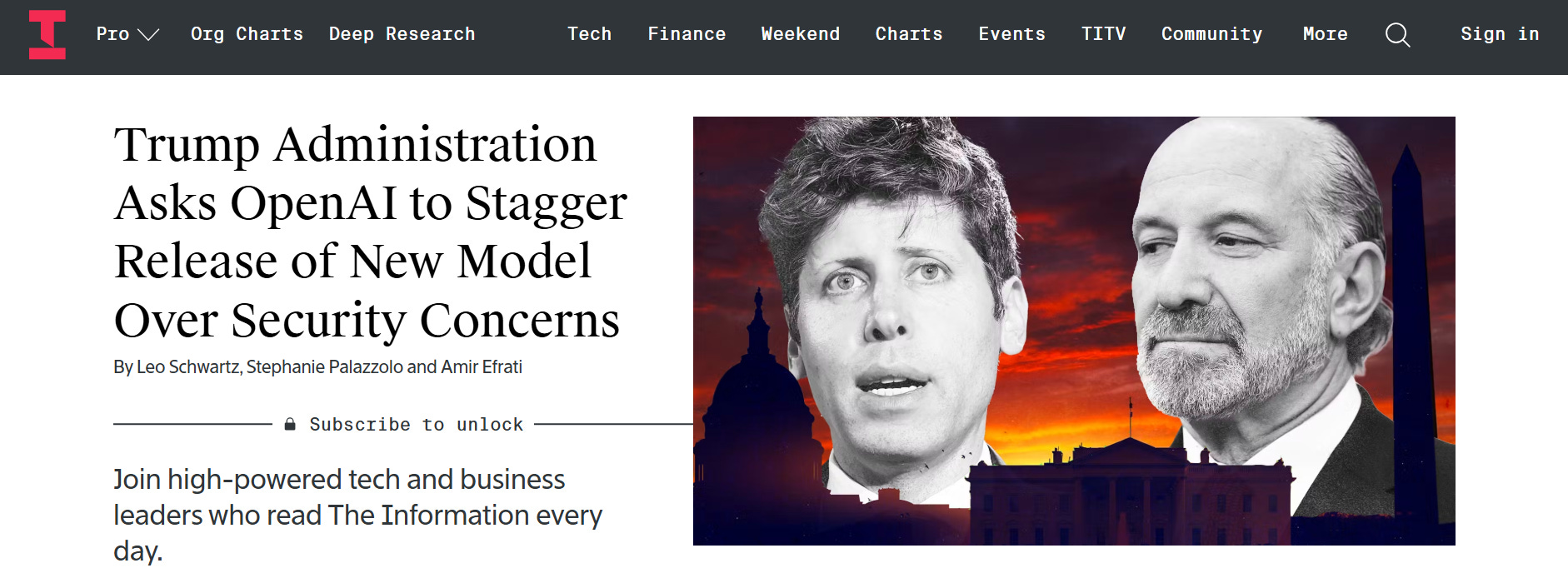
OpenAI is reportedly limiting the first release of its new GPT-5.6 model to a small group of close partners after the White House raised safety concerns. Reports say the U.S. government wants to review access customer by customer during an early preview, with a wider public release possible a few weeks later if things go smoothly. The lineup includes Sol, its most powerful model, Terra for everyday use, and Luna as a faster, lower-cost option, with broader access expected in the coming weeks through ChatGPT, Codex, and the API.
The move suggests the Trump administration is taking a more active role in AI oversight, despite earlier describing its approach as hands-off. The main concern is that powerful AI models can help find software flaws, write malware, and speed up cyberattacks, which has already led other AI companies to keep some advanced models restricted.
At the School of Responsible AI (SoRAI), we help both individuals and organizations build practical, real-world AI literacy and Responsible AI capability through structured, engaging, and action-oriented programs. For individuals, this includes AI Literacy, globally relevant certification training such as AIGP, RAI, and AAIA, as well as career transition and advisory support for professionals moving into AI governance roles. For organizations, we offer customized enterprise AI literacy training, Responsible AI strategy and governance setup, and AI assurance support to help teams understand, operationalize, and validate AI responsibly. At the core of SoRAI is a progressive three-layer approach: first helping people understand AI, then build the right governance foundations, and finally validate readiness through assurance and audit-focused thinking. Want to learn more? Explore our AI Literacy programs, certification trainings, and career support offerings, or write to us for customized enterprise solutions.

⚖️ AI Ethics
Trump Administration Allows Anthropic Mythos 5 for Over 100 US Organizations
The Trump administration has eased part of its recent ban on Anthropic’s cybersecurity-focused AI model Mythos 5, allowing it to be used again by more than 100 selected U.S. government agencies and companies. Reports said the approval also covers non-American employees at those organizations, including Anthropic staff, reversing a key part of the earlier restriction. The administration said safeguards are now in place for trusted partners, but it has not yet cleared the return of Fable 5. Anthropic said it is quickly restoring Mythos 5 access for approved groups and is still working with the government to widen access and bring Fable 5 back for general use.
OpenAI Starts New Program to Help Fix Open Source Security Bugs
OpenAI has started a new program called Patch the Planet to help open source software projects find and fix security bugs. The company is working with cybersecurity firm Trail of Bits, whose engineers will review code issues, support maintainers, and help create fixes and tests using OpenAI tools such as Codex Security. The effort aims to reduce pressure on open source maintainers, who often have limited time and resources despite supporting widely used software. The move also comes as concerns grow over AI tools that can find software flaws, with OpenAI positioning its technology as a way to strengthen defenses rather than help attackers.
Norway Bars AI Use in Elementary Schools as Global Debate Grows
Norway will sharply limit the use of AI in schools from late August, blocking most use for children aged 6 to 13 and allowing limited use for students aged 14 to 16 only under a teacher’s direct supervision. The government says young children must focus first on reading, writing, and mathematics, warning that heavy AI use could interfere with key stages of development. Students aged 17 to 19 will still be taught how to use AI in a proper way for higher education and work, while new rules are also being prepared to support more book use in classrooms. The move comes as debate grows in the US and other countries, where parents and teachers are raising concerns about AI’s effect on learning, social skills, and cheating in schools.
Anthropic Urges Punishment for Alibaba Over Largest Claude Cloning Attack
Anthropic has accused Alibaba of carrying out what it says is the biggest known attempt to copy Claude, claiming that operators tied to Alibaba and its Qwen AI lab made more than 28.8 million interactions with the model through nearly 25,000 fake accounts between April 22 and June 5. In a letter to US senators, Anthropic said the activity targeted Claude’s advanced strengths, including reasoning, coding, and long-task performance, while using proxy networks and other methods to avoid detection. The company argued that such attacks let Chinese AI firms copy leading US models without paying the full cost of research and training. Anthropic also said the alleged campaign continued even after the US raised concerns about large-scale AI theft and earlier accused other Chinese labs of similar tactics.
Oracle Joins Growing 2026 Tech Layoff Wave Tied to AI
A growing number of major tech companies in 2026 have cut jobs while openly linking some of those decisions to AI, even as many of them reported strong revenue and profits. Oracle said its workforce fell by 21,000 over the past year, or 13%, and said AI adoption across its operations has led to and may continue to lead to job cuts. Other companies including Amazon, Meta, Cisco, Intuit, Snap, Salesforce, Dell, Block, Atlassian, Coinbase, Cloudflare, GitLab, Microsoft, IBM, Google, and PayPal have also tied layoffs, restructuring, or slower hiring to AI-driven efficiency, simpler structures, or shifting spending toward AI systems. The broader pattern shows companies using AI both as a growth engine and as a reason to reduce headcount, making AI the most-cited reason for tech layoffs in May, according to Challenger, Gray & Christmas.
New Data Shows Engineering Jobs Remain Most Resilient Despite AI Fears
New hiring data suggests AI is not yet wiping out engineering jobs, even as many tech companies cite AI as a reason for layoffs. Research from venture firm SignalFire found engineering was the most resilient job function in 2025, with hiring for these roles down only 11% from 2019, compared with a 25% overall drop in hiring at large tech firms. Engineers also made up 55% of new hires at major tech companies, up from 46% in 2019, while early-stage startups hired 7% more engineers than they did in 2019. The findings add to wider evidence that AI is making engineers more productive rather than replacing them, with demand for technical talent still holding up better than most other roles.
Anthropic Adds Claude Tag in Slack for Shared Team AI Context
Anthropic has added a new Slack feature called Claude Tag, an always-running version of Claude that works inside channels as a shared AI teammate for teams using Claude Enterprise and Claude Team. Users can tag @Claude to answer questions, handle tasks, and post updates, while the system keeps context from ongoing channel conversations and, with permission, can pull information from other approved channels. Admins control what each Claude instance can access, helping keep legal, engineering, and other work separated. The company says the tool can also step into chats on its own to flag updates, follow up on missed tasks, and provide more context-aware help, as AI companies race to build assistants that better understand how organizations work.
Companies Move to Curb Employee AI Spending on Routine Tasks
Companies that once pushed workers to use AI more often are now trying to limit that use because costs are rising fast and results are unclear. A report by 404 Media said Accenture told employees to avoid spending too many AI tokens on simple jobs such as turning PDFs into slide decks, after earlier warning that not using AI could hurt promotions. Internal comments reportedly showed company leaders are worried that AI spending has become hard to predict and difficult to justify. The shift reflects a wider change in the AI industry, where businesses are facing pressure to prove that expensive AI tools deliver real value.
Switzerland, India and UAE Coordinate Global AI Summit in Geneva
Switzerland is working with India and the UAE to organise the 2027 global AI summit in Geneva, building on discussions from the AI Impact Summit held in New Delhi in February. The Geneva meeting is expected to focus on international law, fundamental rights and ethical AI governance, with an emphasis on giving smaller countries a stronger voice in global policy. Switzerland is drawing on its strong research base, including ETH Zurich and EPFL, and its role in European AI policy work to support the event. The UAE is expected to host the 2028 summit, as countries continue a global series of AI meetings on the benefits and risks of the technology in fields such as medicine, climate and agriculture.
India Among 35 Nations Backing US AI Supply Chain Initiative
At the second Pax Silica Summit in Washington, 35 countries, including India, signed a joint statement backing a pro-growth and pro-innovation approach to artificial intelligence. The US-led initiative focuses on building trusted and resilient supply chains, along with the energy, chips, computing power, and private investment needed to support AI growth. India, which joined the initiative in February, took part in talks on semiconductors, AI, and stronger technology supply chains. Several new members, including Germany, Argentina, the Netherlands, and the European Union, also joined the Pax Silica initiative during the summit.
Italy Regulator Probes Microsoft Over Microsoft 365 Subscription Price Increase
Italy’s antitrust regulator has opened an investigation into Microsoft over a price increase tied to its Microsoft 365 subscription. The authority said Microsoft did not clearly tell users that Microsoft 365 had been bundled with AI tools such as Copilot and Designer. It also said consumers were moved to a more expensive plan by default unless they chose to opt out, without enough information to make an informed renewal decision. The regulator said this may amount to unfair and aggressive commercial conduct that limits consumer choice. Microsoft said it will cooperate with the Italian authority and is committed to following Italian consumer law.
Google Calls for Two-Track AI Rules in the United States
Google has proposed a two-track approach to AI rules in the United States, with stricter oversight for powerful frontier AI models and lighter regulation for widely used AI tools such as chatbots. The company suggests creating an industry-funded body under federal oversight to set safety, security, transparency and audit standards for frontier AI, especially in high-risk areas like cybersecurity and chemical or biological threats. For everyday AI applications, it says the government should mostly use existing laws, with targeted updates focused on real-world harms such as child safety, privacy, copyright and misinformation. The proposal is aimed at balancing national security and consumer protection concerns while allowing the US to remain competitive in AI development.
EU Set to Join US-Led Chip Alliance to Counter China AI
The European Union is moving closer to joining Pax Silica, a US-led alliance focused on coordinating export controls and investment in advanced chips, AI technology and critical minerals to slow China’s technological rise. EU ambassadors are expected to back the move, although final approval from ministers is still needed, possibly as early as next week. The plan has divided Europe, with France and some others warning it could weaken the EU’s tech sovereignty, while Germany, Italy and the Netherlands support a united approach with Washington. The European Commission says the declaration is not legally binding and will not limit the EU’s control over its own rules on trade, investment and technology.
🚀 AI Breakthroughs
OpenAI debuts first Broadcom-built inference chip to reduce Nvidia reliance
OpenAI has revealed its first custom AI chip, called Jalapeño, built with Broadcom to handle inference, the stage where AI models respond to user prompts. The company said early testing shows the chip delivers better performance per watt than current leading options, which could help lower the cost of running AI services. The move is seen as part of OpenAI’s effort to reduce reliance on Nvidia, similar to how Google and Amazon use their own AI accelerators. OpenAI said the chip is tailored for real-time workloads such as coding models, while heavier training tasks are still likely to depend on Nvidia hardware.
OpenAI Starts Limited Preview of GPT-5.6 Sol, Terra and Luna
OpenAI has started a limited preview of GPT-5.6, a new model family with three versions: Sol for top performance, Terra for everyday use, and Luna as the lowest-cost option. The company said Sol is its strongest model yet, with gains in coding, biology, and cybersecurity tasks, while Terra matches GPT-5.5-level performance at about half the price and Luna focuses on speed and affordability. OpenAI is releasing the models first to a small group of trusted partners after discussing the rollout with the U.S. government, and plans a wider launch in the coming weeks through ChatGPT, the API, and Codex. The company also said GPT-5.6 comes with its toughest safety protections so far, including stronger checks against cyber misuse, real-time monitoring, and phased access because of the model’s more advanced capabilities.
Facebook Tests AI Companion App to Help Creators Grow Audiences
Facebook is testing a new stand-alone AI companion app for creators by reworking its Creator Studio tool into a more direct assistant for content planning and audience growth. The app includes Meta’s AI creator assistant, which gives personalized advice based on a creator’s posts, performance, audience activity, and goals, and can answer simple questions such as the best time to post or what viewers are saying in comments. It also adds tools to highlight important comments and draft replies in the creator’s tone, while showing daily tasks like checking post performance and replying to followers. The move is part of Meta’s broader push to keep creators on Facebook and reduce their need for outside tools as it faces competition from TikTok and YouTube.
AI-Narrated Odyssey Audiobook Revives Hollywood Debate Over Voices, Consent and Creativity
A new 13-hour audiobook version of Homer’s The Odyssey has been released using an AI-generated version of Michael Caine’s voice, with his voice and likeness licensed for commercial use. The project was produced by ElevenLabs and combines synthetic voices, music and sound effects to retell the nearly 3,000-year-old epic for modern listeners. Its release has added to a wider Hollywood debate over AI in entertainment, with supporters calling it a new storytelling tool and critics warning about risks to creative jobs, artistic ownership and consent. The discussion has also drawn attention to new efforts such as a human consent registry designed to record whether people allow AI use of their voice, likeness or movements, though enforcement remains unclear.
🎓AI Academia
Study Finds AI Coding Risks Build Up in Repositories, Not Agents
A new research paper argues that the main risk in AI-written software comes less from any single coding agent and more from the shared repository where many agents and humans work together. Looking at more than 930,000 AI-authored pull requests, the study found that about half of the integration problems, such as merge conflicts, repeated reviews, and slow merges, were tied to the repository itself even after accounting for the author, agent, and size of the change. It also found that AI-generated contributions concentrated this repository-level friction about twice as much as human-written ones in the same projects. The paper says this means AI-native software should be tested and governed at the ecosystem level, not just by checking whether individual agents perform well on isolated benchmarks.
Study Finds AI Nudification Expanding From Celebrities to People in Social Circles
A new study of 4chan’s Adult Requests board found 24,105 AI-generated non-consensual sexual images and videos, showing that this abuse is no longer focused mainly on celebrities. Non-celebrities made up 55.8% of targets, a sharp rise from 4.7% reported in earlier research, suggesting the harm is increasingly reaching people in users’ personal circles. The study also found that open-source tools now drive most of the content, with Stable Diffusion used for 42.7% of images and Wan for 66.5% of videos, helped by widely shared models and tutorials. At the same time, the ecosystem is still powered by a relatively small group of highly active creators, whose output and advice help spread the practice and lower the barrier for others to join.
Study Benchmarks Open-Weight AI Models for Global Governance Accuracy Bias
A new study examines whether open-weight AI language models know less about some countries than others when answering questions about AI governance. It argues that earlier research had three key flaws: it often tested closed models that cannot be independently checked, asked about time periods beyond the models’ training knowledge, and judged answers too simply as right or wrong. To address this, the paper tests four open-weight models against a verified global dataset covering 227 countries and nearly 3,000 country-year records from 2010 to 2023. The study also uses a more detailed rating system to separate accurate answers from confident false claims, cautious uncertainty, refusals, and wrong sourcing, aiming to measure geographic bias more reliably, especially for countries in the Global South.
Study Finds AI Is Reshaping Enterprise Software Roles Across SAP Platforms
A new SAP-backed study finds that artificial intelligence is changing how people work in enterprise software, especially in software development on the SAP Business Technology Platform. Based on 20 expert interviews and a 24-person workshop, the research shows AI is taking over more routine operational tasks while human workers increasingly collaborate with AI systems, including more advanced agentic tools. The study says these changes are reshaping daily responsibilities and making current role frameworks such as the BTP User Type Matrix less effective. It concludes that companies will need updated role definitions, stronger governance and oversight, and new design approaches for AI-first enterprise software.
Study Maps WAICO’s Emerging Role in Global AI Governance Rules
A June 2026 draft paper says China’s proposed World Artificial Intelligence Cooperation Organization, or WAICO, could become a major new force in global AI governance. The study finds WAICO is designed to be open to any country, without requiring shared political values, and to focus on development and closing the global AI capability gap. That would make it different from many Western-led AI groups, which often stress rights, safety, and value-based membership rules, and from UN bodies, which are more closely tied to human rights frameworks. The paper argues that WAICO could create a second major center of AI governance, built around national sovereignty and development, if it moves from proposal to a standing international organization.
Cryptographic Proofs Could Certify AI Actions Before They Are Carried Out
A new research paper describes a way to make AI systems prove that their actions follow rules before those actions happen. The idea is to turn a policy or correctness rule into a mathematical test, then attach a small cryptographic proof showing the AI action meets that rule, without asking others to trust the AI or rerun its work. The paper says this could offer a middle path between fully verifying software code and simply checking who sent a request. It is aimed at high-stakes uses such as booking, payments, software deployment, and robotics, though the author notes that real-world use would still need clear specifications, auditing, and deployment safeguards.
Review of 90 Studies Maps How Privacy Engineering Is Evolving
A new literature review finds that privacy engineering is becoming a core part of software development as GDPR and similar rules push companies to prove how they protect personal data in real systems, not just in policy documents. The review examined 90 studies published between 2018 and 2025 and found two main clusters of work: technical tools such as privacy-enhancing technologies, testing and metrics, and organizational work such as governance, accountability and transparency, with modeling acting as the bridge between them. It also shows that most activity happens during system design, implementation and verification, while areas such as incident response, long-term privacy management, and data minimization receive less attention. Across sectors like healthcare, IoT, web services, and AI, the structure stays largely the same, though each field puts different weight on specific privacy methods.
Study Warns Cognitive Digital Twins Need Stronger Rules to Protect Minds
A new research paper warns that “cognitive digital twins” — AI systems built to model how a specific person thinks, feels, decides, or communicates over time — could create major ethical and governance risks. The paper says these systems go beyond today’s assistants or recommendation tools because they can both simulate a person’s mind and act as that person’s proxy in areas like healthcare and workplace communication. It highlights risks such as inaccurate or unfair representations, AI “shadow twins” created without a person’s real control, and growing power imbalances when institutions rely on these models over the person’s own voice. The researchers argue that current AI rules do not fully cover these cases and call for stronger safeguards, including clearer consent, tighter limits on use, better traceability, independent review, ways to challenge outcomes, and rules for retiring high-risk models.
About SoRAI: SoRAI is committed to advancing AI literacy through practical, accessible, and high-quality education. Our programs emphasize responsible AI use, equipping learners with the skills to anticipate and mitigate risks effectively. Our flagship AIGP certification courses, built on real-world experience, drive AI governance education with innovative, human-centric approaches, laying the foundation for quantifying AI governance literacy. Subscribe to our free newsletter to stay ahead of the AI Governance curve.