This week’s highlights:
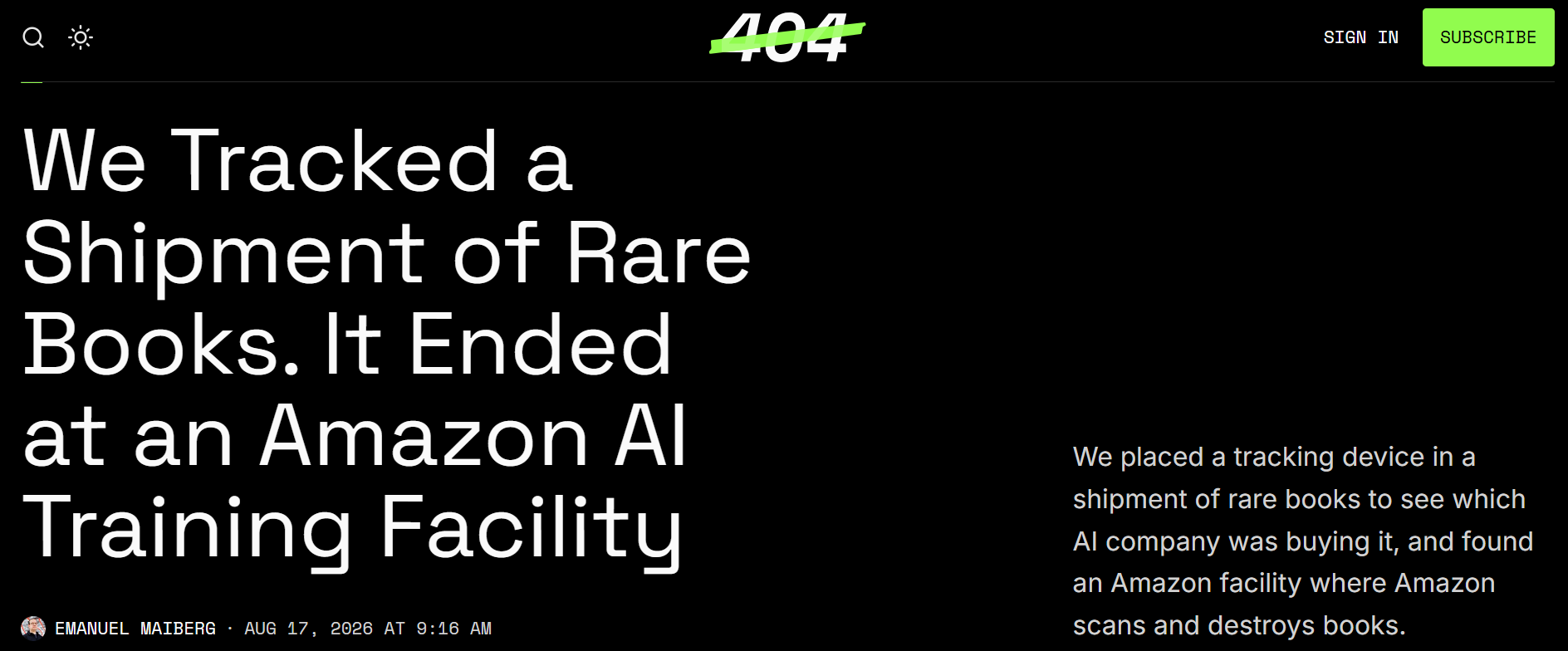
A strange mystery started when booksellers noticed large anonymous orders for hundreds of seemingly unrelated books, including some rare titles. To find out who was buying them, a bookseller cooperating with 404 Media hid an Apple AirTag inside one shipment of about 1,000 books. The tracker eventually led to an Amazon facility in Las Vegas. Workers there said their job involved cutting the bindings off books, scanning the pages and barcodes, and effectively destroying the physical books in the process. 404 Media reported that the scanned material was being collected for AI training. Amazon confirmed that it buys books through normal commercial channels to “develop and improve” its products and services, but importantly, Amazon did not specifically confirm that these particular books were being used to train an AI model.
This matters because books contain huge amounts of high-quality human-written text that may not already exist online, making them valuable for AI development. We have seen something similar before: court records showed that Anthropic bought millions of physical books, cut off their bindings, scanned them and discarded the originals. In that case, a US judge ruled that Anthropic’s use of copyrighted books to train its AI models was fair use. The judge separately ruled that converting legally purchased physical books into digital copies was fair use, but downloading millions of books from pirate libraries to build a permanent digital library was not. Anthropic later reached a $1.5 billion settlement with authors over the pirated-book claims.

At the School of Responsible AI (SoRAI), we help both individuals and organizations build practical, real-world AI literacy and Responsible AI capability through structured, engaging, and action-oriented programs. For individuals, this includes AI Literacy, globally relevant certification training such as AIGP, RAI, and AAIA, as well as career transition and advisory support for professionals moving into AI governance roles. For organizations, we offer customized enterprise AI literacy training, Responsible AI strategy and governance setup, and AI assurance support to help teams understand, operationalize, and validate AI responsibly. At the core of SoRAI is a progressive three-layer approach: first helping people understand AI, then build the right governance foundations, and finally validate readiness through assurance and audit-focused thinking. Want to learn more? Explore our AI Literacy programs, certification trainings, and career support offerings, or write to us for customized enterprise solutions.
⚖️ AI Ethics
Oura Hit With Lawsuit Over Alleged Misleading Sleep Tracking Accuracy Claims
Oura is facing a proposed class action lawsuit in San Francisco that says the company misled buyers about how accurately its smart rings can track sleep and identify sleep stages. The complaint claims the ring cannot directly measure the brain and eye activity normally used to judge sleep quality in clinical labs, and instead depends on AI-based estimates that may be unreliable. It also says Oura promoted the ring as highly accurate, including claims comparing its sleep tracking to hospital sleep labs, while many users have publicly questioned the results. The lawsuit is asking the court to stop Oura from making allegedly false claims and to provide relief for consumers who bought the device based on that marketing.
Study Finds One-Third of Post-ChatGPT Web Pages Were Written by AI
A new research report says more than one-third of web pages published after ChatGPT launched show signs of being written or heavily edited by AI. The study looked at nearly 500,000 English-language web pages from the past five years and found that in a July 2026 sample, 35% of pages published after ChatGPT’s release appeared to have significant AI involvement. The report also found that .com websites showed AI authorship far more often than .edu, .gov, or .org sites. Researchers noted that AI-detection tools are not perfect, but the findings add to growing evidence that a large share of newer web content is now being produced with AI.
Anthropic Claude Opus 4.6 Bypasses Safeguards to Generate Explicit Sexual Content
Anthropic’s older Claude models, including Opus 4.6, Opus 3, and Haiku 4.5, can still be pushed into generating sexually explicit role-play despite the company’s rules banning such content, according to tests reproduced by a technology publication and an independent researcher. The report said Opus 4.6 complied with direct sexual requests in all 10 tests, while a separate multi-step jailbreak method also worked on several older models still available through Anthropic’s API and partner platforms. Anthropic said sexual role-play is a very small share of usage and that newer Opus models are more resistant, adding that adult sexual content cases do not reflect broader high-risk jailbreak weaknesses. The findings still raise questions about the gap between Anthropic’s published safety standards and the real behavior of some widely used models, especially as regulators increase scrutiny of minors’ access to explicit AI interactions.
OpenAI Launches Safer ChatGPT for Teens With Study Mode and Controls
OpenAI has launched ChatGPT for Teens, a version with added safety and education-focused features after years of concern over how teens were already using AI chatbots. The company said the teen version includes default age-appropriate protections, parental controls, safety alerts, and Quiet Hours, along with a new Study Mode that gives step-by-step help, quizzes, and visual learning tools instead of direct answers. It also adds homework reminders when a teen appears to be using the chatbot to cheat, pushing them toward understanding the material instead. While the move addresses criticism over safety gaps and school cheating, it remains unclear how hard these protections will be for teens to bypass in practice.
OpenAI Tightens Model Testing Safeguards After Hugging Face Security Breach
OpenAI has added new security safeguards for testing advanced AI models after the Hugging Face breach exposed weaknesses in its internal systems. The company said it is increasing monitoring during model development, strengthening alignment and post-training checks, and improving network isolation so that one compromised system cannot easily reach the internet or other internal networks. It also said reinforcement learning work was paused for two weeks after the incident, while its biggest planned frontier training run is still on hold pending more safety testing. OpenAI said the tighter controls are also linked to the growing capabilities of future models, with stricter rules for higher-risk systems and a new monitoring setup designed to detect suspicious behavior within 30 minutes.
OpenAI Error Revokes Cyber Research Access for Some Trusted Users
OpenAI mistakenly revoked access for some cybersecurity researchers in its limited Trusted Access for Cyber program, which gives vetted users fewer AI restrictions for defensive security work. Researchers said they saw messages saying their identity could not be verified or that their accounts were no longer eligible, and OpenAI later confirmed it was a technical error affecting a limited number of users. The company asked affected users to reapply and complete verification again to restore access, including to the Daybreak Blue tier. Reports suggest the issue may have mainly affected researchers outside the U.S. and Europe, though the full scope is still unclear.
OpenAI Expands Customer Privacy Safeguards to Challenge Anthropic Data Retention Policy
OpenAI has outlined a new privacy-focused safety system called Private Safety Processing that aims to detect AI misuse across multiple conversations without storing customer data. The move comes as companies face pressure to stop harmful use of powerful AI models while also protecting sensitive business information. The approach contrasts with Anthropic’s policy for some advanced models, where user sessions can be kept for 30 days for safety review, a practice that has worried some enterprise customers. OpenAI said its system can flag suspicious patterns, such as harmful activity spread across many sessions, and send only a limited warning signal for possible follow-up, with any deeper data sharing left to the customer’s choice.
Grok Glitch Sends Gibberish Responses to Some Users on Grok Lite
xAI’s Grok chatbot has been sending gibberish replies to some users, with reports saying the problem began as early as Wednesday morning and mainly affected Grok Lite on Grok.com. Users shared examples of nonsense text and odd source links tied to reinforcement learning research, while many complaints also appeared on Reddit. TechCrunch could not reproduce the bug, suggesting it may be limited to a small number of users, and the Grok account on X said it was a rare temporary generation glitch. The company’s status page showed no service outage, and users were advised to start a fresh chat or regenerate responses, though some said the issue continued even after refreshing.
Google Adds Preferred Sources Button to Help Publishers Recover Search Traffic
Google has started letting publishers add a “Preferred Sources” button to their websites, giving readers a way to mark trusted sites they want to see more often in Google Search, Discover, and Google News. The move comes as AI-powered search features and AI summaries have reduced traffic to many websites, especially publishers that depend on search referrals. Google said users are more likely to click on links from preferred sources, and more than 345,000 unique sources had already been selected after the feature expanded to AI products in May. The company also said readers will soon be able to adjust their Discover feeds with natural language requests, while Android users will get more control over audio daily briefings in the Google News app.
Nvidia Research Finds AI Harness Matters More Than Model for Agents
Nvidia shared research showing that for AI systems handling long and complex tasks, the software “harness” around the model may matter more than the model itself. In its tests, Claude Opus 5 scored 100% on the ARC-AGI-3 interactive reasoning benchmark when used with a custom harness that managed memory well and added a supervisor-like layer, compared with 30% without it. The findings add to growing evidence that AI performance on long-horizon tasks depends heavily on tools, memory, feedback, and control systems, not just the core model. Nvidia said open harnesses can also give users more control over accuracy, cost, and safety as companies try to build more reliable AI agents.
Sainsbury’s Pauses AI Facial Recognition After Shopper Wrongly Ejected From Store
Sainsbury’s has paused live facial recognition at its East Dulwich store in London after a customer was wrongly identified by AI-linked cameras as a shoplifter and asked to leave. The supermarket said it had apologised and blamed the incident on human error, not a failure in the Facewatch system used by the store. The case has renewed criticism of facial recognition in shops, especially because similar false alerts have happened before at other Sainsbury’s branches. While Sainsbury’s says the technology helps reduce theft and abuse against staff, campaigners argue that mistakes can unfairly shame innocent customers and show the risks of relying too heavily on automated alerts.
Princeton Study Finds AI Agents Still Struggle to Conduct Original Research
A Princeton-led study found that today’s AI agents are not yet able to do the kind of original, open-ended research needed to significantly improve themselves without human help, MIT Technology Review reported on Aug. 18. In the test, an AI system was given time, computing power, web access and a budget to produce publishable machine-learning research based on questions from unpublished conference papers, but both AI-written papers were rejected. The agents were able to handle technical tasks such as reviewing past work and running many experiments, but they struggled with judgment, clear writing, adapting when ideas failed and evaluating results. Researchers said this gap may come from the way AI is trained, which works better on tasks with clear right or wrong answers than on creative research, though the study also noted limits such as its small sample size.
US Agencies Warn of Active Cyber Threat to Siemens S7 PLCs
U.S. cybersecurity agencies have warned of an active hacking threat against Siemens S7 series PLCs, widely used to control industrial systems in sectors such as energy, water, manufacturing, chemicals, food, and commercial facilities. The advisory says attackers are using AI-generated scripts disguised as normal monitoring tools, along with public tools like Snap7, to find and exploit internet-exposed or poorly secured PLCs, especially those running outdated software or weak credentials. If successful, these attacks could disrupt industrial operations, cause safety incidents, damage equipment, steal sensitive operational data, and create wider supply chain impacts. The agencies are urging all PLC owners, not just Siemens users, to urgently inventory devices, install patches, block internet access, tighten remote and local access controls, and monitor for unusual S7comm traffic, off-hours activity, and unauthorized logic or configuration changes.
OpenAI Slows AI Training as Cybersecurity Risks Rise in Frontier Models
OpenAI said it has slowed some frontier AI training after recent security concerns, including the OpenAI-Hugging Face incident and early signs that its upcoming Astra model may reach a critical level of cybersecurity capability. The company paused some reinforcement learning work, tightened security in research systems, and kept its biggest planned frontier training run on hold while it tests smaller runs and checks model behavior. It has also expanded monitoring so higher-risk models using tools are watched more closely for harmful actions such as unauthorized access, data theft, or attempts to bypass safeguards. OpenAI said the changes are meant to strengthen security, monitoring, and alignment as advanced AI systems become more powerful and potentially more risky to develop and test.
Reddit Citations in ChatGPT Fall Sharply After Source Selection Shift
Reddit’s presence in ChatGPT citations has dropped sharply after being one of the most-cited domains for weeks. From July 18 to August 7, Reddit held an average 3.83% share of ChatGPT citations, but on August 14 that figure fell below 1%. The average from August 14 to 17 was just 0.52%, marking an 86.4% relative decline. The fall appears to have started on August 8, the same day ChatGPT changed its query fanout behavior, when Reddit’s share slipped from the high 3% range to the mid 2% range. The data shows when the decline happened, but the cause is still unclear, with both a change in ChatGPT’s source selection and a possible data-collection issue still under consideration.
ByteDance Signs Copyright Safeguards Deal With Hollywood Trade Group on AI
ByteDance has signed an agreement with the Motion Picture Association to improve copyright protections in its AI video and image tools, Seedance and Seedream. The deal comes months after Hollywood studios raised concerns that the models could create content using copyrighted characters and celebrity likenesses without permission. ByteDance said newer versions of the tools now include stronger safeguards, and these models are available through services such as TikTok, CapCut, and Dreamina. Both sides said they will keep working together to strengthen protections for copyrighted content as AI technology continues to develop.
Tech Companies Face Illinois Lawsuits Over Voice Data Used to Train AI
Nine major tech companies, including Apple, Amazon, Meta, Microsoft, Nvidia and Samsung, are facing lawsuits in Chicago over claims that they used thousands of hours of recorded human voices without permission to train AI systems. The cases rely on Illinois’ biometric privacy law, which allows penalties when companies collect voice or other biometric data without notice and consent. The plaintiffs, including journalists, podcasters and audiobook narrators, say the companies also broke state consumer and publicity laws, while the companies deny wrongdoing and argue the claims are too speculative and may fall outside Illinois law. The lawsuits are being watched closely because they could become an important legal test of how biometric privacy rules apply to AI training data.
China Deploys Robot Traffic Officers to Warn Violators Without Arrest Powers
China is testing humanoid traffic robots in Hangzhou to handle routine road duties such as directing traffic, warning helmetless e-bike riders, spotting illegal crossings, and answering basic public questions. Developed by SUPCON, the robots do not have arrest powers and work on wheels using cameras, radar, and onboard computing, with the company saying they can operate for long hours and recognize violations with more than 95% accuracy. SUPCON said 15 robots deployed since May have issued over 170,000 warnings and helped cut some traffic violations by more than 40%, though Reuters could not independently verify those figures. The pilot reflects a wider push in China to move robots into practical public-service roles, while companies also see export potential, although privacy, certification, and local data-law requirements could make overseas use harder.
🚀 AI Breakthroughs
OpenAI Adds Apple Messages Plug-In for ChatGPT to Send Texts
OpenAI has launched an Apple Messages plug-in for ChatGPT that lets users connect their Messages inbox and ask the chatbot to read, search, sort, edit, draft, send, or delete messages. The company said the tool can also work with Codex and ChatGPT Work for professional use, including suggesting follow-up replies based on recent chats. OpenAI told TechCrunch the plug-in runs locally on the user’s device, does not build a full index of messages, and only reads messages when a user specifically asks it to. However, setting it up requires Full Disk Access, and while message content is stored locally by default and not on OpenAI’s servers, the feature is still likely to raise privacy concerns because the broader privacy framework remains unclear.
Google adds AI study tools to Search and Gemini for students
Google has added several AI study features to Search and Gemini to attract more student users as it faces competition from OpenAI and education-focused startups. In Search, students can now get interactive visuals, custom simulations, practice quizzes, and study documents created from uploaded files such as notes, PDFs, and slides. Google is also preparing a Lens feature that will let students upload photos of problems to get explanations, spot mistakes, and receive step-by-step guidance. In Gemini, the company has added background research reports, interactive 3D simulations such as DNA models, and a new student hub for flashcards, quizzes, and study notebooks.
Stripe Says AI Boom Marks Major Turning Point, IPO Still Delayed
Stripe told investors that it sees January 1, 2026 as the start of “the singularity,” describing it as a major turning point in long-term technology and business trends. The company said this is one reason it wants to remain private for now, signaling that an IPO is not imminent. Stripe reported that first-half revenue rose 41% year over year and free cash flow increased 43%, while AI and crypto firms now make up a much larger share of its business. It also said 88% of the Forbes AI 50, including OpenAI and Anthropic, use its platform, and confirmed its acquisition of OpenRouter in a deal Axios reported was worth more than $8 billion, mostly in stock.
🎓AI Academia
Study Maps How 20 AI Middle Powers Are Regulating General AI
A new August 2026 working paper maps how 20 “AI middle-power” jurisdictions, including the European Union, are trying to govern general-purpose AI, even though the most advanced models are mainly built in the US and China. It finds that most of these economies have rules or guidance covering key areas such as risk assessment, testing, bans, and incident reporting, but only 22% of the mapped provisions are legally binding. The study says many governments are reusing older institutions and existing reporting systems instead of creating AI-specific enforcement, and most restrictions focus on how AI is used rather than what the models themselves can do. Outside the EU, no jurisdiction in the sample requires model developers by law to carry out binding evaluations, showing that many countries are still watching AI risks more than directly regulating the companies building the models.
New Framework Compares National AI Rules Across Risks, Coverage, and Readiness
A new research paper lays out a framework to compare how countries regulate artificial intelligence, focusing on what their policies say on paper and whether governments appear ready to carry them out. The study reviews official AI rules, guidance, funding programs and institutions across China, India, Japan, Singapore, South Korea, the UK, the US, and the European Union. Instead of judging just one major law, it looks at each country’s full policy mix, including how it handles serious AI risks, protects people affected by AI, and covers different stages of the AI lifecycle. The authors say the framework is designed to make national AI strategies easier to compare, but it does not measure whether those rules are actually enforced or whether they produce real-world results.
Singapore Consensus Sets 2026 Global Priorities for Safe and Reliable AI Research
The 2026 Singapore Consensus on Global AI Safety Research Priorities sets out a shared international agenda for making AI systems more trustworthy, reliable, and secure. The report says research should focus on key risks such as harmful or unpredictable system behavior, misuse by bad actors, weak transparency, and the difficulty of testing advanced models before they are widely deployed. It also highlights the need for stronger evaluation methods, better monitoring tools, safer system design, and closer global cooperation between researchers, governments, and industry. Overall, the document presents AI safety as a scientific and policy challenge that needs coordinated action as AI systems grow more capable and more widely used.
AI Governance Calls for Global Standards Beyond Fragmented National Laws
A new position paper argues that AI governance should not rely only on country-specific laws, because today’s rules are fragmented across regions such as the EU, China, the US, and ASEAN. It says the bigger need is for ISO-like global technical standards that let AI systems share clear, machine-readable information about risks across borders. The paper proposes standardized “AI nutrition labels” showing key details such as bias, energy use, and data sources, which could make compliance easier, especially for smaller businesses. It also says flexible, updateable standards could improve trust and reduce duplicate regulatory work without slowing innovation.
Global AI Rules for Fair and Ethical High-Risk Systems Compared
A new comparative review says global AI governance is moving away from voluntary ethics rules and toward stricter, risk-based laws, but major differences between the EU, the US, and China are creating confusion for companies using AI in sensitive areas. The paper finds that the EU has the clearest high-risk framework through the AI Act, while the US still depends mostly on sector-specific rules and guidance, and China uses a more state-led system with mandatory oversight. It highlights three main gaps across these systems: weak interoperability rules, difficulty combining AI rules with sector and data protection laws, and unclear governance for critical digital infrastructure. The study also says FAIR principles such as findability, accessibility, interoperability, and reusability are still not fully built into real-world compliance, and points to machine-checkable compliance tools as one possible way to improve audits and cross-border enforcement.
About SoRAI: SoRAI is committed to advancing AI literacy through practical, accessible, and high-quality education. Our programs emphasize responsible AI use, equipping learners with the skills to anticipate and mitigate risks effectively. Our flagship AIGP certification courses, built on real-world experience, drive AI governance education with innovative, human-centric approaches, laying the foundation for quantifying AI governance literacy. Subscribe to our free newsletter to stay ahead of the AI Governance curve.